
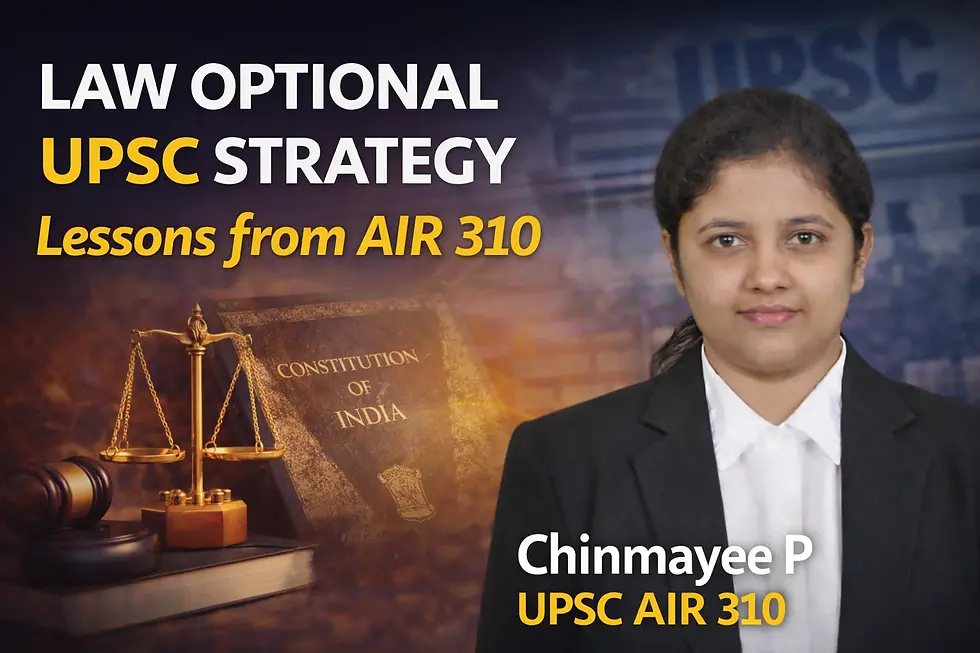
Chinmayee P: AIR 310 Journey with law optional UPSC

Preparing for the Civil Services Examination (CSE) conducted by the Union Public Service Commission is one of the most demanding academic journeys in India. Among the many optional subjects available, Law Optional UPSC stands out as both intellectually stimulating and strategically rewarding—especially for candidates with a legal background.
However, it is also widely regarded as one of the more challenging optionals due to its vast syllabus, heavy reliance on case laws, and the analytical depth required in answer writing.
In this article, we explore the preparation strategy for Law Optional UPSC through the inspiring journey of Chinmayee P, who secured All India Rank 310 with law as her optional subject.
Her insights offer a valuable roadmap for aspirants considering law optional for UPSC preparation. From managing multiple attempts to mastering case laws, optimizing answer writing, and handling setbacks, her story provides practical lessons for aspirants aiming to succeed with law optional in UPSC.
The Journey : Persistence Through Six Attempts
Chinmayee P’s UPSC journey began in 2020, while she was simultaneously practicing as an advocate. Like many civil services aspirants, her preparation journey was filled with ups and downs.
She faced setbacks—including failing to clear prelims after writing mains in one of the attempts. Yet, through persistence, mentorship, and strategic self-analysis, she finally secured AIR 310 in her sixth attempt.
Her story highlights a critical reality of the UPSC preparation journey—success often requires perseverance, continuous improvement, and the ability to learn from failures.
She credits her success to three key factors:
Support system – parents, mentors, and teachers.
Self-assessment – conducting a SWOT analysis of strengths and weaknesses.
Focused improvement – working on weak areas with external help.
For aspirants preparing Law Optional UPSC, this mindset is essential because the subject requires consistency and sustained engagement over time.
Why Choose Law Optional in UPSC?
One of the most frequently asked questions among aspirants is whether law optional is a good choice for UPSC.
There is a widespread perception that law optional is difficult and risky compared to other subjects. Chinmayee acknowledges that the subject is demanding but emphasizes that success depends primarily on interest and curiosity in the subject.
She advises aspirants to choose an optional based on:
Genuine interest
Intellectual curiosity
Long-term engagement potential
For law graduates, choosing law optional for UPSC offers several advantages:
1. Academic Background Advantage
Candidates who studied law during graduation already possess conceptual familiarity with many subjects in the syllabus.
2. Overlap with General Studies
Topics such as constitutional law, governance, rights, and legal principles often intersect with GS Paper II and ethics discussions.
3. Analytical Edge
Legal training develops structured thinking and argumentation skills, which help in writing better answers in UPSC mains.
4. Interview Advantage
As Chinmayee noted, 80% of her interview questions were related to law because of her educational background and optional subject.
Understanding the Law Optional UPSC Syllabus
The UPSC Law Optional syllabus consists of two papers:
Paper I
Constitutional Law
Administrative Law
International Law
Paper II
Law of Crimes
Law of Torts
Law of Contracts and Mercantile Law
Contemporary Legal Developments (CLD)
Each paper carries 250 marks, making the optional worth 500 marks in total—significantly influencing final rank.
How Chinmayee Prepared Constitutional Law
According to Chinmayee, constitutional law is the backbone of law optional UPSC preparation.
Her preparation strategy included:
1. Following the Syllabus Closely
She first broke down the syllabus into individual topics and prepared them systematically.
2. Limited Sources
She relied primarily on:
MP Jain (constitutional law reference)
Classroom notes
Personal college notes
Keeping sources limited prevented information overload.
3. Article-Case Law Mapping
For each constitutional article, she prepared:
Key provisions
Landmark case laws
Evolution of judicial interpretation
4. Historical Evolution of Judgments
Tracing the development of constitutional doctrines through case laws helped her understand the reasoning behind legal interpretations.
5. Concise Notes
Initially, her notes were elaborate. But with repeated revisions, she reduced them to concise and exam-oriented summaries.
Her key advice:
Your entire constitutional law revision notes should not exceed about 10–12 pages before the mains exam.
This ensures quick revision and better recall during the exam.
Preparing International Law for UPSC Law Optional
International law often appears intimidating to aspirants. Chinmayee simplified her preparation by focusing on:
College notes
Class material
Notes from previous toppers
The goal was to keep notes short, structured, and revision-friendly.
She also emphasized incorporating:
Recent developments in international law
Current global legal issues
Relevant treaties and conventions
Tackling Contemporary Legal Developments (CLD)
CLD is one of the most dynamic sections in law optional UPSC.
Chinmayee’s strategy for CLD revolved around Previous Year Questions (PYQs).
She adopted a technique called reverse engineering preparation:
Analyze previous years’ questions.
Identify recurring themes.
Build notes around those themes.
This ensured that her preparation aligned directly with UPSC expectations.
Preparing Paper II: A Strategic Approach
Law Paper II covers multiple subjects, making it comparatively broader than Paper I.
Chinmayee emphasized repeated revision and concise note-making.
Below is her approximate preparation timeline:
Subject | Time Required |
Constitutional Law | 15–20 days |
International Law | 20 days |
Law of Crimes | 30 days |
Torts | 10–15 days |
Contracts | 20–25 days |
Mercantile Law | 15–20 days |
For non-law graduates, these timelines may extend slightly.
Preparing Law of Crimes: Understanding IPC and BNS
One of the unique challenges in recent UPSC exams is the transition from Indian Penal Code (IPC) to the Bharatiya Nyaya Sanhita (BNS).
Chinmayee stressed the importance of:
Understanding both IPC and BNS
Comparing changes between them
Learning relevant sections thoroughly
Since UPSC increasingly asks analytical and problem-based questions, aspirants must develop a comprehensive understanding of criminal law principles.
Strategy for Torts and Contract Law
Subjects like Torts and Contracts are relatively logical and principle-based.
Chinmayee recommends focusing on:
Fundamental principles
Landmark case laws
Practical application of doctrines
For Sale of Goods Act and Partnership Act, she advises aspirants to rely heavily on the Bare Act.
Key preparation steps:
Read the Bare Act carefully.
Identify key provisions.
Understand the underlying legal principles.
Supplement with relevant case laws.
Answer Writing Strategy for Law Optional UPSC
One of the biggest challenges aspirants face is writing structured legal answers within the three-hour exam timeframe.
Chinmayee admitted that in her early preparation phase, she took six hours to complete a three-hour paper.
Her improvement came from:
Continuous feedback from mentors
Practicing concise writing
Avoiding unnecessary paragraphs
Her recommended answer structure includes:
Introduction with relevant legal principle
Relevant statutory provisions
Landmark case laws
Analytical discussion
Short conclusion
The key is precision, clarity, and structured arguments.
Importance of Case Laws in Law Optional
Case laws are the backbone of legal answers. Chinmayee emphasizes that certain case laws are non-negotiable.
Examples include:
Kesavananda Bharati case – Basic structure doctrine
Minerva Mills case – Judicial review
Ajay Hasia case – Interpretation of Article 12
Without mentioning landmark cases, answers remain incomplete.
Time Management During the Exam
To finish the paper within three hours, aspirants must:
Practice timed answer writing
Avoid lengthy introductions
Write in bullet points where appropriate
Memorize key provisions beforehand
Efficiency comes only through consistent answer writing practice.
The Role of Interest in Choosing Law Optional
A significant takeaway from Chinmayee’s experience is the importance of genuine interest in the subject.
She believes that choosing an optional solely based on scoring trends can lead to burnout.
Law optional works best for candidates who:
Enjoy legal reasoning
Like reading judgments
Are curious about constitutional and legal developments
How Law Optional Helps in UPSC Interview
Because Chinmayee’s optional and professional background were in law, most of her interview questions revolved around legal concepts.
Examples of questions she faced include:
What is constitutional morality?
Explain the doctrine of legitimate expectation.
Legal perspectives on contemporary issues.
Since legal issues frequently appear in current affairs and editorials, law optional also strengthens interview preparation.
Recommended Study Plan for Law Optional UPSC
Chinmayee suggests the following preparation roadmap:
Step 1: Study the Syllabus Thoroughly
Understand every topic in both papers.
Step 2: Analyze Previous Year Questions
Review at least five years of PYQs.
Step 3: Choose Limited Sources
Too many sources slow down preparation.
Step 4: Make Concise Notes
Prepare revision-friendly notes.
Step 5: Revise Multiple Times
Repeated revision is essential for retention.
Should Aspirants Use AI for Law Optional Preparation?
Chinmayee did experiment with AI tools but offers a word of caution.
She observed that AI sometimes provides incorrect legal interpretations or incomplete case law references.
Her advice:
Use AI only for clarification and research
Do not rely on it as the primary study source
Always verify information with authentic materials
This is especially important in law, where accuracy of case laws and legal principles is crucial.
Key Takeaways for Law Optional UPSC Aspirants
Chinmayee’s journey highlights several lessons:
1. Persistence is essential
Success may take multiple attempts.
2. Keep sources limited
Quality matters more than quantity.
3. Focus on case laws
They are indispensable in legal answers.
4. Practice answer writing
Concise and structured answers score higher.
5. Revise repeatedly
Revision transforms elaborate notes into crisp exam-ready material.
The journey of Chinmayee P, AIR 310, proves that law optional UPSC is a viable and rewarding choice for aspirants who are passionate about the subject and willing to invest sustained effort.
While the subject is demanding, it offers significant intellectual depth and analytical advantage.
With the right strategy—limited sources, strong case law knowledge, concise notes, and continuous answer writing practice—aspirants can perform exceptionally well in the UPSC examination.
Ultimately, choosing law optional for UPSC should be guided by curiosity, commitment, and long-term interest in the discipline.
As Chinmayee’s journey demonstrates, perseverance combined with a well-structured strategy can transform even a challenging optional into a powerful tool for success in the civil services examination.

