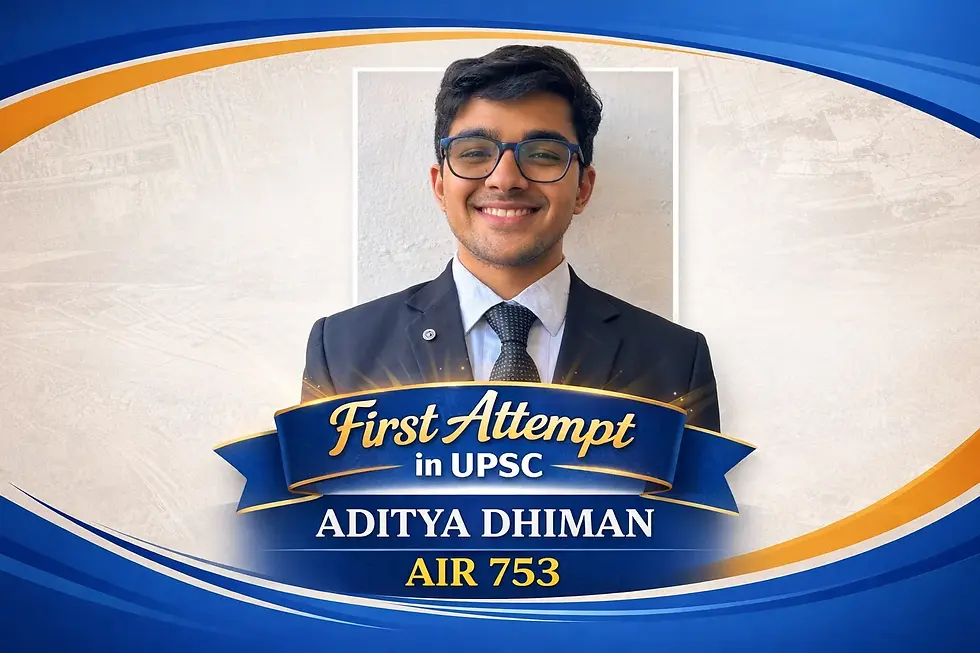
Law Optional UPSC Strategy: What AIR 347 Adarsh Pandey Did Differently


Choosing Law Optional for UPSC is often a difficult decision for many aspirants. Some believe it is not highly scoring, while others assume it requires a law background from elite universities.
However, the journey of Adarsh Pandey (AIR 347, UPSC CSE) proves that with the right strategy, Law Optional UPSC can consistently fetch strong marks around 260–280.
In this blog, we break down the Law Optional UPSC preparation strategy, booklist, answer-writing approach, and key lessons from his interview conversation. If you are preparing for UPSC Law Optional, this guide will help you understand how to study the subject efficiently.
Who is Adarsh Pandey (AIR 347)?
Adarsh Pandey comes from Amethi district in Uttar Pradesh and completed his 5-year integrated LL.B from City Academy Law College affiliated with Lucknow University.
He cleared the Civil Services Examination with Law as his optional subject and wrote his Mains and interview in English medium.
His academic profile also reflects consistent performance, With Consistent good score throughout 10th 12th and Graduation.
All these qualifications were obtained from institutions in Lucknow, including schooling under CBSE and graduation under Lucknow University.
What makes his story inspiring is that he did not come from a National Law University (NLU). His success clearly shows that UPSC Law Optional is not restricted to NLU graduates.
Your college background does not determine success in UPSC.
Is Law Optional a Good Choice for UPSC?
Many aspirants ask whether Law Optional is scoring in UPSC. According to Adarsh Pandey, the subject may not produce extremely high scores like some humanities optionals, but it reliably delivers marks above 250 for well-prepared candidates.
The biggest advantage of Law Optional UPSC is that it is a conceptual subject. Once the concepts are clear, repeated revision becomes easier and answer writing improves naturally.
Another advantage is the overlap with General Studies, particularly GS Paper II. Topics such as constitutional law, governance, and international law directly help in GS answers.
Important advice:➡️ If you genuinely like the subject, Law Optional can be a very stable and predictable optional.
Best Books for Law Optional UPSC
One of the strongest elements of Adarsh Pandey’s preparation was limited but reliable sources. Instead of reading multiple books, he focused on a few core materials and repeatedly revised them.
Constitutional Law Books for UPSC
For constitutional law, he initially studied M.P. Jain’s Indian Constitutional Law during college. Later, he shifted to Dukki notes because they present the syllabus in a concise and exam-oriented manner.
He also referred to J.N. Pandey occasionally when concepts required deeper clarity.Always update constitutional law notes with recent case laws and Law Current Affair
International Law Book for UPSC
For international law, he relied almost entirely on S.K. Kapoor’s International Law.
For topics like WTO, UN bodies, and nuclear treaties, he supplemented the book with online sources and current affairs updates.
International law answers become stronger when combined with recent global developments.
Criminal Law Preparation (IPC and BNS)
In criminal law, his preparation was based primarily on the Indian Penal Code (IPC).
However, because of recent legal reforms, he also incorporated references to Bharatiya Nyaya Sanhita (BNS) in answers.
His approach was simple:
Write the IPC section first
Mention the equivalent BNS section
This method ensured answers were both traditional and updated. Do not completely abandon IPC yet; examiners are more familiar with it.
Contract Law Preparation
For contract law and related subjects like Sale of Goods, he mainly used:
Dukki notes
College notes
Reference from Avtar Singh
Instead of memorizing lengthy explanations, he focused on conceptual clarity and structured notes.
Law optional rewards conceptual understanding more than rote learning.
Commercial Law (CLD) Preparation
Commercial law is one of the most challenging areas in UPSC Law Optional Paper II.
Adarsh prepared this section mainly from online legal resources and law firm publications because the subject constantly evolves.
He created personal notes based on current developments in competition law, corporate law, and other regulatory topics. CLD requires continuous updating — static books alone are not enough.
Why Previous Year Questions Are Crucial in Law Optional
One of the biggest mistakes Adarsh admitted was ignoring Previous Year Questions (PYQs) in his early attempts.
He realised later that UPSC repeats themes regularly in law optional. For example:
Recognition in international law
Separation of powers in constitutional law
Essentials of valid contract
These topics appear repeatedly with slight variations. Analyse at least 25–30 years of PYQs before starting preparation.
He believes that 40–60% of the syllabus can be predicted through PYQ analysis.
How to Make Notes for Law Optional UPSC
A common question among aspirants is whether they should rely on coaching notes or make their own notes.
Adarsh strongly recommends making personal notes.During his preparation, he primarily relied on notes created during law school, which he gradually refined and updated.
He believes each aspirant develops a unique writing structure, and copying someone else’s notes may not suit that structure. Refer to others’ notes only for structure — never copy them entirely.
How Long Does It Take to Finish Law Optional?
Many aspirants worry about the length of the law optional syllabus.
According to Adarsh Pandey, a beginner can complete the entire optional in around four to four and a half months if they study consistently for 3–4 hours daily.
The first reading should focus on:
Understanding concepts
Creating notes
Structuring answers
Once this foundation is built, revision becomes much faster.
In later stages, he could revise the entire optional in two months or even less.The first reading is the hardest — subsequent revisions become much easier.
Answer Writing Strategy for Law Optional
One important improvement he introduced in his later attempts was adding jurist opinions and case references in answers.
For example, instead of writing plain explanations, he started including:
Quotes from famous jurists
Landmark judgments
Analytical commentary
This made answers appear more academic and law-oriented, which likely improved his marks. Even adding two jurist references in an answer can make it stand out.
Mistakes He Made in Early Attempts
One of the most valuable insights from Adarsh Pandey’s journey comes from the mistakes he made during his early UPSC attempts.
Unlike many success stories that only highlight strategies that worked, he openly discussed the errors that delayed his progress in the exam.
The most significant mistake, according to him, was not analysing Previous Year Questions (PYQs) seriously during his early preparation phase.
Like many aspirants, he initially believed that having strong conceptual knowledge and performing well in mock tests would be enough to clear the prelims examination.
In fact, he shared that during his first two attempts, he was consistently scoring around 110–125 marks in mock tests, which gave him confidence that he was well prepared.
However, despite these scores, he was unable to clear the prelims stage. The reason, he realised later, was that he had not understood the actual nature and pattern of the UPSC prelims paper.
During the conversation, he explained this realization very candidly:
“My first two attempts were the most serious attempts, but I was not able to clear prelims. I was continuously scoring 110–120 in mocks, but still I couldn’t clear the exam. The problem was that I was not able to judge the nature of the prelims paper.”
This experience taught him an important lesson. UPSC prelims is not just about knowledge; it is also about understanding how UPSC frames questions and how the exam pattern evolves over time.
He later realised that the best way to understand this pattern is through deep analysis of previous year questions. Once he shifted his focus to PYQs, his preparation became far more exam-oriented. Instead of studying randomly, he began identifying recurring themes, frequently asked concepts, and the type of traps UPSC sets in questions.
He further emphasised this point during the discussion:
“For any beginner, the most important thing is analysing PYQs. If you have limited time, first go for previous year questions. That is the most important thing to start with.”
After incorporating PYQ analysis into his preparation, his performance improved significantly. In his later attempts, he was able to clear the prelims stage and move forward in the examination process.
Myth: Only NLU Graduates Succeed in Law Optional
A common misconception among UPSC aspirants is that only graduates from National Law Universities (NLUs) perform well in the Law Optional UPSC subject. This belief often creates unnecessary self-doubt among students from other colleges, making them feel that their chances of success are limited because of their educational background.
However, the journey of Adarsh Pandey strongly challenges this notion. According to him, success in the UPSC examination has very little to do with the brand name of the institution from which one graduates.
What truly matters is the quality of preparation and the ability to present ideas clearly in the examination.
Adarsh himself studied in a college affiliated with Lucknow University, not a National Law University. Despite this, he was able to perform strongly in Law Optional and secure a good rank in the Civil Services Examination.
His success demonstrates that UPSC does not favour candidates based on the prestige of their university; rather, it rewards those who have developed a deep understanding of their subject and the ability to express it effectively in answers.
According to him, the UPSC examiner is primarily interested in how a candidate analyzes legal concepts, connects them with relevant case laws, and structures arguments in a logical manner.
The evaluation is based on the clarity of explanation, the strength of reasoning, and the relevance of examples used in the answer. The name of the college mentioned on the degree certificate plays no role in the answer sheet.
This insight is particularly important for aspirants who often feel discouraged because they did not study in a well-known institution. The UPSC examination is designed in such a way that every candidate competes on equal footing once they enter the examination hall. What distinguishes successful candidates is their preparation, consistency, and ability to apply legal principles to questions asked in the paper.
For aspirants preparing with Law Optional UPSC, the real focus should therefore be on mastering the syllabus, understanding landmark judgments, practising answer writing, and regularly revising core concepts.
Developing analytical thinking and improving the clarity of expression in answers will contribute far more to success than the name of the law school.
In simple terms, your preparation matters far more than your university. Aspirants from any college or background can succeed in the UPSC examination if they approach their preparation with dedication, discipline, and confidence.
Final Advice for Law Optional UPSC Aspirants
Adarsh Pandey’s journey offers several practical lessons for aspirants preparing for Law Optional UPSC.
The most important principles from his preparation strategy include:
Stick to limited standard books
Analyse previous year questions deeply
Make your own notes
Add case laws and jurist quotes in answers
Continuously update current legal developments
Above all, he emphasises one simple idea.
If you genuinely enjoy studying law, you should confidently choose it as your UPSC optional.