
First Attempt AIR 753: Understand Aditya Dhiman’s UPSC Journey

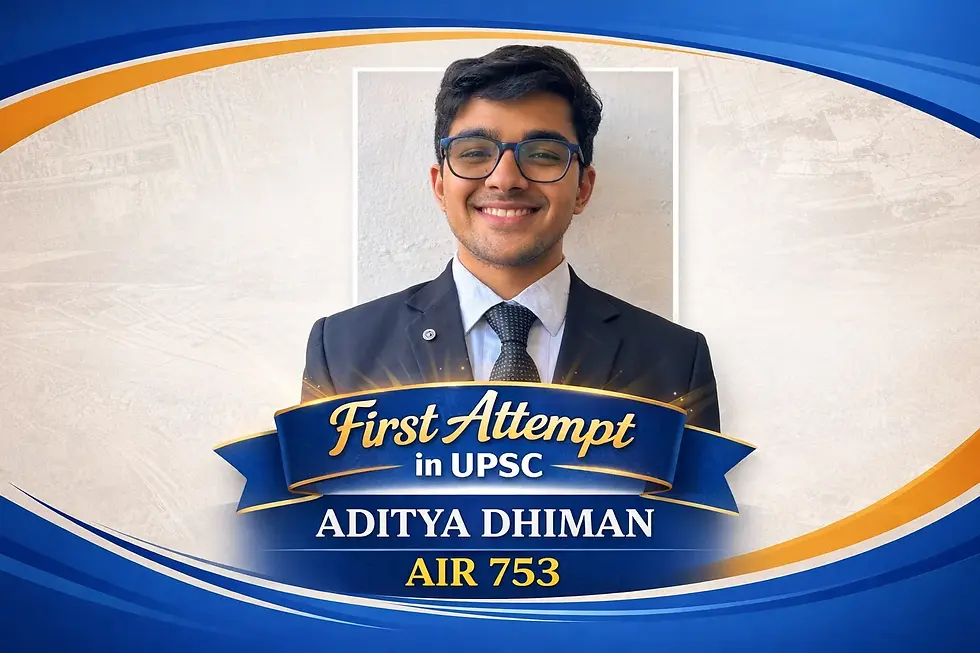
For many UPSC aspirants, success stories often feel distant. They sound inspiring, but not always practical. That is why Aditya Dhiman’s journey stands out.
Aditya Dhiman, a young law graduate from Dharamshala, Himachal Pradesh, completed his LL.B. from National Law Institute University, Bhopal in 2025 and chose Law as his optional subject in UPSC CSE.
In his very first attempt, he secured AIR 753. For students of law, especially those in the third, fourth, and fifth year, his journey offers something very valuable: a preparation model that is realistic, strategic, and deeply relevant.
This is not a story of someone who prepared in isolation for many years with perfect conditions. This is the story of someone who prepared while still in college, while handling a demanding law curriculum, while figuring out his career path, and while learning how to study smart rather than just study endlessly.
If you are a law student thinking about UPSC, this journey deserves your attention.
Why Aditya’s Story Important
What makes Aditya’s journey especially useful is not just the final rank. It is the timing and method of his preparation.
He did not wait until graduation to begin. He started thinking seriously about civil services by the end of his third year. At that point, he was clear about one thing: he did not want to pursue the corporate route.
The bigger confusion was between judiciary and civil services. That is a common dilemma for law students. Both seem natural options after law school, and both carry the promise of public service.
In Aditya’s case, the push towards civil services was also shaped by his family background. His father was in the state civil services and had always seen it as one of the best platforms to serve the country.
That influence stayed with him. But importantly, he did not jump into UPSC blindly. He began slowly, thought through the demands of the exam, and gradually built his preparation in a structured way.
That gradual clarity is one of the biggest lessons from his journey.
Starting in Law School: The Advantage Most Students Ignore
Many students in law school think serious UPSC preparation can only begin after graduation. Aditya’s journey challenges that assumption.
According to him, the ideal time to begin is around the third or fourth year. Not in a rushed, panicked way, but with a long-term mindset. He started around the end of third year and used the next phase of college life to build his fundamentals.
This matters because law school is not a waste for UPSC aspirants. In fact, if used well, it can become a major advantage.
Law students already engage with subjects like constitutional law, public international law, governance, legal reasoning, institutions, and rights-based thinking.
These are directly or indirectly useful for UPSC. Aditya repeatedly underlines that one should take college subjects seriously when they are actually taught in class, especially subjects like constitutional law and public international law.
His point is not that your class notes will become UPSC notes. They usually will not. The real benefit is deeper: your legal understanding matures. That conceptual strength later shows up in your optional answers, in analytical writing, and even in the personality test.
So for law students, the message is simple: do not treat college and UPSC as two separate worlds. Use college to build the intellectual base that UPSC can later reward.
The Big Decision: Why He Chose Law Optional
Choosing an optional subject is one of the most anxiety-filled decisions in UPSC preparation. Law students especially face a dilemma.
Should they choose Law because they already know it? Or should they avoid it because it is often seen as lengthy, technical, and not always the “safest” scoring optional?
Aditya was fully aware of this concern. He knew that in UPSC, even a difference of a few marks can change the final rank significantly. He also knew that Law optional is not considered by everyone to be the easiest path.
Yet he still chose it.
Why? Because his interest was genuine. He was especially drawn to constitutional law and international law. That made a big difference.
Optional preparation is too demanding to be sustained through calculation alone. When a subject genuinely interests you, revision becomes easier, answer-writing becomes richer, and your ability to stay with the subject improves.
His choice also shows something important: for students with a strong legal background, Law optional can become a strategic strength, provided it is prepared intelligently.
His Core Preparation Strategy: General Studies First, Optional Later
One of the smartest aspects of Aditya’s preparation was his sequencing.
Instead of jumping early into Law optional, he first invested heavily in General Studies.
From the end of third year till the beginning of fifth year, he focused mostly on GS. In his view, GS is so large and interconnected that it demands sustained time. You need to understand multiple subjects, connect them with one another, and build comfort with wide-ranging issues.
That is why he delayed optional preparation until later.
This is highly relevant for law students. Since they are already familiar with parts of law, polity, and legal reasoning, many assume optional can be managed naturally and that GS can be compressed later.
Aditya’s preparation suggests the opposite approach works better. Build the larger GS base first. Optional, especially for law graduates, can be sharpened in a more focused window if the strategy is right.
This sequence also reflects maturity. He understood that UPSC is not cleared by studying what you like first. It is cleared by studying what needs the most patient groundwork.
The Real Hero of His Preparation: PYQs
If there is one idea that runs through Aditya’s entire preparation strategy, it is this: Previous Year Questions Law Optional are everything.
He repeatedly emphasizes that PYQs are not just a reference point. They are the best way to understand what UPSC actually wants.
In General Studies, he did not use PYQs in a simplistic “same question will repeat” manner. Instead, he used them to understand themes.
UPSC may not repeat the exact wording, but it often returns to similar areas: centre-state relations, federalism, governance, constitutional principles, social justice, and policy design. Once you identify those patterns, preparation becomes sharper and more bounded.
This is crucial because one of the biggest problems in UPSC preparation is endlessness. There is always more to read. There is always another source, another report, another coaching note. PYQs help cut through that chaos.
They help you decide what matters and what can be left out. That same PYQ-based discipline shaped his Law optional even more strongly.
How He Prepared Law Optional Smartly, Not Endlessly
Law optional can easily become unmanageable if approached like a law school syllabus. There are too many judgments, too many sections, too many Acts, and too many possible themes.
Aditya avoided that trap by preparing around PYQs. His approach was simple but powerful. If there was a recurring topic like constitutional morality, he would not try to prepare everything loosely connected to it.
Instead, he would take the exact question trend, understand the expected angle, and convert it into a concise note—sometimes even just two pages.
That is a very important lesson.
UPSC does not reward unlimited information. It rewards selective mastery plus revision. Aditya makes it clear that in Law optional, especially, repetition of themes is very high.
So building notes from PYQs is not just useful; it is efficient. It creates focus. It prevents over-reading. And most importantly, it produces material that is actually revisable before the exam. This selective approach seems to have been central to his success.
Handling Law Optional Paper II: The Art of Compression
One of the most practical parts of his discussion is how he handled Paper II, especially the difficult and bulky portions.
He openly says that sections like CLD were intimidating. He knew they formed a significant part of the paper, so they could not be ignored. But he also knew it was impossible to study every topic in great detail.
So he chose a middle path: cover the area, but do it selectively and in a compressed format.
For example, on a topic like trial by media, he reduced the issue to the essentials: which constitutional rights are affected, which key cases matter, and what the broad legal logic is. He did not burden himself with pages of detail. He turned a large topic into a short, memorable framework.
This is exactly the kind of preparation style serious aspirants need.
Optional papers are won not just by knowledge, but by what can be recalled under pressure. Compression is not laziness. It is exam intelligence.
He followed the same logic in areas like the Negotiable Instruments Act, Sale of Goods Act, and Partnership Act. Instead of drowning in statutory detail, he kept his preparation PYQ-led and exam-focused.
Where Law Optional Helped the Most: The Interview
Aditya makes a particularly strong point about how Law optional helped him in the UPSC interview.
He realized that the board was not trying to test him like a law professor. In fact, no one on the board was necessarily a law specialist. The questions were often designed in a way that required him to explain legal concepts clearly to non-specialists.
That was an advantage.
He makes a sharp observation here: when the board feels it is learning something from you, that is often a positive sign. It means you are not merely reciting information. You are explaining, clarifying, and adding value to the interaction.
His interview reportedly revolved heavily around legal themes—judicial review, constitutional morality, judicial functioning, important recent cases, and legal reform. Even when he was asked a non-legal question, such as why India’s shoe industry is not as mature, he gave not just an economic answer but also a legal-regulatory perspective.
That is where optional truly helps. A good optional subject should not remain confined to Papers VI and VII. It should improve the way you think across issues. In Aditya’s case, Law did exactly that.
The CSAT Lesson Every NLU Student Needs
One of the most underrated parts of his advice is about CSAT.
He warns law students, especially NLU students, against a common mistake: assuming that because they cleared CLAT, CSAT comprehension will be easy.
According to him, UPSC comprehension is very different.
In CLAT, the answer often lies more directly in the passage. In UPSC, all options can appear plausible. What UPSC is testing is not just reading speed, but judgment, balance, and a certain administrative mindset.
How did he improve? Again, through PYQs.
He solved past papers, matched answer keys carefully, and tried to understand why UPSC preferred one option over another.
That process helped him decode the examiner’s mindset. For mathematics, he stayed practical. Since maths was not his strong area, he chose only the easier, safer questions instead of wasting time on difficult ones.
That is powerful advice: in CSAT, selection of questions is often more important than ego.
What Law Aspirants Should Learn From This Journey
Aditya Dhiman’s story is inspiring not because it sounds extraordinary, but because it sounds possible.
It tells law students that they do not need to wait passively for graduation to begin. They can start building GS in the third and fourth year. They can use law school to strengthen conceptual depth.
They can prepare Law optional in a smarter and more selective way. And they can rely on PYQs not just as a practice tool, but as the backbone of their strategy.
His journey also shows that first attempts can succeed when they are backed by planning rather than panic.
There is no mythology here. No magical study routine. No unrealistic claims. Just a clear method:build GS patiently, take college subjects seriously, keep optional focused, trust PYQs, compress your notes, practice selectively, and carry your domain knowledge confidently into the interview room.
That is what makes this story genuinely useful.
Final Thoughts
Aditya Dhiman’s AIR 753 in UPSC CSE 2025 is more than a result. It is a reminder that for law students, UPSC preparation can be deeply aligned with their academic journey instead of competing with it.
He came from Dharamshala, studied law at NLIU Bhopal, chose Law optional, and appeared in English medium. But the real story is not just those facts. It is the discipline behind them.
For every law student wondering whether UPSC is possible alongside college, his answer is clear: yes, it is possible — but only if you prepare with clarity, selectivity, and consistency.
And perhaps that is the biggest lesson of all: success in UPSC does not always come from studying more than everyone else. Sometimes, it comes from understanding the exam better than everyone else.

