
Cases at a glance
Scope of Protection
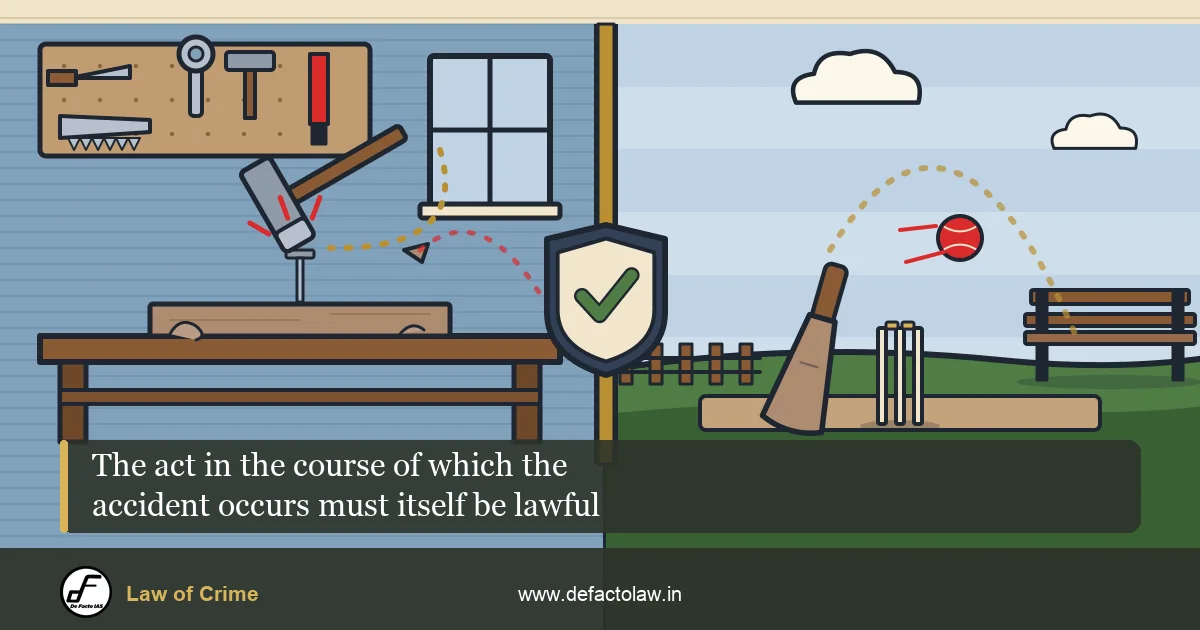
A carpenter driving a nail hits a bystander who walks unexpectedly into the path of the hammer swing. A surgeon whose patient moves without warning during a lawful procedure creates an unintended incision.
A cricketer, playing a lawful shot in the ordinary course of a game, drives the ball into a spectator. A person cleaning a licensed firearm, following correct procedure, experiences a mechanical malfunction that injures someone nearby.
In each case, an injury occurs. No injury was intended. No recklessness was involved. The person was doing something entirely lawful, in a lawful way, using lawful means, and with appropriate care. The harm that resulted was a true accident — sudden, unexpected, out of the ordinary course of things.
Section 80 IPC provides the General Exception that speaks to precisely this situation: nothing is an offence done by accident or misfortune, without criminal intention or knowledge, in the doing of a lawful act in a lawful manner by lawful means and with proper care and caution.
But Section 80 is also sharply limited. Its protection is not available the moment someone describes an injury as 'accidental'. It is available only when all four cumulative conditions are met — lawful act, lawful manner, lawful means, and proper care — together with the absence of criminal intention or knowledge.
Absence of any one of these requisites takes away the protection of accident as an extenuating factor (Atmendra v State of Karnataka AIR 1998 SC 1985). And the most powerful disqualifier is negligence: an act done without proper care and caution is an offence and will not fall under this exception.
Text and Conditions
Section 80 IPC provides: Nothing is an offence which is done by accident or misfortune, and without any criminal intention or knowledge, in the doing of a lawful act in a lawful manner by lawful means and with proper care and caution.
The BNS comparison table confirms that Section 18 BNS (= Section 80 IPC) is reproduced without any change. The heading is 'Accident in doing a lawful act.' The entire provision, all conditions, all judicial interpretation, and all case law under Section 80 IPC apply identically to Section 18 BNS.
The provision establishes five requirements that together define the scope of the accident defence:
(i) The act must be done by accident or misfortune — the injury must be unexpected and unintended.
(ii) The act must be done without any criminal intention or knowledge — the requisite mental element of any offence charged must be absent.
(iii) The act must be a lawful act — the underlying conduct must itself be legally permissible.
(iv) The act must be done in a lawful manner — the method of execution must be within the law.
(v) The act must be done by lawful means and with proper care and caution — the instruments used must be lawful, and the actor must have exercised appropriate care.
Accident or Misfortune
A sudden or unexpected event, mishap, misfortune or disaster is an accident. An injury is said to be accidentally caused when it is not caused either by a wilful or negligent act (Bhupendra Singh A Chudasama v State of Gujarat AIR 1997 SC 3790).
An effect is said to be accidental when it results from an innocent or lawful act done in a lawful or innocent manner. An injury caused is neither wilful nor negligent. It is something that happens out of the ordinary course of things (Sukhdev Singh v Delhi State (NCT of Delhi) (2003) 7 SCC 441).
This definition establishes three key negative elements: the accident must not be caused by a wilful act (which would establish criminal intent), not by a negligent act (which would disqualify under the proper care condition), and not be something in the ordinary course of things (which would make it foreseeable rather than accidental).
The accidental nature of the injury is thus defined by reference to what it is not: not wilful, not negligent, and not ordinarily foreseeable. True accidents are the residual category — genuinely unexpected outcomes that fall outside the range of what prudent care would have predicted and beyond the reach of any blameworthy mental state.
A mere accident does not amount to negligence (Verghes Cheriyan v Sirkar Prosecutor AIR 1950 TC 14). This is the critical legal proposition that animates Section 80's existence as a distinct General Exception.
It confirms that accident and negligence are different legal categories, not points on the same spectrum. A negligent act is not simply a less serious accident; it is a categorically different thing — the product of a failure of care that could and should have been exercised.
Four Conditions
Lawful Act
The act in the course of which the accident occurs must itself be lawful. If the underlying conduct is an unlawful act — a criminal enterprise, an act of violence, a prohibited activity — the fact that an injury occurring in the course of it was accidental provides no defence. The accident defence does not protect against harms arising from unlawful conduct, however unintended those harms may be.
The lawfulness of the act is assessed by reference to the legal status of the activity itself, not by reference to the actor's intention regarding the injury.
A person lawfully driving a vehicle, lawfully practising a sport, lawfully performing professional duties, lawfully carrying out household activities — all are engaged in lawful acts. A person engaged in an illegal activity, an act prohibited by statute, or an act that is itself an offence, is not.
Lawful Manner
It is not enough that the act itself is lawful; it must also be done in a lawful manner. The manner of doing the act refers to the way in which it is carried out — the procedure followed, the method used, the circumstances of execution. The act done must also be a lawful act, done in a lawful manner by lawful means (Jagesbar v Emperor AIR 1924 Oudh 228).
A lawful act done in an unlawful manner loses the protection. A licensed firearms holder who carries a loaded weapon in conditions that are prohibited by the licence conditions, or a surgeon who performs a lawful operation using a procedure that is prohibited by medical regulations, is not doing the act in a lawful manner. The legality of the act must extend to the manner of its performance.
Lawful Means
The means used to perform the act must also be lawful. Using an unlicensed weapon, an unregistered vehicle, an unapproved substance, or any instrument whose use for the purpose in question is prohibited by law takes the act outside Section 80's protection.
This condition reinforces the overall message of Section 80: the entire chain of conduct — the act, its manner, and its means — must be within the law. The protection is for the person who has done everything right and still produced an unforeseen, unfortunate result. It is not for the person who cut corners on legality and then suffered an accident as a consequence.
Proper Care
This is the most demanding and the most frequently litigated condition. An act done negligently without proper care and caution is an offence and will not fall under the exceptions. Acting with proper care and caution is the primordial requirement of the exception (Bhupendra Singh A Chudasama v State of Gujarat AIR 1997 SC 3790).
The word 'primordial' signals the hierarchy of conditions. Even if all other conditions are met — the act, manner, and means are all lawful, and there is no criminal intention — the absence of proper care and caution is disqualifying. Negligence is the enemy of the accident defence.
No Criminal Intention
In addition to the four positive conditions, Section 80 requires that the act be done without any criminal intention or knowledge. This negative requirement ensures that the defence does not extend to acts where the actor had the mental element required for criminal liability.
In order to escape criminal liability, it is essential to establish that the offence which is done by accident or misfortune was done without any criminal intention or knowledge (In re Devasabayam (1962) 1 Mad LJ 161). Both intention and knowledge are separately excluded.
Knowledge here means the awareness that the harmful consequence is likely to result from the act — which would constitute the mental element required for many IPC offences. Where the actor knew the injury was likely to result, the plea of accident fails even if there was no intention to cause harm.
This negative requirement distinguishes Section 80 from Section 81 (necessity). Section 81 expressly applies to acts done with knowledge that they are likely to cause harm — in that context, the harm is foreseen but the act is justified by the preventive purpose. Section 80, by contrast, applies to acts where no harm was anticipated at all — the injury is truly outside the actor's contemplation.
Care and Caution
Prudent Person Standard
The standard of care expected is what a prudent and reasonable person would consider sufficient, in the circumstances of the case (State Government, Madhya Pradesh v Rangaswami AIR 1952 Nag 268). The amount of care and circumspection taken by an accused must be one taken by a prudent and reasonable man in the circumstances of a particular case (Shankar Narayan Bhadolkar v State of Maharashtra AIR 2004 SC 1966).
This is the objective standard of the reasonable person — not the standard of the exceptionally careful or the exceptionally skilled, but the care that a prudent person of ordinary competence would exercise in the same circumstances.
The standard varies with circumstances: the care required of a surgeon is higher than that required of a layperson; the care required in handling explosives is higher than that required in handling paper.
The extent of reasonableness will always depend upon the attending and surrounding circumstances of each case (SN Hussain v State of Andhra Pradesh AIR 1972 SC 685). What is sufficient care in one context may be entirely inadequate in another. The question is always fact-specific.
Unqualified Persons
Acts of an unqualified person would be rash and negligent (Juggankhan v State of Madhya Pradesh AIR 1965 SC 831). A person who performs an act requiring specific qualifications, training, or licensing without possessing those qualifications is negligent in the very act of attempting the task.
The proper care and caution condition therefore requires not just careful execution of the act but the antecedent qualification to perform it at all.
A person without medical training who performs surgery, causing death, cannot plead accident under Section 80. They are negligent in assuming the task. The act itself — undertaken without the knowledge, skill, and qualification that lawful performance requires — is intrinsically one that a prudent person would not perform.
Misjudgment vs Negligence
Misjudgment does not amount to negligence (Syad Akbar v State of Karnataka AIR 1979 SC 1848). A qualified, careful professional who assesses a situation and makes a decision that, in hindsight, was wrong has not necessarily been negligent.
Negligence is the failure to exercise reasonable care; it is not the failure to achieve a perfect outcome. A surgeon who correctly applies the appropriate professional standard to a difficult case, but whose patient has an unexpected adverse reaction, has not been negligent. The standard demanded is care, not infallibility.
This proposition is important because it keeps the accident defence available to genuinely careful professionals whose work involves inherent risk. Medicine, engineering, construction, emergency services — all involve situations where even careful, qualified practitioners produce unintended harmful outcomes. Section 80 is available to protect them when they have genuinely exercised proper care.
Any Requisite Missing
The four conditions of Section 80 are cumulative, not alternative. All four — lawful act, lawful manner, lawful means, proper care and caution — must be satisfied simultaneously. Absence of any one of these requisites takes away the protection of accident as an extenuating factor (Atmendra v State of Karnataka AIR 1998 SC 1985).
This cumulative structure is deliberate and demanding. It ensures that the accident defence cannot be invoked piecemeal — that a person cannot rely on the lawfulness of the act to excuse the negligent manner of its execution, or on the propriety of the means to excuse the unlawfulness of the underlying activity. Every element must be present for the defence to stand.
In practice, the most common failure point is the proper care and caution condition. Courts scrutinise this condition with particular care because the line between accident and negligence is frequently determinative of criminal liability for negligence-based offences under the IPC.
Games and Sports
Accidents in games and sports are all covered by this exception (Basant Singh v Emperor AIR 1927 Lah 880(2)). This application of Section 80 is both practically important and conceptually clear.
Games and sports are lawful activities; they are conducted by lawful means in accordance with rules; and participants exercise appropriate care within the rules of the game. Injuries that occur in the ordinary course of a lawfully played game — a blow from a cricket ball, a tackle in football, a collision in a race — are accidental injuries in the Section 80 sense.
The extension to sports reflects the law's recognition that certain lawful activities carry inherent risks that participants knowingly accept. So long as the sport is played within its rules and with proper care, the incidental injuries it produces are accidents, not criminal acts.
This position complements the consent doctrine of Section 87 IPC (Section 25 BNS) — a participant in a sport consents to the ordinary risks of that sport.
Where, however, a player acts negligently — using excessive force beyond what the sport requires, ignoring safety rules, playing under impairment — the proper care condition is violated, and neither Section 80 nor the consent under Section 87 provides a defence.
Series of Occurrences
Section 80 permits the court to look beyond the single incident when assessing whether an injury was truly accidental. For the purpose of deciding whether an act was accidental or intentional, or done with a particular knowledge or intention, the fact that the act formed a part of a series of similar occurrences, in each of which the person doing the act was concerned, may be taken into consideration.
This principle prevents systematic harmful conduct from escaping liability by characterising each individual incident as a stand-alone 'accident'. Where a person's acts repeatedly produce similar injuries in similar circumstances, the pattern is evidence — cogent and often decisive — that the harm was not truly accidental. Repetition transforms apparent accident into constructive knowledge or intention.
This evidentiary principle is of particular importance in cases of alleged professional negligence, industrial accidents, and recurring harmful incidents involving the same actor. The medical practitioner whose patients repeatedly suffer the same unexpected complication, or the driver who has multiple 'accidental' collisions, faces a cumulative evidentiary challenge that a single incident would not present.
Private Defence Overlap
A specific and important procedural rule governs the intersection of Section 80 (accident) and the right of private defence: where an accused acted in pursuance of a lawful right of self-defence and accidentally hit another person, a mere plea of accident will not suffice. It needs to be supported by a plea of self-defence as well (Girish Saikia v State of Assam (1993) Cr LJ 3808 (Gau)).
This rule reflects the necessary architecture of the defences. Section 80 is a General Exception that operates regardless of the identity of the victim; private defence is a General Exception that specifically justifies the use of force against an aggressor.
Where the context of the accident is the exercise of private defence — where the accused was lawfully acting to defend themselves or another, and in the course of that lawful defensive action accidentally injured a third party — the full picture requires both defences to be before the court.
Pleading only accident in such a case would omit the essential context that makes the act itself lawful (the private defence) and would leave the court without the complete picture required for fair assessment of the plea.
Burden of Proof
Where a substantive defence of accident within the purview of Section 80 is put forward by the accused, it is incumbent on him to prove it (Emperor v Dwijendra Chandra Mukerjee AIR 1916 Cal 633).
He has to prove that he is entitled to the exception, otherwise there is a presumption against him that he is not entitled thereto. The burden to rebut the presumption lies on him (KM Nanavati v State of Maharashtra AIR 1962 SC 605).
This is the standard burden applicable to all General Exceptions: the accused bears the evidential burden of establishing the exception on the preponderance of probabilities — not beyond reasonable doubt, but sufficiently to raise a real possibility in the court's mind. The prosecution does not need to disprove the accident defence; the accused must prove it.
The accused may discharge this burden through their own evidence, through evidence elicited by cross-examination of prosecution witnesses, or through the overall circumstances of the case.
But passive reliance on the mere fact that no harm was intended is insufficient. The accused must affirmatively establish all four conditions — lawful act, lawful manner, lawful means, and proper care — together with the absence of criminal intention or knowledge.
Versus Section 81
Section 80 (accident) and Section 81 (necessity — Section 19 BNS: word 'steam' excluded from illustration) are neighbouring provisions that address different situations requiring contrast.
Section 80 applies where harm occurred entirely outside the actor's contemplation — genuinely unexpected, unforeseen, resulting from something outside the ordinary course of events. The actor had no knowledge that harm was likely. The harm was not chosen.
Section 81 applies where the actor knew harm was likely — but acted anyway because the harm caused was the lesser evil to prevent a greater harm. The actor had knowledge of the probable harmful consequence but no criminal intention to cause it. The harm was a foreseen but unchosen byproduct of a preventive act.
The two sections together cover the full spectrum from pure accident (no knowledge or intention) to knowing but purposive harm (Section 81). Between them, they establish the IPC's comprehensive framework for harm caused without the guilty mind that criminal liability demands.
BNS Position
The BNS comparison table confirms that Section 18 BNS (= Section 80 IPC) is reproduced without any change. The heading 'Accident in doing a lawful act', the four cumulative conditions, the negative requirement of no criminal intention or knowledge, and all judicial interpretation under Section 80 IPC apply without modification to Section 18 BNS.
This is in contrast to Section 19 BNS (= Section 81 IPC), where the word 'steam' was removed from an illustration. Section 80/18 requires no such update because its provision text did not contain any outdated illustrative element.
All the cases decided under Section 80 IPC — on the definition of accident, the conditions of the exception, the standard of care, the burden of proof, the games and sports application, and the series of similar occurrences principle — continue to govern Section 18 BNS.
Conclusion
Section 80 IPC / Section 18 BNS is the IPC's clearest recognition that accidents happen — that even careful, lawful people doing lawful things in lawful ways can produce injuries that no degree of reasonable care would have prevented. In those cases, criminal liability would be unjust: the actor has done nothing blameworthy, and punishment would serve neither deterrence nor reform.
But the section's gatekeeping is strict. All four conditions must be met. The lawfulness of the act, its manner, its means, and the standard of care exercised are each independently assessed.
The most demanding of these conditions — proper care and caution — is the most frequently dispositive. Negligence defeats the plea, and the standard of care is the objectively assessed reasonable person, not the actor's own subjective sense of having been careful.
The result is a narrow but important gateway. True accidents — those outside the ordinary course of things, unforeseen by any prudent person, occurring in the course of entirely lawful and carefully executed activities — are not offences. Everything short of that — the negligent, the careless, the reckless — remains within the reach of criminal liability.
Frequently Asked Questions
Q: What are the conditions for the accident defence under Section 80 IPC / Section 18 BNS?
The defence requires that the injury was caused by accident or misfortune; that the act was done without criminal intention or knowledge; that the act was a lawful act; that it was done in a lawful manner; that it was done by lawful means; and that it was done with proper care and caution. All conditions are cumulative — absence of any one removes the protection.
Q: Does negligence defeat the accident defence under Section 80 IPC?
Yes, absolutely. An act done negligently without proper care and caution is an offence and will not fall under the exception. Acting with proper care and caution is the primordial requirement. The standard is that of a prudent and reasonable person in the circumstances — not the actor's own subjective sense of having been careful.
Q: Does the accident defence cover injuries occurring in sports and games?
Yes. Accidents in games and sports are all covered by Section 80 IPC / Section 18 BNS, provided the sport is lawful, played in a lawful manner, using lawful means, and the participant exercised proper care. Injuries that occur in the ordinary course of a lawfully played game are accidental injuries, not criminal acts.
Q: Who bears the burden of proving the accident defence under Section 80 IPC?
The accused bears the burden of proving that he is entitled to the exception. There is a presumption against him that the exception does not apply. He must establish, on the preponderance of probabilities, all the conditions of the exception: that the act was lawful, done in a lawful manner, by lawful means, with proper care, and without criminal intention or knowledge.
Q: What is the difference between Section 80 (accident) and Section 81 (necessity) IPC?
Section 80 applies where the harmful consequence was entirely outside the actor's contemplation — genuinely unforeseen, with no criminal knowledge or intention. Section 81 applies where the actor knew harm was likely but acted without criminal intention, in good faith, to prevent greater harm.
Section 80 requires no knowledge of likely harm; Section 81 expressly applies where such knowledge existed. The BNS carries both provisions forward: Section 18 BNS = Section 80 IPC: no change; Section 19 BNS = Section 81 IPC: word 'steam' excluded from illustration only.