
On this page 13 sections
When the residents of Ward 12, New Road, in Ratlam town finally went to a magistrate, the municipality had a ready answer. They had bought their houses next to open drains and a stream of foul liquid from an alcohol plant, it said, with their eyes open, so they could not complain. The Supreme Court called it a strange plea.
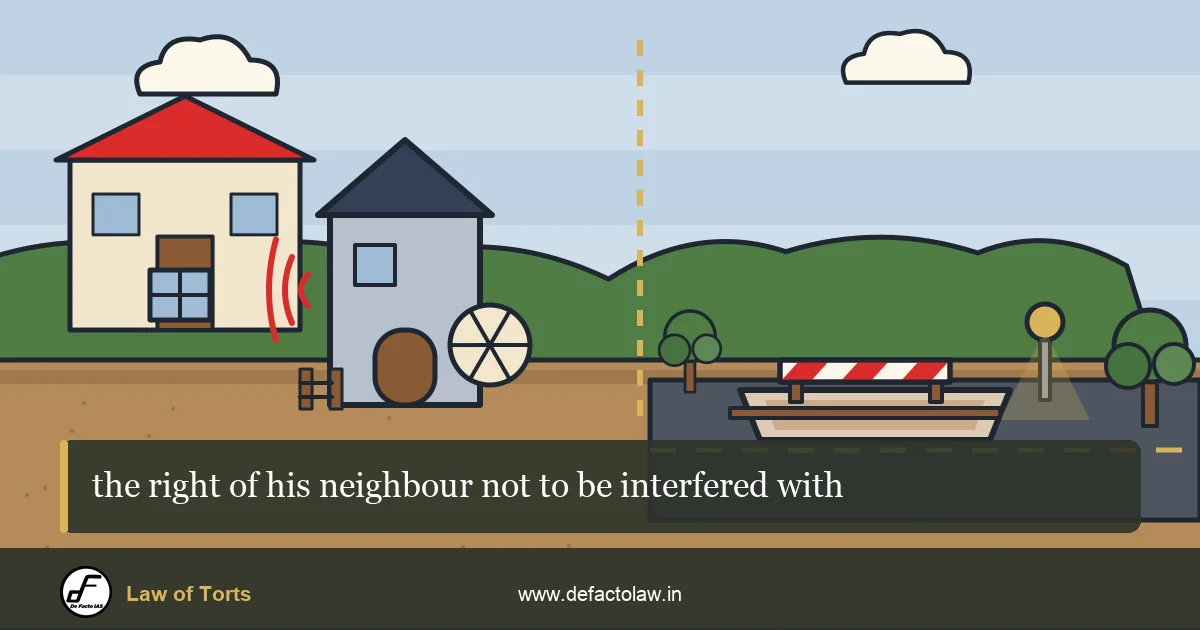
The story of Ratlam holds most of what the law of nuisance is about: smell, filth and noise that spoil a place for living, a wrong shared by many people, a wrong felt by one household, and several different routes to a remedy.
Cases at a glance 37
- Rylands v. Fletcher
- Winterbottom v. Lord Derby
- Benjamin v. Storr
- Rose v. Milles
- Campbell v. Paddington Corporation
- Dr. Ram Raj Singh v. Babulal
- Sedleigh-Denfield v. O'Callaghan
- Sturges v. Bridgman
- Polsue and Alfieri v. Rushmere
- Radhey Shyam v. Gur Prasad
- Robinson v. Kilvert
- Heath v. Mayor of Brighton
- Ushaben v. Bhagya Laxmi Chitra Mandir
- Mayor of Bradford v. Pickles
- Christie v. Davey
- Hollywood Silver Fox Farm v. Emmett
- Dollman v. Hillman
- St. Helen's Smelting Co. v. Tipping
- Stroyan v. Knowles
- Dalton v. Angus
- Colls v. Home and Colonial Stores
- Bass v. Gregory
- Fay v. Prentice
- Barber v. Penley
- Dwyer v. Mansfield
- Ware v. Garston Haulage
- Leanse v. Egerton
- Noble v. Harrison
- Caminer v. Northern and London Investment Trust
- Tarry v. Ashton
- Shanmughavel Chettiar v. Sri Ramkumar Ginning Firm
- Smith v. London and South Western Railway
- Metropolitan Asylum District v. Hill
- Shelfer v. City of London Electric Lighting
- Adams v. Ursell
- Rapier v. London Tramways
- Bills v. Hall
This article takes the subject as a chapter of the law of torts. It separates the two kinds of nuisance, builds up the elements of private nuisance, deals with highways, parties, defences and remedies, sets nuisance beside trespass, negligence and the rule in Rylands v. Fletcher, and ends with the Indian cases on noise and public sanitation.
Two Kinds of Nuisance
Nuisance as a tort means an unlawful interference with a person's use or enjoyment of land, or of some right over or connected with it. Acts that interfere with comfort, health or safety are the usual examples. The interference may come as noise, vibration, heat, smoke, smell, fumes, water, gas, electricity, excavation or even disease-producing germs.
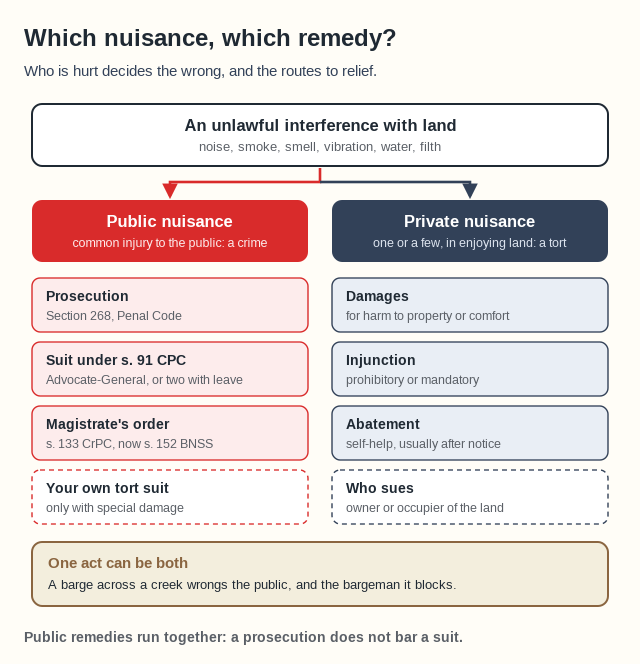
The law recognises two kinds. A public or common nuisance harms the public at large and is a crime. A private nuisance harms one person or a few, in the enjoyment of land, and is a civil wrong. One act can be both at once, and much of the learning lies in how the two meet.
| Point | Public nuisance | Private nuisance |
|---|---|---|
| Who is affected | The public, or people in general who live or occupy property nearby | One person or a few, as against the public at large |
| Nature of wrong | An offence, punishable under criminal law | A civil wrong, giving damages or an injunction or both |
| Who may sue in tort | Only a person who proves special damage | The owner or occupier whose enjoyment of land is disturbed |
| Proof of damage | Special and particular damage is essential for a private suit | Damage is an element, though the law often presumes it |
Public Nuisance
Penal Code Definition
Section 268 of the Indian Penal Code states the offence. A person is guilty of a public nuisance who does any act or is guilty of an illegal omission:
"which causes any common injury, danger, or annoyance to the public or to the people in general who dwell or occupy property in the vicinity"
The section also covers acts that must necessarily cause injury, obstruction, danger or annoyance to persons who have occasion to use any public right. Its second paragraph closes off an obvious excuse: "A common nuisance is not excused on the ground that it causes some convenience or advantage."
The annoyance need not injure every member of the public within its range. It is enough that it affects people in general who dwell in the vicinity. The commentary on the section explains that it is the quantum of annoyance that separates public from private nuisance.
Obstructing a public highway, polluting a public waterway, storing inflammable material in a way that endangers the public, and ringing a bell day and night are all given as instances.
Why No Civil Suit
If a trench dug across a road inconveniences a thousand people, the law could have let each of them sue. It does not. Allowing a civil action to every inconvenienced person would produce hundreds of suits for one act, so the wrong is left to the criminal law and to suits brought on behalf of the public.
The English case that states the limit is Winterbottom v. Lord Derby. The defendant's agent blocked a public footway. The plaintiff said he sometimes had to take another route and sometimes spent money removing the obstruction. He lost, because he had suffered no more than anyone else. The court observed that otherwise
"there would really be no limit to the number of actions which might be brought."
Special Damage Rule
The exception is special damage. A person who suffers harm of a different kind, or a greater degree, than the public at large may sue in tort. For that person the public nuisance is also a private wrong. Digging a trench on a highway troubles everyone who must go around it; the traveller who falls into it and is severely injured has a claim of his own.
The cases show what counts as special:
- Benjamin v. Storr: horses and wagons were left standing for an unreasonable time outside a man's house, causing darkness and a bad smell and blocking customers from entering. The damage was particular, direct and substantial.
- Rose v. Milles: the defendant moored his barge across a public navigable creek. The plaintiff's barges were blocked and he had to unload cargo and carry it by land at considerable expense.
- Campbell v. Paddington Corporation: the borough erected a stand on the highway to view the funeral procession of Edward VII, blocking the view from the plaintiff's windows. She lost the chance to let seats and was entitled to compensation. The case also settled that a corporation answers for such acts even if they exceed its powers.
- Dr. Ram Raj Singh v. Babulal (Allahabad High Court): a brick-grinding machine next to a doctor's premises sent dust into his consulting chamber and onto his patients' clothes. Special damage was proved and a permanent injunction followed.
The point of these cases is that the loss must differ from the public's, not merely be larger in number or amount.
Suits Under Section 91
The special-damage rule left the public without a civil remedy when no single person was hurt enough to sue. Section 91 of the Code of Civil Procedure fills that gap. In the case of a public nuisance or other wrongful act affecting or likely to affect the public, a suit for a declaration and injunction, or other appropriate relief, may be brought by the Advocate-General, or with the leave of the court by two or more persons,
"even though no special damage has been caused to such persons by reason of such public nuisance or other wrongful act."
Section 91(2) adds that nothing in the section limits any right of suit that exists independently of it. Before 1976 the two persons needed the Advocate-General's written consent; after 1976 they need the leave of the court. The commentary adds several working rules:
- The section creates a right of action where there was none; it takes away no existing one.
- It applies only to a true public nuisance, such as obstruction of a public highway, and not to a right of way claimed by only some classes of persons.
- It does not apply to private nuisance.
- A person who suffers special damage can sue for removal or abatement of the nuisance without resorting to it, and where many persons have suffered special damage a representative suit under Order I, rule 8 can be brought.
The remedies against a public nuisance are concurrent. A criminal prosecution does not bar a suit under section 91, and the suit does not bar prosecution. In the horses-and-wagons illustration, the owner may be prosecuted, may be sued under section 91 for an order to abate and an injunction though no special damage is shown, and may be sued for damages by the occupiers whose damage is special.
Magistrate's Summary Power
A third route is the summary one in the Code of Criminal Procedure. Section 133 lets a District Magistrate, a Sub-divisional Magistrate or another specially empowered Executive Magistrate, on a police report or other information, make a conditional order for removal of a nuisance.
The grounds include unlawful obstruction of a public place, way, river or channel; a trade or occupation injurious to the health or physical comfort of the community; construction likely to cause fire or explosion; a building or tree likely to fall; an unfenced tank, well or excavation beside a public way; and a dangerous animal.
The correspondence table in the commentary shows this provision carried into the new procedural code as section 152 without change.
The commentary stresses that section 133 serves cases that cannot wait for civil litigation, and that a civil dispute pending on the same matter is no bar to it. Once the order is made absolute, disobedience is punishable under section 188 of the Penal Code.
Ratlam and Public Duty
The Ratlam residents moved the Sub-divisional Magistrate under section 133. They complained that the municipality had not provided sanitary facilities on the road, had not built public conveniences for slum-dwellers who used the road as a latrine, and had allowed the alcohol plant to discharge malodorous fluids into the public street.
The municipality was bound by section 123 of the Madhya Pradesh Municipalities Act, 1961 to cleanse public streets and sewers and to abate all public nuisances. The Magistrate ordered drains to be built, on pain of prosecution under section 188 of the Penal Code. The Sessions Court disagreed; the High Court restored the order.
Justice Krishna Iyer, for the Supreme Court, first dealt with the plea that the residents chose to live there:
"A public body constituted for the principal statutory duty of ensuring sanitation and health cannot outrage the court by such an ugly plea."
The municipality then pleaded that it had no funds. The Court held that financial inability is no legal excuse for a municipality. The Code, it said, operates against statutory bodies "regardless of the cash in their coffers". It added a line that has been quoted ever since:
"Decency and dignity are non-negotiable facets of human rights and are a first charge on local self-governing bodies."
On the power itself the Court said "Section 133 Cr.P.C. is categoric, although reads discretionary." Where the facts of a public nuisance are before the Magistrate, he must act. The Court dismissed the petition with modifications, and the work was to begin within two months, with the Magistrate inspecting progress every three months.
The decision matters for tort in two ways. It shows that a public nuisance may be abated by a positive, time-bound order against a public body and not only by punishing the offender. And it treats the nuisance as a failure of a public duty, which links the old wrong to the modern law of environmental and municipal accountability.
Private Nuisance
The commentary reduces the tort to three elements: unreasonable interference; interference with the use or enjoyment of land; and damage. Each has a body of law of its own.
Unreasonable Interference
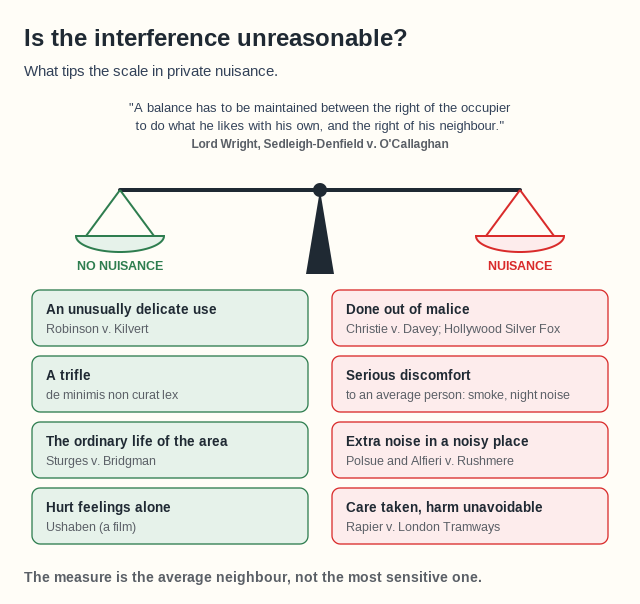
Not every interference is a nuisance. Everyone must put up with some noise, some vibration and some smell, so that members of society can enjoy their own rights. A person with a house beside a road cannot sue over inconvenience necessarily incidental to the traffic, or over a neighbour's radio that disturbs his studies. The test is a balance, put by Lord Wright in Sedleigh-Denfield v. O'Callaghan:
"A balance has to be maintained between the right of the occupier to do what he likes with his own, and the right of his neighbour not to be interfered with."
Reasonableness is judged by "the ordinary usages of mankind living in society", and an activity that is unreasonable is not excused because reasonable care was taken to prevent it from becoming a nuisance.
Locality and Sensitivity
What is unreasonable varies with the place. Thesiger L.J. put it in Sturges v. Bridgman:
"what would be a nuisance in Belgrave Square would not necessarily be so in Bermondsey."
Locality does not license everything, though. In Polsue and Alfieri v. Rushmere the plaintiff lived in a noisy district, yet printing machinery next door added so seriously to the noise that an injunction was granted. In Radhey Shyam v. Gur Prasad a flour mill installed in the same building as the plaintiffs' rooms was restrained for the same reason: the rattle seriously interfered with their physical comfort.
The standard is that of the average person in the area, not of the particular plaintiff. An act otherwise reasonable does not become actionable because the plaintiff is unusually sensitive or puts his land to an unusually delicate use. In Robinson v. Kilvert the defendant's heat dried and spoiled brown paper stored by the plaintiff in the same building.
The paper was the victim of an "exceptionally delicate trade" and ordinary paper would not have suffered, so the defendant was not liable. In Heath v. Mayor of Brighton an injunction against a buzzing noise from a power station was refused because it troubled the incumbent alone, not the ordinary worshipper.
And in Ushaben v. Bhagya Laxmi Chitra Mandir a claim that a film hurt religious feelings failed: hurt feelings were not an actionable wrong, and the plaintiffs were free not to see the film.
Role of Malice
In Mayor of Bradford v. Pickles the House of Lords held that a lawful act does not become unlawful because of a bad motive:
"It is the act, not the motive for the act, that must be regarded."
Yet malice matters in nuisance when it makes the interference unreasonable. In Christie v. Davey a neighbour, irritated by music lessons next door, retaliated by hammering the party wall, beating trays, whistling and shrieking. North J. granted an injunction, holding that
"it was not a legitimate use of the defendant’s house to use it for the purpose of vexing and annoying his neighbours."
Hollywood Silver Fox Farm v. Emmett followed it. The defendant fired guns on his own land, as near as possible to the plaintiff's breeding pens, to upset the nervous vixens. Although he was entitled to shoot there, the court gave an injunction and damages. A person who uses his telephone to harass a neighbour with persistent calls is liable in the same way.
A State of Affairs
Nuisance is generally a continuing wrong. A constant noise, smell or vibration is a nuisance, and an isolated escape ordinarily is not. In the cricket-ball case the trial judge said that
"A nuisance must be a state of affairs, however temporary, and not merely an isolated happening."
The commentary qualifies this. The Court of Appeal looked at the whole activity, a game played beside the highway, and found no dangerous state of affairs where the ball rarely reached the road. In other cases an isolated escape of a dangerous thing has been enough to recover for damage to property.
An intermittent interference may even be worse than a constant one, since a noise that does not come at fixed intervals is likely to be more disagreeable. In Dollman v. Hillman a customer slipped on fat left on the pavement outside a butcher's shop, and the butcher was held liable in nuisance and negligence for that single act.
Injury to Property
The second element covers two kinds of harm. The first is physical damage to land or things on it: overhanging branches, escaping roots, water, gas, smoke, fumes or vibration. In St. Helen's Smelting Co. v. Tipping fumes from the defendant's works killed the plaintiff's trees and shrubs. The plea that the locality was devoted to such works failed, because the harm was damage to property.
Support, Light and Air
Some interests are not natural rights and are acquired only by grant or long use. A landowner has a natural right to support of his land by neighbouring land, but not to support of buildings. If the damage to a building follows from withdrawal of support from the land, an action lies, as in Stroyan v. Knowles, where mining caused subsidence under a factory.
A right of support for a building can be acquired by grant or prescription, as in Dalton v. Angus, where the plaintiff had enjoyed lateral support for his factory for over twenty years. In India the Easements Act insists on real damage. Section 34 provides:
"The removal of the means of support to which a dominant owner is entitled does not give rise to a right to recover compensation, unless and until substantial damage is actually sustained."
Light and air follow the same logic. Both can be acquired by an easement, in India through peaceable enjoyment as of right, without interruption, for twenty years (section 15 of the Indian Easements Act, 1882).
Having less light than before is not enough; there must be substantial privation. In Colls v. Home and Colonial Stores an office that needed electric light in any case lost only some daylight and the claim failed. Section 33 of the Easements Act lets the owner or occupier of the dominant heritage sue for disturbance if it causes substantial damage.
Where the easement is light, damage is substantial only if it materially affects physical comfort or prevents the plaintiff from carrying on his accustomed business as beneficially as before. For air, material interference with physical comfort is enough, even if health is not harmed.
English law adds that there is no right to air over the general surface of a neighbour's land, but there can be one through a defined channel, as in Bass v. Gregory, where a ventilation shaft to a public house was blocked after forty years.
Comfort and Health
The second kind of harm is to the comfort or health of those on the land. Here the law ignores trifles; the maxim is de minimis non curat lex. There must be serious inconvenience, judged by what an average person in the same area would take.
Night-long noise from horses in a converted stable, a noisy crowd outside a club open until three in the morning, and smoke, noise and offensive vapour have all been held nuisances, even where health was not harmed. By contrast, a lawful trade such as that of a butcher or brewer may be carried on near another's house without liability, so long as it is conducted without causing what is a nuisance in law.
Proof of Damage
Unlike trespass, nuisance is not actionable per se. Actual damage must be shown, though in private nuisance the law will sometimes presume it. In Fay v. Prentice a cornice on the defendant's house projected over the plaintiff's garden. That alone raised a presumption that rainwater would fall into the garden and damage it, and no further proof was needed.
Highway Nuisances
Obstructing a highway, or creating danger on or near it, is a nuisance, and the obstruction need not be total. It must, however, be unreasonable.
In Barber v. Penley queues for a theatre made access to a boarding house difficult at certain hours, and the theatre was liable. In Dwyer v. Mansfield long queues formed outside a greengrocer's shop during a scarcity of potatoes.
The shopkeeper was doing business in the ordinary way, so he was not liable to the neighbouring shopkeepers.
The cases on dangerous structures turn on knowledge:
- Ware v. Garston Haulage: a lorry and trailer left on the highway at night with no rear light was a dangerous obstruction, and the owner was liable to a motorcyclist who ran into it.
- Leanse v. Egerton: window panes broken in an air raid were left unrepaired for days. The owner, though unaware, was presumed to know the danger and was liable.
- Noble v. Harrison and Caminer v. Northern and London Investment Trust: a beech branch and an elm, both sound to the eye, fell on the highway. The occupiers neither knew nor could have known of the danger, so there was no liability in nuisance.
- Tarry v. Ashton: a decayed lamp fell on a passer-by. The occupier knew of the defect and had hired a contractor who did the repair badly. He was still liable, since the duty to make the lamp safe was his own and could not be passed on.
The mere fact that something projects over a highway is not a nuisance; if it were, every signboard and awning would be one. A projection over a neighbour's private land is different. It interferes with his absolute right to enjoy it and is a nuisance in itself.
Offence alone is not nuisance either. Cutting up meat in one's own compound, even where passers-by could see it and some were offended, was held not to be a nuisance.
Who May Sue
Nuisance protects the use and enjoyment of land, so the plaintiff must show an interest in it. The commentary notes that in both nuisance and trespass the plaintiff has to show possession of land. The occupier, and the owner of an interest in the affected property, can sue.
Under section 33 of the Easements Act, the owner of any interest in the dominant heritage, or its occupier, may sue for disturbance of an easement. A person who has no interest and merely suffers inconvenience as a member of the public cannot sue for a public nuisance; he needs special damage, or must come within section 91.
A right to prevent a nuisance before it occurs is also recognised. In Shanmughavel Chettiar v. Sri Ramkumar Ginning Firm a ginning factory owner obtained an injunction against a neighbour's proposed brick kiln, whose fumes would spoil cotton and whose sparks threatened the cotton godown. The kiln's licence from the Municipality did not prevent the injunction.
Who Is Liable
The creator of the nuisance is liable. Where premises are used so as to cause a public nuisance, it is generally the occupier for the time being who is liable and not an absent proprietor. An occupier who knows of a dangerous defect and does not remove it is liable, and cannot escape by pointing to an independent contractor, as Tarry v. Ashton shows.
For withdrawal of support, the defendant is liable even when the act was done by an independent contractor, as the commentary on vicarious liability records. Corporations are liable like any person, as Campbell v. Paddington Corporation shows.
Several independent wrongdoers can each be liable. If a hundred people leave wheelbarrows in one place, and one wheelbarrow alone would harm no one, each of the hundred can be sued and none may plead that his own act caused no damage.
Valid Defences
Prescriptive Right
A right to do what would otherwise be a nuisance may be acquired as an easement by peaceable and open enjoyment, as of right and without interruption, for twenty years. After that the nuisance is treated as if the neighbour had granted it from the start. The twenty years do not begin until the act becomes a nuisance.
In Sturges v. Bridgman a confectioner had pounded materials in mortars in his kitchen for over twenty years without bothering anyone. When the physician next door built a consulting room at the end of his garden, the noise and vibration for the first time interfered with his work.
An injunction followed, and the confectioner's claim of prescription failed, because the activity had not been an actionable nuisance for the full period.
Statutory Authority
An act done under the authority of a statute is a complete defence where the nuisance is necessarily incidental to what the statute authorises. Lord Halsbury put it so:
"It cannot now be doubted that a railway company constituted for the purpose of carrying passengers, or goods, or cattle, are protected in the use of the functions with which Parliament has entrusted them"
A railway authorised to run trains is not liable if sparks set a neighbour's property alight in spite of due care, nor if noise, vibration and smoke reduce its value. The defence has limits. The authority must be exercised carefully, and an action lies if the authorised act is done negligently, as in Smith v. London and South Western Railway, where trimmings left beside the line caught fire and burned a cottage.
The authority may also be conditional. In Metropolitan Asylum District v. Hill a hospital authority empowered to set up a smallpox hospital built it in a residential area; since it could have done so without creating a nuisance, it was ordered to remove it.
Defences That Fail
Several pleas that sound plausible have been rejected:
- Others also contributed. The wheelbarrow example above shows that a defendant cannot say his own share alone would not be a nuisance.
Public good. It is no defence that what harms one plaintiff benefits the public, or no public undertaking could be held liable.
In Shelfer v. City of London Electric Lighting violent vibrations from a power house damaged the plaintiff's house, and the plea that the city would otherwise lose its light was rejected. In Adams v. Ursell an injunction closed a fried-fish shop in a residential street despite hardship to its poor customers. This is also the rule of section 268 of the Penal Code for public nuisance.
- Reasonable care. In Rapier v. London Tramways the stench from stables for two hundred tram horses was a nuisance although every possible care had been taken. The commentary states the consequence:
"If an operation cannot, by any care and skill, be prevented from causing a nuisance, it cannot lawfully be undertaken at all, except with the consent of those injured by it or by the authority of a statute."
Coming to the nuisance. A person cannot be expected to refrain from buying land on which a nuisance already exists, and volenti non fit injuria does not apply.
In Bills v. Hall a tallow-chandlery that had run for three years before the plaintiff arrived got no protection. The municipality in Ratlam tried the same argument and the Supreme Court dismissed it.
Available Remedies
Money Damages
Damages compensate the harm done, whether physical damage to property or loss of comfort. In a public nuisance the plaintiff recovers only for special damage, and proof of malice can aggravate the award.
Court Injunctions
For a continuing nuisance, damages alone are no answer, and the usual remedy is an injunction. A temporary injunction preserves the position until the case is heard; a perpetual injunction follows a full hearing. A prohibitory injunction forbids the act, such as running the machine. A mandatory injunction requires a positive step, such as demolishing a wall that blocks light.
The cases above show the range: a brick grinder restrained in Ram Raj Singh, a flour mill in Radhey Shyam, a brick kiln before it was built in Shanmughavel Chettiar, and a hospital removed in Metropolitan Asylum District.
Abatement by Occupier
The occupier may also act himself. An occupier of land may abate, that is end by his own act, a nuisance affecting his land, for example by cutting the branches or roots of a neighbour's tree that have crossed into his land. Notice is generally required first, unless the nuisance endangers life or property. No notice is needed where abatement can be done without entering the wrongdoer's land.
Where more than one way is available, the less mischievous should be chosen; if the more mischievous is used, notice should be given.
For a public nuisance, the remedies listed earlier are added: prosecution, the section 91 suit and the section 133 order.
Nuisance Beside Other Torts
Against Trespass
Trespass is a direct physical interference with possession of land through a material object. Nuisance is a consequential interference with use or enjoyment, and can operate through intangibles such as noise, smell or vibration. Throwing stones on a neighbour's premises is trespass; letting stones fall from a ruinous chimney is nuisance.
Planting a tree on another's land is trespass; planting on one's own land a tree whose roots or branches cross over is nuisance. Trespass is actionable per se, and nuisance needs damage. The two may coincide, as in some continuing trespasses.
Against Negligence
Nuisance is not a branch of negligence. It protects an interest in land, it looks to the unreasonableness of the interference and not to the defendant's care, and reasonable care is no answer to it. The commentary on negligence notes that negligence may be the mode of committing nuisance, as with trespass or defamation, where it denotes the mental element.
The highway cases show the overlap: the occupier's knowledge or constructive knowledge of the danger matters, and Dollman v. Hillman found liability in both torts at once.
Rylands v. Fletcher
The rule in Rylands v. Fletcher makes a person who keeps on his land something likely to do mischief if it escapes answerable for the damage, without proof of negligence. It has been applied to gas, electricity, vibrations, noxious fumes and sewage, which are also the usual stuff of nuisance.
The two causes of action are often pleaded together, as in Noble v. Harrison, where the plaintiff relied on nuisance and, in the alternative, on the rule. The claim failed under both: the overhanging branch was not itself a nuisance, the defendant neither knew nor could have known it would break, and growing a tree is a natural use of land.
Noise and the Environment
The Indian law of public nuisance has moved most in the cases on noise and sanitation, which bring in Article 21. In the Noise Pollution case (2005), which arose from public interest petitions, Chief Justice Lahoti restated the tort rule on noise:
"Any noise which has the effect of materially interfering with the ordinary comforts of life judged by the standard of a reasonable man is nuisance."
Whether it is actionable depends on "its degree and the surrounding circumstances including the place and the time". The Court quoted the old rule that
"No proprietor has an absolute right to create noises upon his own land, because any right which the law gives is qualified by the condition that it must not be exercised to the nuisance of his neighbours or of the public."
It then tied the tort to the Constitution. Those who make noise often plead freedom of speech under Article 19(1)(a). The Court answered that nobody can claim a fundamental right to create noise by amplifying speech with loudspeakers, that others have a right to listen or decline to listen, and:
"Nobody can indulge into aural aggression."
Such conduct violates the right of others to a peaceful, comfortable and pollution-free life under Article 21, and Article 19 cannot be used to defeat Article 21. The Court also noted that noise has been within the definition of an air pollutant in the Air (Prevention and Control of Pollution) Act since 1987.
Ratlam and Noise Pollution share a pattern. Both start from the ordinary elements of nuisance, an interference with comfortable use of a place judged by the standard of a reasonable person. Both then add a public law dimension: Ratlam reaches the municipality through a magistrate's order, and the noise case reaches the loudspeaker through Article 21.
Straight Answers
Q: Can one act be both public and private nuisance?
Yes. A public nuisance becomes a private one for the person who suffers special damage. A barge across a creek was a public nuisance, and a private wrong to the plaintiff whose barges it blocked.
Q: Is nuisance actionable without damage?
No. Unlike trespass, nuisance requires damage, though the law sometimes presumes it, as with a cornice projecting over a garden.
Q: Does a licence or statute protect the defendant?
Statutory authority is a defence where the nuisance is necessarily incident to what the statute authorises. A municipal licence for a kiln did not stop an injunction.
Q: What is the difference between damages and abatement?
Damages are awarded by the court after the harm. Abatement is self-help by the occupier, ordinarily after notice.
Q: Is it a defence that the plaintiff came to the nuisance?
No. Neither Ratlam nor the tallow-chandlery case accepted it.
Sources: Law of Torts, Chapter 9 (Nuisance), with the commentaries on the Indian Penal Code (Chapter XIV), the Code of Civil Procedure (section 91) and the Code of Criminal Procedure (Chapter X and the BNSS correspondence table); Supreme Court of India, Municipal Council, Ratlam v. Vardhichand (1980); In re Noise Pollution (2005).