
On this page 11 sections
Parliament passed the Consumer Protection Bill, 2019 on 6 August 2019, and the new Act was published in the Official Gazette on 9 August 2019; it came into force on 20 July 2020. It replaced the Consumer Protection Act, 1986, which had served for more than three decades, and it was written for a market the old law never saw: digital commerce, digital branding, online payment and home delivery.
Two of its changes matter most, both in the examination hall and to the ordinary buyer. The online buyer is now an ordinary consumer under the statute, and the maker and the seller of a defective product now answer for the harm it causes. This article takes both in turn, with the machinery that enforces them.
Cases at a glance 4
Why a New Act
The 1986 Act gave the consumer a cheap and quick forum, but it was built for face-to-face trade. It had no regulator, no statutory action for defective products, no mediation, and nothing on e-commerce or misleading advertisements.
The 2019 Act filled each gap. Its main changes are these:
- E-commerce covered: the definition of "consumer" was widened to take in online transactions.
- Filing where the consumer lives: a complaint may be filed where the consumer resides or works, not only where the seller sits, and it may be filed electronically and heard through video-conferencing.
- A regulator: the Central Consumer Protection Authority, with an investigation wing headed by a Director-General, power to act on its own motion, recall products, order reimbursement and file class actions.
- Product liability: a statutory action against the manufacturer, the service provider and the seller of a defective product.
- Mediation: consumer mediation cells attached to every Commission.
- Misleading advertisements: penalties on the manufacturer, and on the endorser too.
The pecuniary limits were also raised. The Act originally set them at Rs. 1 crore for the District Commission and Rs. 10 crore for the State Commission; the 2021 rules lowered them to Rs. 50 lakh and Rs. 2 crore, with the National Commission above that.
Who Is a Consumer
"Consumer" is the gateway concept of the whole statute: only a consumer may invoke the redressal machinery. That is why UPSC keeps returning to the definition, most recently in 2026, when it asked how the changed definition aligns with e-commerce.
Section 2(7) has two limbs. A consumer is any person who buys goods for a consideration paid, promised or deferred, including any user of the goods with the buyer's approval; and any person who hires or avails of services for a consideration, including any beneficiary of those services with the hirer's approval. One who obtains goods for resale or for any commercial purpose is excluded.
The Supreme Court read the earlier definition, which the 2019 Act carries forward in substance, as deliberately wide. In Lucknow Development Authority v. M.K. Gupta (1993) it said:
"A scrutiny of various definitions such as 'consumer', 'service', 'trader', 'unfair trade practice' indicates that legislature has attempted to widen the reach of the Act."
The width reaches beyond the person who pays. In Spring Meadows Hospital v. Harjol Ahluwalia (1998) a child was treated in a hospital engaged by his parents. The Court held that the definition includes not only the person who hires the services but also the beneficiary, so that "both the parents of the child as well as the child would be consumer".
Commercial Purpose
The commercial-purpose exclusion is limited by an Explanation: "commercial purpose" does not include goods bought and used by the buyer exclusively for earning his livelihood by means of self-employment. The leading case is Laxmi Engineering Works v. P.S.G. Industrial Institute (1995), where a small engineering unit had bought a defective machine.
"It is not the value of the goods that matters but the purpose to which the goods bought are put to."
The Court explained the test with illustrations. A person who buys a typewriter or a car and works the typewriter or plies the car as a taxi himself does not cease to be a consumer. But a person who buys an auto-rickshaw, a car or a lathe "to be plied or operated exclusively by another person would not be a consumer". The question is one of fact in each case.
What Is a Service
The definition of service is built the same way. In Indian Medical Association v. V.P. Shantha (1995) the Court split it into three parts: a main part, an inclusionary part (banking, financing, insurance, transport, housing construction and the like) and an exclusionary part. The exclusion covers "rendering of any service free of charge or under a contract of personal service".
On that reading, medical services rendered for payment are a service, and a deficiency in them can be taken to a consumer forum.
The Online Buyer
The 2019 Act's change for e-commerce is worked by Explanation (b) to Section 2(7). Under it, the expressions "buys any goods" and "hires or avails any services" include
"offline or online transactions through electronic means or by teleshopping or direct selling or multi-level marketing."
The definition is therefore mode-neutral. No separate class of "online consumer" is created; the online buyer is simply a consumer, with the same rights and the same forum. Section 2(16) defines e-commerce as buying or selling goods or services, including digital products, over a digital or electronic network, and Section 2(17) brings in the electronic service provider.
Did E-commerce Hurt Consumers?
A 2019 question asked candidates to examine the claim that e-commerce has adversely affected consumer protection in India. The claim is only half right. Shopping online gave the buyer choice and convenience the market had never offered, yet it also moved the bargain to a place the 1986 Act could not follow.
The buyer could no longer handle the goods before paying; he had only a photograph, a description and ratings that might be bought. The person who actually sold the goods was often a small or foreign vendor hidden behind a platform, and the platform said it was only a meeting place. And when something went wrong, nobody could say with confidence which forum had jurisdiction over a sale that happened nowhere in particular.
The 2019 Act met each of these points: the online buyer inside the definition of consumer, misleading advertisement made an unfair trade practice by Section 2(47), a regulator with investigating powers, a product seller answerable under Section 86, and a complaint that may be filed where the consumer lives under Section 34(2). The harm was real, but it belonged to the years when the law trailed the technology.
E-commerce Rules 2020
The Act gives the rights; the Consumer Protection (E-Commerce) Rules, 2020, made under Section 101, tell the platforms what they must do. They apply to every e-commerce entity that offers goods or services to consumers in India, even one that operates from abroad.
An entity must appoint a nodal officer and a grievance officer and show its legal name, address and customer-care details. It must tell the buyer who the real seller is, what the total price is, where the goods come from, and what the terms are for return, refund, exchange, warranty and delivery. It may not manipulate prices, discriminate between consumers or post fake reviews. A complaint must be acknowledged within forty-eight hours and settled within a month.
Product Liability
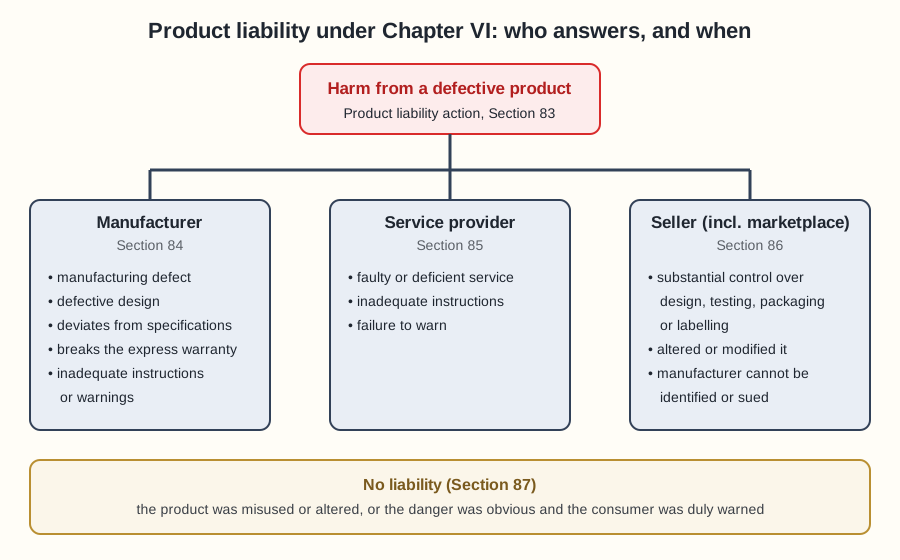
Chapter VI of the Act (Sections 82 to 87) creates the product liability action. Section 83 states its reach:
"A product liability action may be brought by a complainant against a product manufacturer or a product service provider or a product seller, as the case may be, for any harm caused to him on account of a defective product."
Under Section 84(1), a product manufacturer is liable if
- the product contains a manufacturing defect;
- the product is defective in design;
- there is a deviation from manufacturing specifications;
- the product does not conform to the express warranty; or
- the product fails to contain adequate instructions of correct usage to prevent any harm, or any warning regarding improper or incorrect usage.
Section 84(2) adds that the manufacturer is liable "even if he proves that he was not negligent or fraudulent in making the express warranty of a product". Liability turns on the defect, not on fault.
Under Section 85, a product service provider is liable where the service was faulty, imperfect, deficient or inadequate in quality, nature or manner of performance; where there was an act of omission or commission or negligence, or a conscious withholding of information, which caused harm; where adequate instructions or warnings were not issued; or where the service did not conform to the express warranty or the terms of the contract.
The Seller's Liability
Section 86 reaches a product seller who is not the manufacturer, on five grounds:
- he exercised substantial control over the designing, testing, manufacturing, packaging or labelling of the product that caused harm;
- he altered or modified the product, and the alteration was the substantial factor in causing the harm;
- he made an express warranty of his own, independent of the manufacturer's, and the product failed to conform to it;
- he sold the product and the identity of its manufacturer is not known, or the manufacturer cannot be served or proceeded against in India;
- he failed to exercise reasonable care in assembling, inspecting or maintaining the product, or did not pass on the manufacturer's warnings, and that failure was the proximate cause of the harm.
The fourth ground matters most online. A marketplace that sells goods whose maker cannot be traced or sued in India cannot hide behind the absent manufacturer.
Section 87 sets the limits. No action lies against the seller if, at the time of harm, the product was misused, altered or modified. And a manufacturer is not liable for failing to warn about "a danger which is obvious or commonly known to the user or consumer of such product".
Buyer Beware to Seller Beware
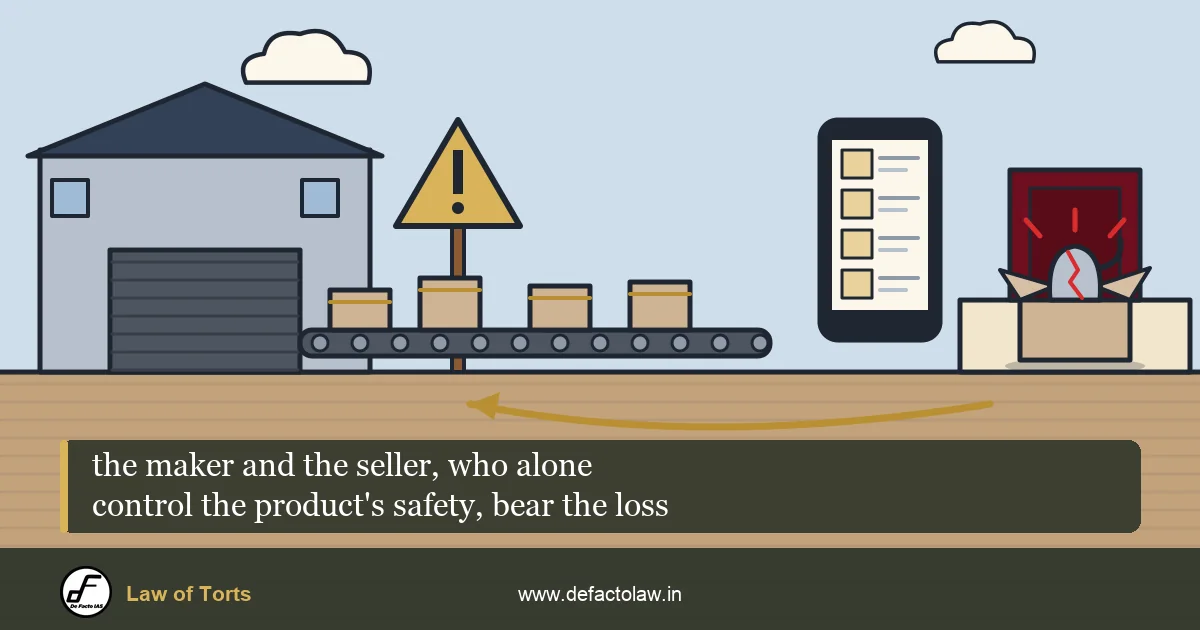
Under caveat emptor a buyer who failed to inspect bore the risk of a latent defect. Under Chapter VI the maker and the seller, who alone control the product's safety, bear the loss, whatever the privity and largely regardless of negligence. The consumer has to show a defective product and the harm.
This is the shift the 2024 paper asked candidates to discuss: whether product liability marked the end of "buyer beware" and the start of "seller beware". The honest answer is yes, with one qualification. Caveat emptor survives only where the buyer misused the product, altered it, or ignored an obvious and warned-against danger.
Mediation Cells
The 1986 Act had no mediation machinery at all. Chapter V of the 2019 Act (Sections 74 to 81) builds one. Under Section 74(1),
"The State Government shall establish, by notification, a consumer mediation cell to be attached to each of the District Commissions and the State Commissions of that State."
The Central Government establishes cells for the National Commission and its regional Benches. Every cell keeps a list of empanelled mediators, a list of the cases it has handled and a record of proceedings, and submits a quarterly report to its Commission.
Where a Commission finds that elements of a settlement exist, it may refer the parties to mediation; a settlement reached there is recorded and becomes the Commission's order, and unsettled issues go back to the Commission.
CCPA and Penalties
The 2023 paper asked for two things together: the reasons for including e-commerce, and the consequences for e-commerce entities that do not comply. The reasons are the mischiefs set out above; the consequences begin with the regulator. The Central Consumer Protection Authority, established under Section 10, may investigate violations of consumer rights, order the recall of unsafe goods, direct the discontinuance of unfair trade practices and impose penalties.
Under Section 21, the Authority may penalise a manufacturer or endorser of a false or misleading advertisement up to Rs. 10 lakh, and up to Rs. 50 lakh for a subsequent contravention, and may bar an endorser from endorsing for up to one year, or three years for a repeat.
Section 89 adds a criminal offence: a manufacturer or service provider who causes a false or misleading advertisement prejudicial to consumers may be imprisoned for up to two years and fined up to ten lakh rupees, and for a subsequent offence up to five years and fifty lakh rupees.
Consumer Protection Councils
Besides the Commissions, which decide disputes, the Act sets up Consumer Protection Councils at the Central, State and District levels. They are advisory bodies. Their work is to promote and protect the rights the Act gives a consumer: protection from hazardous goods, information about the goods, choice, a hearing, redressal and consumer education. A Commission acts after the harm; a Council works to stop it happening.
An Additional Remedy
The consumer remedy is additional, not exclusive. Section 100 of the 2019 Act, like Section 3 of the 1986 Act before it, provides that the Act is in addition to and not in derogation of any other law for the time being in force. The consumer may choose the cheaper, quicker forum without losing his rights under the general law, unless a special statute expressly bars the consumer forum.
1986 and 2019 Compared
| Point | Consumer Protection Act, 1986 | Consumer Protection Act, 2019 |
|---|---|---|
| Regulator | None | Central Consumer Protection Authority (Section 10) |
| Product liability | No statutory action | Chapter VI, Sections 82 to 87 |
| Mediation | No machinery | Consumer mediation cells, Chapter V |
| E-commerce | Not addressed | In the definitions; E-Commerce Rules, 2020 |
| Misleading advertisements | No specific machinery | CCPA penalties (Section 21) and an offence (Section 89) |
| Place of filing | Where the opposite party resides or the cause of action arose | Also where the complainant resides or works (Section 34(2)) |
| Forum names | District Forum, State and National Commissions | District, State and National Commissions |
The 2019 Act thus turns a curative regime into a preventive and curative one. Its test lies in working: the strength of the Authority and the staffing of the Commissions will decide how much of the promise is kept.
Frequently Asked Questions
Q: Is a person who buys online a "consumer" under the 2019 Act?
Yes. Explanation (b) to Section 2(7) includes online transactions through electronic means, so the online buyer is a consumer with the same rights and forum as any other.
Q: Does a person who buys a machine for his business remain a consumer?
Only if he uses it himself, exclusively to earn his livelihood by self-employment. Laxmi Engineering Works holds that the purpose, not the value, decides.
Q: When is a product seller liable instead of the manufacturer?
Under Section 86, on five grounds, including where the seller exercised substantial control over the product, altered it, gave his own warranty, or where the manufacturer cannot be identified or proceeded against.
Q: Where can a consumer file a complaint against a distant online seller?
Under Section 34(2), also where the complainant resides or personally works for gain.
Sources: Consumer Protection Act, 2019 and the Consumer Protection (E-Commerce) Rules, 2020; Lucknow Development Authority v. M.K. Gupta (1993); Laxmi Engineering Works v. P.S.G. Industrial Institute (1995); Indian Medical Association v. V.P. Shantha (1995); Spring Meadows Hospital v. Harjol Ahluwalia (1998); commentary on the Consumer Protection Act, 2019; textbook on the Law of Torts (Consumer Protection Act chapter).