
On this page 15 sections
Two cement companies may compete hard for every truckload sold in a district. If their sales heads meet over dinner and agree that neither will sell below a fixed rate, the market still looks normal from outside: two sellers, two price lists, no merger and no monopoly.
Yet competition between them has ended. Section 3 of the Competition Act, 2002 is written for that kind of situation.
The section governs agreements. It does not care how big the parties are; it asks what their agreement does to rivalry in the market.
This article reads the section clause by clause, along with the Supreme Court cases that have given it shape: how an agreement is proved, why some agreements are presumed harmful and others are not, what falls outside the section, and what follows when it is broken.
Cases at a glance 6
Before 2002
India's first competition statute, the Monopolies and Restrictive Trade Practices Act, 1969, was built around size. Its aim was to ensure that the operation of the economic system does not result in the concentration of economic power to the common detriment. Its Commission looked at large undertakings, monopolies and restrictive trade practices, and its main weapon was an order to stop.
By the 1990s that design no longer fitted an economy that had opened up. Commentary on the 2002 Act describes the change as a move from control to regulation, and from ideology to pragmatism. The Supreme Court gave the reason in Excel Crop Care v. CCI (2017):
"the law prevailing at that time, namely, Monopolistic Restrictive Trade Practices Act, 1969 was not equipped adequately enough to tackle the competition aspects of the Indian economy."
The weakness was also one of remedy. In CCI v. Kerala Film Exhibitors Federation (2025) the Court explained why the new Act carries heavy penalties:
"This is the only way that the change that was desired from the erstwhile MRTP regime which only rest contented with the cease-and-desist orders, could be achieved."
The new Act's object, as the Court recalled it in Rajasthan Cylinders v. Union of India (2018) while quoting the SAIL case, is wider than free trade:
"the Act requires not only protection of free trade but also protection of consumer interest."
So the test changed from how large a firm is to how it behaves. A firm may grow as large as it can on its own merits. What it may not do is agree with others to shut rivalry out, and the harm the Commission looks for is harm to the market and to the people who buy in it. UPSC set this shift as a question in 2026, asking how far the Act protects the interests of consumers.
The Core Prohibition
Section 3(1) is a single long sentence. No enterprise, association of enterprises, person or association of persons:
"shall enter into any agreement in respect of production, supply, distribution, storage, acquisition or control of goods or provision of services, which causes or is likely to cause an appreciable adverse effect on competition within India."
Section 3(2) gives the civil consequence: "Any agreement entered into in contravention of the provisions contained in subsection (1) shall be void."
Each part of the sentence widens the net. The parties include individuals and associations as well as companies, so the way a business is organised offers no escape. The subject matter runs through the whole life of a product, from making it to storing, selling and buying it, and it covers services too. And the harm may be actual or only likely, so the Commission need not wait until consumers have already paid more.
The phrase that does the real work is "appreciable adverse effect on competition", usually shortened to AAEC. It sets a threshold. A trivial restraint between two corner shops does not engage the Act; an agreement that changes how a market works does.
Notice also what Section 3 does not do. It does not punish a single firm acting alone. A dominant firm abusing its own position is dealt with under Section 4; Section 3 needs two or more minds.
Meaning of Agreement
Because cartels rarely sign contracts, everything depends on how "agreement" is defined. The definition in Section 2(b) is deliberately loose. In CCI v. Coordination Committee of Artists and Technicians (2017) the Court read it as including any arrangement, understanding or action in concert, whether formal or informal, oral or written, and whether or not it is meant to be enforceable in law.
Three consequences follow. A nod across a table can be an agreement. A pattern of conduct can show an agreement without any document. And a decision of a trade association, binding on its members only in a social sense, can be an agreement among the members.
The word "enterprise" is read just as widely. In the same case, the Court said "An economic activity includes any activity, whether or not profit making, that involves economic trade." A body that calls itself a federation, committee or union is judged by what it actually does.
The Protected Interest
Before turning to the tests, it helps to be clear about the interest Section 3 guards. In Excel Crop Care the Court said the rules on anti-competitive agreements set rules of the game
"that protect the competition process itself, rather than competitors in the market."
That distinction matters. A firm that loses customers because a rival is cheaper or better has no complaint under the Act. The law steps in when firms stop competing and start coordinating. The same judgment explains the damage done when they do:
"cartels or anti-competitive agreements cause harm to consumers by fixing prices, limiting outputs or allocating markets."
In Rajasthan Cylinders the Court described three kinds of efficiency that competition produces. Allocative efficiency puts resources where buyers value them most. Productive efficiency makes goods at the lowest cost. Dynamic efficiency drives new products and methods over time. It put the object of the law in one sentence:
"The main objective of competition law is to promote economic efficiency using competition as one of the means of assisting the creation of market responsive to consumer preferences."
Each kind of agreement in Section 3 attacks one of these. Price-fixing and output limits defeat allocative efficiency. A cartel that shields inefficient members from rivals defeats productive efficiency. Agreements that keep new entrants or new products out defeat dynamic efficiency.
The 2019 paper asked whether efficient allocation of resources is the basic purpose of competition policy; the case law treats it as one purpose among these three, with the consumer at the end of each.
The AAEC Test
Section 19(3) tells the Commission what to weigh in deciding whether an agreement has an appreciable adverse effect. The six factors fall into two groups.
- creation of barriers to new entrants in the market;
- driving existing competitors out of the market;
- foreclosure of competition by hindering entry into the market;
- accrual of benefits to consumers;
- improvements in production or distribution of goods or provision of services;
- promotion of technical, scientific and economic development.
The first three count against an agreement and the last three count in its favour. The list therefore builds a balance into the statute: an arrangement that raises some barrier may still pass if it brings real gains to consumers or to distribution.
When does the Commission have to run this exercise? Rajasthan Cylinders answers:
"this inquiry would be needed in those cases which are not covered by clauses (a) to (d) of sub-section (3) of Section 3."
In other words, the full balancing is the normal route, and the four kinds of horizontal agreement are the exception. That exception is the most important feature of the section.
Agreements Between Rivals
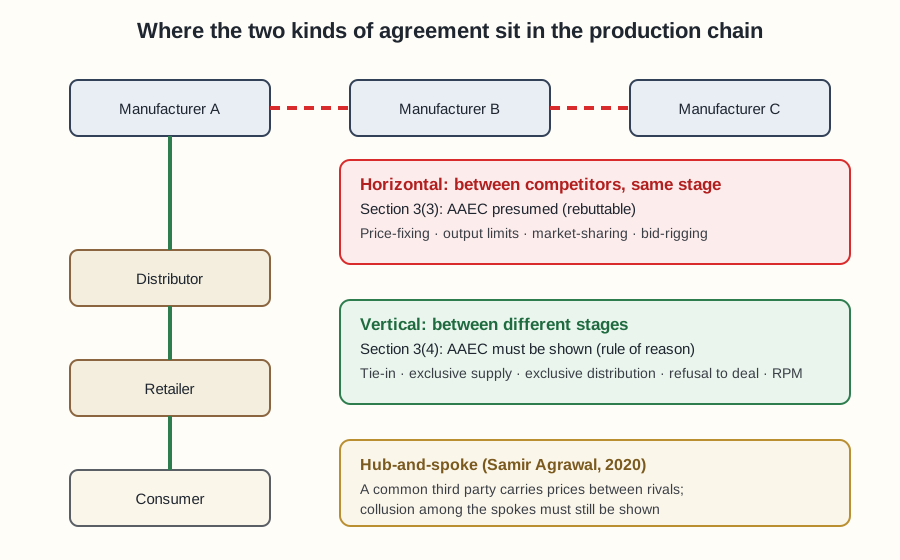
Section 3(3) applies to agreements between enterprises, persons or associations "engaged in identical or similar trade of goods or provision of services", including cartels, and to practices carried on or decisions taken by associations of them. It lists four kinds of agreement, those which:
- directly or indirectly determine purchase or sale prices;
- limit or control production, supply, markets, technical development, investment or provision of services;
- share the market or source of production by allocating areas, types of goods or services, or numbers of customers;
- directly or indirectly result in bid rigging or collusive bidding.
Such an agreement "shall be presumed to have an appreciable adverse effect on competition". Once the Commission shows an agreement of one of these kinds, it does not have to measure the harm. In Coordination Committee the Court said that such an agreement
"it is per se treated as adversely effecting the competition to an appreciable extent and comes within the mischief of sub-section (1)."
The reasoning is easy to follow. Rivals who agree on price, output, territory or bids have given up the very thing the Act protects, which is each firm's independent decision about how to compete. There is rarely an innocent reason for doing so, and the parties alone know why they did it.

Bid Rigging
The fourth clause is the one that most often reaches public money. The Explanation to Section 3(3) defines bid rigging as an agreement between competitors
"which has the effect of eliminating or reducing competition for bids or adversely affecting or manipulating the process for bidding."
Government tenders are where this bites. In CCI v. State of Mizoram (2022) the Commission was looking into collusive bidding for appointment as selling agents and distributors of the State's lotteries.
The High Court stopped the inquiry, reasoning that lotteries are a form of gambling, outside lawful trade, and so outside the Act. The Supreme Court reversed it:
"Lotteries may be a regulated commodity and may even be res extra commercium. That would not take away the aspect of something which is anti-competition in the context of the business related to lotteries."
The Commission was not regulating lotteries; it was examining the tender. The Court relied on the wide definition of "service" in Section 2(u), and held that a tendering process tainted by collusion cannot be shielded because of the nature of the business behind it.
Proving Collusion
The presumption only starts once an agreement is proved, and proof is where most cartel cases are won or lost. The standard is not proof beyond reasonable doubt. In Rajasthan Cylinders the Court said that direct evidence is rare and "The standard of proof which is required is one of probability".
The hardest problem is parallel conduct. Firms in the same market often charge similar prices for honest reasons: the same input costs, the same buyer, the same information. The Court adopted the European Court's approach in Dyestuffs. Parallel behaviour is not itself a concerted practice, but
"it may however amount to strong evidence of such a practice if it leads to conditions of competition which do not respond to the normal conditions of the market"
Two cases show the line from either side.
In Excel Crop Care, three makers of aluminium phosphide, a grain fumigant, quoted identical prices in tender after tender floated by the Food Corporation of India. When the FCI negotiated, all three cut their price by the same Rs. 2. They argued that identical prices are natural in a market with few sellers and one buyer. The Court said the "argument of parallelism is not applicable in bid cases", and added:
"There cannot be coincidence to such an extent that almost on all occasions price quoted by the three appellants is identical"
In Rajasthan Cylinders, makers of LPG cylinders had quoted identical or near-identical prices in an Indian Oil tender, and nineteen of them had met in Mumbai two days before bids were due. The Commission found bid rigging. The Supreme Court set the finding aside.
There were only three buyers, all public sector oil companies, with Indian Oil the largest; the cylinders were made to one fixed specification; steel made up about half the cost; and the Government tightly controlled supply and pricing. The Court held:
"the appellants have been able to discharge the onus by referring to various indicators which go on to show that parallel behaviour was not the result of any concerted practice."
It also faulted the Commission for not hearing the buyer: "in such a watertight tender policy of IOCL which gave IOCL full control over the tendering process, it was necessary to summon IOCL." Its conclusion was that "there is no sufficient evidence to hold that there was any agreement between the appellants for bid rigging."
The two results fit together. Identical bids can prove collusion where nothing else explains them. They prove little when the structure of the market explains them. The Commission has to look at that structure before it lets the presumption run.
Trade Associations
Section 3(3) expressly catches decisions of associations, and many Indian cases are about them. In Coordination Committee, bodies representing Bengali film producers, artists and technicians pressed television channels to stop telecasting a Bangla dubbed version of the serial Mahabharat. The technicians' body argued it was only a trade union.
The Court accepted that a trade union acting as such is not an enterprise, but found that these bodies were in substance associations of people engaged in making and distributing films. Their boycott limited supply:
"It amounted to creating barriers to the entry of new content in the said dubbed TV serial."
In Kerala Film Exhibitors Federation a federation of cinema owners told distributors not to supply films to a theatre that had fallen out with it. The Commission held this a violation of Section 3(1) read with Section 3(3)(b), and that finding was not disturbed on appeal.
The lesson from both cases is that a collective boycott does not need a price term. Restricting who may supply, or to whom, is a way of limiting supply and markets, and it falls in the presumed category when the members are rivals.
Hub and Spoke
A cartel does not always need competitors to talk to each other directly. In a hub-and-spoke arrangement each competitor deals with a common third party, and that party carries information or prices between them. The question came before the Court in Samir Agrawal v. CCI (2020), where an informant argued that Ola and Uber were hubs fixing fares for thousands of drivers through their pricing algorithms.
The Commission's order, set out in the judgment, drew the line:
"For a cartel to operate as a hub and spoke, there needs to be a conspiracy to fix prices, which requires existence of collusion in the first place."
Drivers who simply accepted the fare the app calculated had not agreed with each other on anything. The Court saw no reason to disturb the concurrent finding that the platforms did not facilitate cartelisation among drivers, who act independently of each other.
The case shows that a common pricing tool is not, by itself, a common agreement; what has to be found is coordination among the spokes, or an agreement that the hub will coordinate them.
Presumption, Not Per Se
Indian writing often borrows the American labels: agreements under Section 3(3) are called per se violations, and those under Section 3(4) are judged by the rule of reason. The Court itself used the phrase "per se" in Coordination Committee. But the Indian text is not a true per se rule. It is a rebuttable presumption, and Rajasthan Cylinders describes how it works:
"it need not undertake any further enquiry and burden would shift upon such enterprises or persons etc. to rebut the said presumption by leading adequate evidence."
A firm accused of a horizontal agreement can therefore lead evidence that the agreement had no appreciable adverse effect, and the Commission then returns to the Section 19(3) factors. The proviso to Section 3(3) adds a statutory exception: a joint venture is outside the presumption if it "increases efficiency in production, supply, distribution, storage, acquisition or control of goods or provision of services".
So the Indian scheme is best described in three steps. The Commission proves an agreement among competitors of a listed kind. The law presumes harm. The parties may rebut it. That is closer to a shifting of the burden than to an absolute ban.
Supply Chain Deals
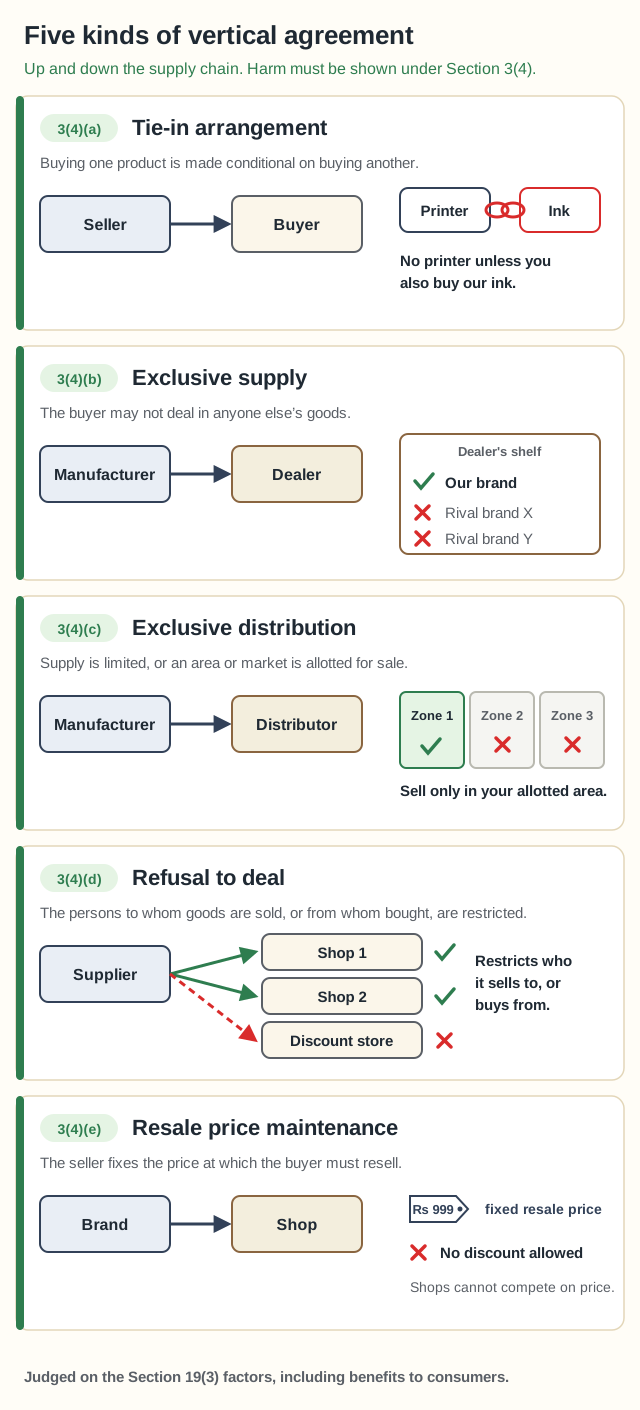
Section 3(4) deals with agreements among enterprises or persons "at different stages or levels of the production chain in different markets": a manufacturer and its distributor, a distributor and a retailer, a supplier of raw material and a factory. It names five kinds:
- Tie-in arrangement: the buyer must purchase some other goods as a condition of getting the goods it wants.
- Exclusive supply agreement: the buyer is restricted from acquiring or dealing in goods other than the seller's.
- Exclusive distribution agreement: output or supply is limited or withheld, or an area or market is allocated for sale.
- Refusal to deal: the persons to whom goods are sold, or from whom they are bought, are restricted.
- Resale price maintenance: goods are sold on condition that the resale price shall be the one the seller stipulates.
The list is illustrative; the word "including" leaves room for other vertical restraints. The consequence is worded differently from Section 3(3). Such an agreement
"shall be an agreement in contravention of sub-section (1) if such agreement causes or is likely to cause an appreciable adverse effect on competition in India."
There is no presumption. The Commission has to establish the harm, weighing the Section 19(3) factors on the facts. A car maker that insists its dealers buy spare parts only from it, or a brand that fixes the price at which shops may resell, may or may not be acting unlawfully; the answer depends on the market power behind the restraint and on what it does to rivals and buyers.
Why the Difference
| Point | Horizontal, Section 3(3) | Vertical, Section 3(4) |
|---|---|---|
| Parties | Competitors in identical or similar trade | Enterprises at different stages of the chain |
| Examples | Price-fixing, output limits, market sharing, bid rigging | Tie-in, exclusive supply, exclusive distribution, refusal to deal, resale price maintenance |
| Effect on competition | Presumed; rebuttable | To be shown from the Section 19(3) factors |
| Who must prove | The parties, once the agreement is found | The Commission |
The two standards follow from what each agreement usually does. Rivals who coordinate remove competition between themselves and gain nothing for the buyer. Firms at different stages are not rivals; a manufacturer generally wants its distributors to sell more, and a restraint that organises distribution can bring better service, wider reach or lower costs. Treating both alike would either let cartels escape or condemn ordinary business arrangements.
That is why the 2025 paper's statement, that Section 3 includes both kinds although horizontal ones are thought more harmful, contains no contradiction. Parliament placed both within one prohibition and then gave each a different burden of proof.
What Is Excluded
Section 3(5) leaves two rights untouched. The first is the right of any person to restrain infringement of, or to impose reasonable conditions to protect, rights under the Copyright Act, the Patents Act, the Trade Marks Acts, the Geographical Indications Act, the Designs Act and the Semi-conductor Integrated Circuits Layout-Design Act. The second is:
"the right of any person to export goods from India to the extent to which the agreement relates exclusively to the production, supply, distribution or control of goods or provision of services for such export."
The intellectual property exception is limited by the word "reasonable". A licence that protects a patent is safe; a licence that uses the patent as a lever to fix prices or tie unrelated goods goes beyond protection, and the exception does not cover the excess. The export exception reflects the Act's concern with competition within India: an export cartel's effect falls on foreign markets.
Who Can Complain
Section 19(1) lets the Commission act on its own motion, on a reference from a government or statutory authority, or on information from any person. In Samir Agrawal the Appellate Tribunal had held that only a person who had personally suffered could inform. The Supreme Court disagreed, holding that
"the CCI may receive information from any person and not merely from a person who is aggrieved by the conduct that is alleged to have occurred."
It noted that Section 45 punishes false or reckless information with a penalty of up to one crore rupees, and that the Commission can impose costs on frivolous informants. Since the Commission's work at this stage is inquisitorial, it said, the doors must be kept wide open in public interest. Cartels harm the public at large, and a narrow rule of standing would let many go unreported.
Penalties and Turnover
Section 27 lets the Commission direct the parties to discontinue the agreement and not re-enter it, to modify it, and to pay a penalty. Before the 2023 amendment, the ceiling under clause (b) was "not more than ten per cent. of the average of the turnover for the last three preceding financial years". For cartels the proviso went further:
"a penalty of up to three times of its profit for each year of the continuance of such agreement or ten per cent of its turnover for each year of the continuance of such agreement, whichever is higher."
The key question in Excel Crop Care was what "turnover" meant for a company that makes many products. The Commission had applied 9 per cent to total turnover; for one company that came to Rs. 252.44 crore, against a turnover of about Rs. 77 crore from the product in question. The Court held:
"it is the relevant turnover, i.e., turnover of the particular product which is to be taken into consideration and not total turnover of the violator."
It grounded this in proportionality: a penalty should not be disproportionate and "it should not lead to shocking results".
Parliament has since changed the text. Section 27, as amended and set out in Kerala Film Exhibitors Federation, speaks of "turnover or income", and its Explanation says turnover
"means global turnover derived from all the products and services by a person or an enterprise."
The 2017 ruling read the older wording. How far the new definition displaces the relevant-turnover rule is still to be settled by the Supreme Court.
Officers' Liability
A cartel is run by people, and Section 48 reaches them. Where a company, firm or association contravenes the Act, every person in charge of and responsible for its business is deemed guilty, unless the person proves that the contravention happened without their knowledge or despite all due diligence.
Under Section 48(3), a director, manager, secretary or other officer is also liable where the contravention occurred with their consent or connivance, or was due to their neglect.
Kerala Film Exhibitors Federation shows the provision at work. The Commission fined the federation 10 per cent of its average income, fined its president and general secretary 10 per cent of theirs, and barred both from its affairs for two years. The Appellate Tribunal upheld the finding against the federation but quashed the orders against the office-bearers, because they had not been given a separate notice on penalty. In 2025 the Supreme Court restored the Commission's order. On notice it said:
"There is no mandate in the statute for the issuance of a second show cause notice setting out the proposed penalty."
On the two-year bar, it treated the direction as part of the penalty on the enterprise:
"Stricto senso the penalty is on the enterprise and the corollary direction is a consequential direction to give effect to the penalty imposed on the enterprise."
The same office-bearers had been fined 7 per cent earlier for similar conduct without effect. The Court said "We do not find that the penalty is disproportionate", and accepted that only removing them from the federation's affairs would stop the conduct.
Open Questions
Section 3 is settled in its structure, but several points remain open.
Rebuttal in practice. The presumption under Section 3(3) can be rebutted, yet the cases say little about what evidence is enough. Rajasthan Cylinders shows that market structure can explain parallel bids; it does not tell us how far efficiency claims can save an agreement that is plainly about price.
Algorithms. Samir Agrawal was decided on the facts of ride-hailing, where each fare was set separately for each trip. Pricing software shared by competing sellers, or a platform that sets uniform prices for traders who would otherwise compete, may present a closer case.
Penalty base. The tension between the relevant-turnover rule of 2017 and the global-turnover Explanation now in Section 27 will need resolution, and proportionality will remain the Court's guide.
Vertical restraints. The Supreme Court has said much more about cartels than about tie-ins, exclusive dealing and resale price maintenance. The balance between the two halves of Section 19(3) in vertical cases has been worked out mostly by the Commission, not by the Court.
Common Doubts
Q: What is the difference between horizontal and vertical agreements under Section 3?
Horizontal agreements are between competitors and, if they fix prices, limit output, share markets or rig bids, are presumed to have an appreciable adverse effect on competition under Section 3(3). Vertical agreements are between enterprises at different stages of the chain and are unlawful under Section 3(4) only if that effect is shown.
Q: Is Section 3(3) a per se rule?
Not strictly. It raises a presumption of harm once an agreement of the listed kind is proved, and the parties may rebut it with evidence, as Rajasthan Cylinders explains. Efficiency-enhancing joint ventures are outside the presumption.
Q: Do identical bids prove a cartel?
Not by themselves. Identical bids supported a finding of collusion in Excel Crop Care, but in Rajasthan Cylinders the same pattern was explained by a market with few buyers and fixed specifications, and the finding failed.
Q: Can anyone file information about a cartel with the CCI?
Yes. In Samir Agrawal the Supreme Court held that information may come from any person, not only from someone personally harmed, with Section 45 penalties and costs as a check on false or frivolous information.
Sources: Competition Act, 2002, Sections 2, 3, 19, 27, 45 and 48, as set out in the judgments below; Excel Crop Care Ltd. v. Competition Commission of India (2017); Competition Commission of India v. Coordination Committee of Artists and Technicians of West Bengal Film and Television (2017); Rajasthan Cylinders and Containers v. Union of India (2018); Samir Agrawal v. Competition Commission of India (2020); Competition Commission of India v. State of Mizoram (2022); Competition Commission of India v. Kerala Film Exhibitors Federation (2025); commentary on administrative law, tribunals and regulatory bodies.