
On this page 20 sections
- What Article 368 Provides
- The Assembly's Choice
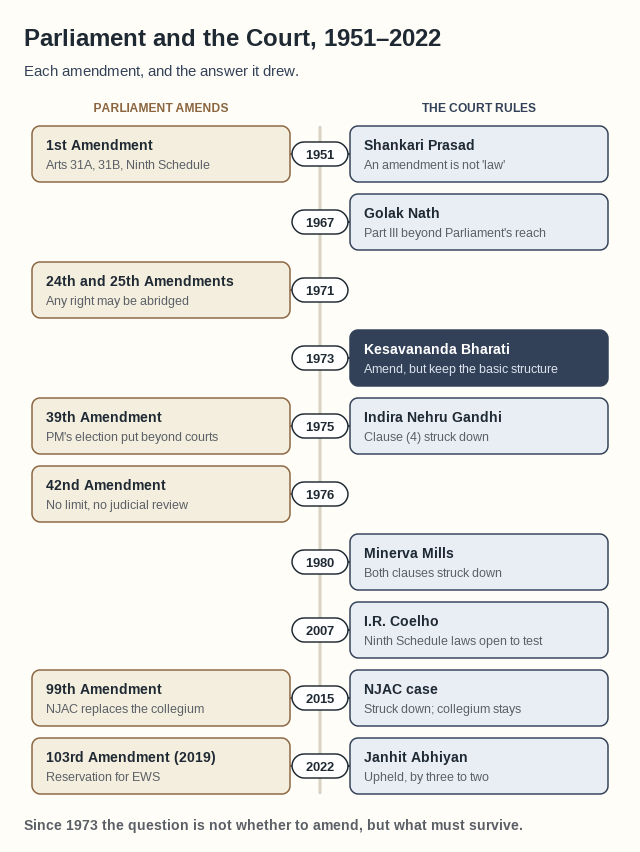
- Shankari Prasad, 1951
- Sajjan Singh, 1964
- Golak Nath, 1967
- Parliament's Answer
- Thirteen Judges, Eleven Opinions
- Why Amendment Has Limits
- Features Named by Judges
- The Election Case
- The Forty-Second Amendment
- Waman Rao's Cut-Off
- The Ninth Schedule Revisited
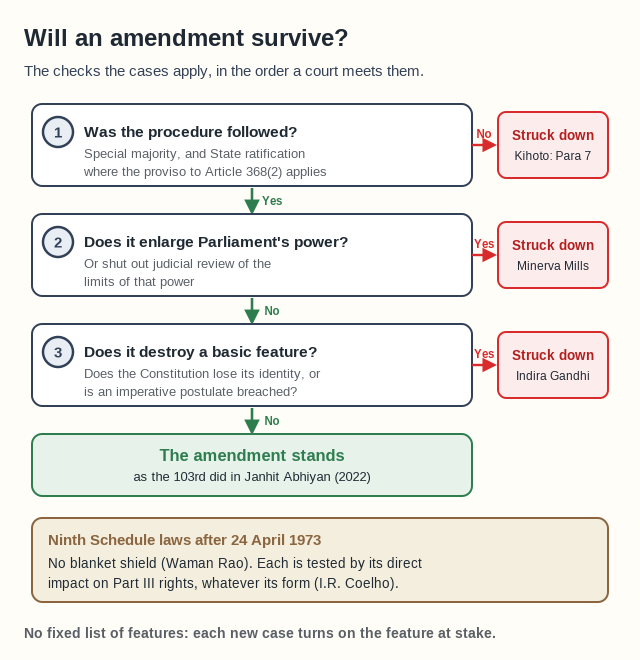
- Procedure as a Limit
- Applied Features at Work
- Judges and the Appointment Case
- Reservations and the Doctrine
- Tests Courts Apply
- Criticism and Open Questions
- Questions Readers Ask
Early in 1977 two clauses were added to Article 368. The first said that no amendment of the Constitution "shall be called in question in any court on any ground". The second declared that "there shall be no limitation whatever on the constituent power of Parliament to amend by way of addition, variation or repeal the provisions of this Constitution under this article."
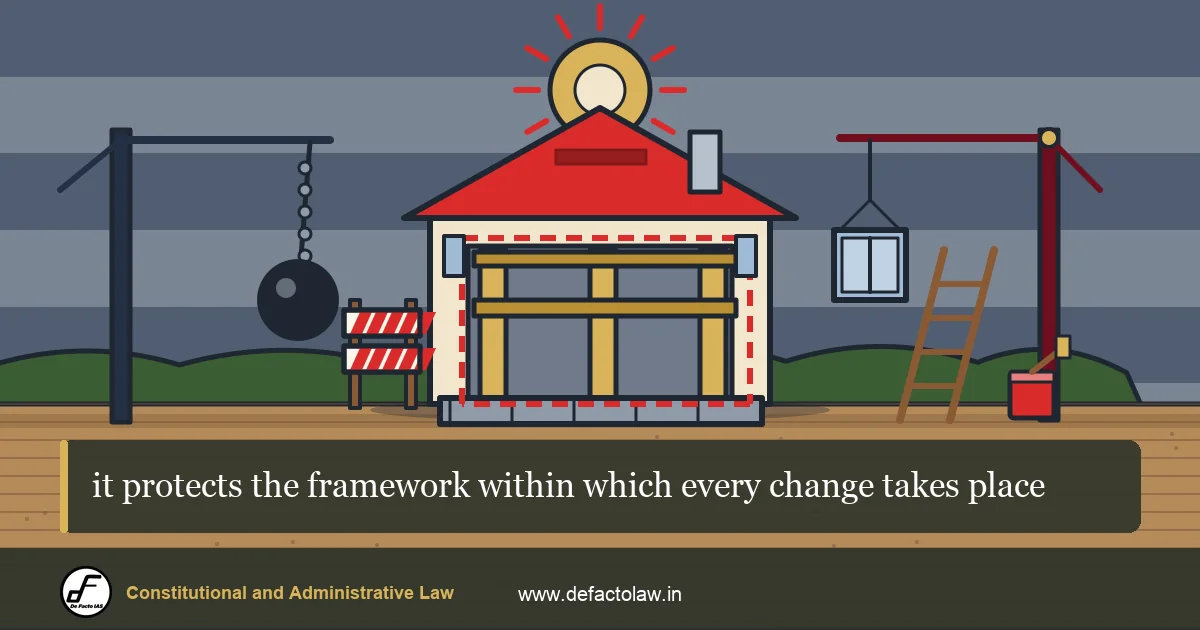
In 1980 the Supreme Court struck down both clauses. Its reason was not found in any article of the Constitution. It came from a doctrine the Court had built seven years earlier, out of the single word "amendment". This article follows that doctrine from the Constituent Assembly to the judgments of 2022: what Article 368 allows, the cases that fixed its limits, the features the judges have named, the tests used to apply them, and the criticism that still surrounds them. The doctrine does not stop Parliament from amending; it protects the framework within which every change takes place.
Cases at a glance 9
- Indira Nehru Gandhi v. Raj Narain
- Minerva Mills v. Union of India
- Waman Rao v. Union of India
- I.R. Coelho v. State of Tamil Nadu
- Kihoto Hollohan v. Zachillhu
- S.R. Bommai v. Union of India
- Raghunathrao Ganpatrao v. Union of India
- Supreme Court Advocates-on-Record Association v. Union of India
- Janhit Abhiyan v. Union of India
What Article 368 Provides
Article 368 stands alone in Part XX. Its first clause, in the form given by the Twenty-fourth Amendment of 1971, reads:
"Notwithstanding anything in this Constitution, Parliament may in exercise of its constituent power amend by way of addition, variation or repeal any provision of this Constitution in accordance with the procedure laid down in this article"
The procedure has a fixed order. An amendment can be started only by a Bill in either House of Parliament, never in a State legislature. The Bill must be passed by each House separately, by a majority of the total membership of that House and by two-thirds of the members present and voting. If it touches the federal provisions, half of the State legislatures must also ratify it. The President then gives assent, and he cannot withhold it.
Not everything needs this special route. The Constitution can be changed in three ways:
- by a simple majority of Parliament, outside Article 368, for matters such as new States, Legislative Councils, citizenship and the Fifth and Sixth Schedules;
- by the special majority of Article 368(2), which covers most of the Constitution, including the Fundamental Rights;
- by the special majority plus ratification by half of the States, for the election of the President, the Supreme Court and High Courts, the distribution of legislative power, the Seventh Schedule lists, State representation in Parliament and Article 368 itself.
Article 368 prescribes the procedure and the majority. It does not say what an amendment may not do. The whole doctrine of basic structure is an answer to that silence.
The Assembly's Choice
The framers knew they were leaving this question open, and they discussed it. On 17 September 1949, answering critics who wanted the Constitution to be amendable by a bare majority, Dr. Ambedkar explained the three categories of articles and defended the procedure. He gave the reason for a harder route in one sentence:
"the purpose of a Constitution is not merely to create the organs of the State but to limit their authority"
Answering the complaint that the Assembly had not been elected on adult suffrage, and so could not bind the future, he said:
"Power and knowledge do not go together. Oftentimes they are dissociated"
On the same day the Assembly voted down an amendment that would have opened Article 304, the draft of Article 368, with the words "Any provision of this Constitution may be amended, whether by way of variation, addition or repeal, in the manner provided in this article". Words to the same effect entered Article 368 only in 1971, through the Twenty-fourth Amendment.
The other side of the Assembly's thinking was flexibility. Pandit Nehru told the House on 8 November 1948:
"while we want this Constitution to be as solid and as permanent a structure as we can make it, nevertheless there is no permanence in Constitutions. There should be a certain flexibility."
At the close of its work, Dr. Ambedkar said that the Assembly had refused to put a seal of finality on the Constitution and had "provided a most facile procedure for amending the Constitution". That word was put to candidates in 2025, together with the question whether the doctrine of basic structure significantly limits Article 368.
So the debates do not settle the matter either way. They show a deliberate choice of a procedure neither rigid nor easy, and a Constitution described as a document that limits the organs of the State. Both sides of the later litigation found support in them.
Shankari Prasad, 1951
The first test came early. The Constitution (First Amendment) Act, 1951 inserted Articles 31A and 31B and the Ninth Schedule, to protect land reform laws from challenge. The petitioners argued that Article 13(2) forbids the State to make any law that takes away or abridges the Fundamental Rights, that Parliament is part of the State, and that "law" must therefore include a constitutional amendment.
The Court rejected the argument and drew a line between two kinds of law:
"there is a clear demarcation between ordinary law, which is made in exercise of legislative power, and constitutional law, which is made in exercise of constituent power."
It added that the power of amendment, "though it has been entrusted to Parliament, has been so hedged about with restrictions that its exercise must be difficult and rare." Article 13(2) therefore did not touch amendments made under Article 368. The Court also held that the new articles needed no ratification by the States.
They did not, in terms or in effect, change the High Courts' power under Article 226; they only removed a class of cases from the reach of Part III, so that there would be no occasion for that power to be used.
Sajjan Singh, 1964
The Seventeenth Amendment of 1964 amended Article 31A again and added forty-four State Acts to the Ninth Schedule. Writ petitions challenged it. Three judges of a Bench of five held that there was no ground to reconsider Shankari Prasad; the Constitution is an organic document, but earlier decisions should not be lightheartedly reviewed.
On the proviso to Article 368, the Court applied the test of pith and substance: the amendment touched Article 226 only incidentally, so ratification was not needed.
Two of the five judges, though they agreed with the order, saw a larger issue coming. Justice Hidayatullah wrote:
"I would require stronger reasons than those given in Sankari Prasad's case to make me accept the view that Fundamental Rights were not really fundamental"
Justice Mudholkar went further and raised the idea in a form close to the doctrine. Pointing to the Preamble, the oaths of office and the fact that the Constituent Assembly had made the Constitution, he asked:
"It is also a matter for consideration whether making a change in a basic feature of the Constitution can be regarded merely as an amendment or would it be, in effect, rewriting a part of the Constitution"
He also noted that the Supreme Court of Pakistan had held franchise and form of government to be fundamental features that a delegated power could not alter. The question was left open in 1964. It did not stay open for long.
Golak Nath, 1967
The Seventeenth Amendment came up again before a Bench of eleven judges, constituted to consider whether Shankari Prasad was rightly decided. This time the Court, led by Chief Justice Subba Rao, reversed it.
The reasoning had three steps. First, Article 368 laid down only a procedure; the power to amend came from Parliament's legislative power, including the residuary power under Article 248. Secondly, an amendment is a "law" within Article 13(2). Thirdly, the Fundamental Rights occupy a special place:
"fundamental rights are given a transcendental position under our Constitution and are kept beyond the reach of Parliament."
The Court did not undo the past. It applied the doctrine of prospective overruling, and declared that its decision would not affect the Seventeenth Amendment or other earlier amendments:
"in future Parliament will have no power to amend Part III of the Constitution so as to take away or abridge the fundamental rights."
Justice Wanchoo, dissenting, thought it doubtful that any other body, even a newly convened Constituent Assembly, could amend the Constitution outside Article 368. Commentary on the case notes that the majority's rule was a policy choice, made after the Fundamental Rights had been amended repeatedly since 1950, and that it left Parliament with no route to amend them except a fresh Constitution.
The Court also said nothing about the other Parts of the Constitution, so Golak Nath protected one Part and no more.
Parliament's Answer
Parliament answered with three amendments in quick succession.
- The Twenty-fourth Amendment (1971) amended Articles 13 and 368. It declared that Parliament may abridge or take away any Fundamental Right under Article 368, and that such an amendment is not a "law" under Article 13.
- The Twenty-fifth Amendment (1971) changed Article 31(2), replacing "compensation" with "amount", and inserted Article 31C. That article protected laws giving effect to the Directive Principles in Article 39(b) and (c) from challenge under Articles 14, 19 and 31.
- The Twenty-ninth Amendment (1972) placed two Kerala land reform Acts in the Ninth Schedule.
Swami Kesavananda Bharati, head of a mutt in Kerala, challenged these changes by a petition under Article 32. The result was a Bench of all thirteen judges then on the Court.
Thirteen Judges, Eleven Opinions
The Bench of thirteen judges heard arguments for more than sixty days, and eleven opinions were delivered on 24 April 1973. The judges did not speak with one voice, and the Court recorded a short statement of the majority view. Its second point was that Article 368 does not enable Parliament to alter the basic structure or framework of the Constitution. Justice Khanna's own summary put it in these words:
"The power of amendment under Article 368 does not include power to abrogate the Constitution nor does it include the power to alter the basic structure or framework of the Constitution."
The statement of the majority view also recorded that Golak Nath was overruled; that the Twenty-fourth Amendment is valid; that the first part of Section 3 of the Twenty-fifth Amendment, which inserted Article 31C, is valid but its second part is invalid; and that the Twenty-ninth Amendment is valid. The majority consisted of seven judges, as the Court itself later counted.
Two things are worth stating at the outset. The Court did not strip Parliament of the power to amend Fundamental Rights; it restored that power. And it did not make any Part unamendable. What it did was to read a limit into the word "amendment" itself.
Why Amendment Has Limits
The judges reached the limit by different routes. Chief Justice Sikri held that "amendment" in Article 368 has a limited meaning. He summed up the result as follows:
"The expression 'amendment of this Constitution' does not enable Parliament to abrogate or take away, fundamental rights or to completely change the fundamental features of the Constitution so as to destroy its identity."
Justices Hegde and Mukherjea reasoned from the nature of the document:
"one cannot legally use the Constitution to destroy itself. Under Article 368 the amended Constitution must remain 'the Constitution' which means the original Constitution."
Justice Khanna, one of the seven in the majority, made the point from the word itself:
"The word 'amendment' postulates that the old Constitution survives without loss of its identity despite the change and continues even though it has been subjected to alterations."
He concluded that what survives is the "basic structure or framework", and he gave examples of changes no amendment could make: turning democratic government into a dictatorship or hereditary monarchy, abolishing the Lok Sabha and the Rajya Sabha, or doing away with the secular character of the State. He added that Article 368 is not to be read to "embody the death wish of the Constitution".
Justice Ray, in the minority, took the plain text. In his view the article imposes no limit on what may be amended, and "It is not permissible to add to Article 368 words of limitation which are not there."
Features Named by Judges
The majority did not provide a complete list. Each judge gave examples, and the examples overlap without matching. The table is drawn from the opinions themselves, as summarised by Justice Chandrachud in 1975, with Justice Khanna's examples added from his own judgment:
| Judge or judges | Features named |
|---|---|
| Sikri, C.J. | Supremacy of the Constitution; republican and democratic form of government; secular character; separation of powers; federal character; all built on the dignity and freedom of the individual |
| Shelat and Grover, JJ. | The same, with the mandate to build a welfare State and the unity and integrity of the nation |
| Hegde and Mukherjea, JJ. | Sovereignty of India, democratic character of the polity, unity of the country, essential features of individual freedoms, and the mandate to build a welfare State |
| Khanna, J. | Democratic government, both Houses of Parliament, secular character; the right to property is not part of the basic structure |
Two of these passages are worth reading in the judges' own words. Sikri C.J. wrote that the structure rests on a foundation: "the dignity and freedom of the individual. This is of supreme importance." And Shelat and Grover JJ. said of their list that its features "cannot be catalogued but can only be illustrated".
Justice Khanna also held that no part of a Fundamental Right could claim immunity by being described as its essence or core, and that the right to property does not pertain to the basic structure. Article 31 itself was later deleted by the Forty-fourth Amendment, as the Court noted in 1980.
Justice Chandrachud, writing two years later, explained why the absence of a fixed list does not matter:
"The ratio of the majority decision is not that some named features of the Constitution are a part of its basic structure"
It is rather, he said, that the power of amendment cannot be exercised so as to damage or destroy the essential elements or the basic structure, whatever those expressions may comprehend. The doctrine is a limit on the power, applied case by case.
The Election Case
The doctrine was tested within two years. The Allahabad High Court had set aside Prime Minister Indira Gandhi's election to the Lok Sabha. Parliament responded with the Thirty-ninth Amendment, which inserted Article 329A. Its clause (4) withdrew the election of a Prime Minister or Speaker from the scope of any court, declared the Prime Minister's own election valid, and ended the pending appeal.
In Indira Nehru Gandhi v. Raj Narain (1975) the Court struck clause (4) down, though the judges gave separate reasons. Justice Khanna tied it to democracy, a feature on which all seven judges of the Kesavananda majority were agreed:
"Democracy further contemplates that the elections should be free and fair, so that the voters may be in a position to vote for candidates of their choice."
He then stated the test for any later amendment:
"What has to be seen in such a matter is whether the amendment contravenes or runs counter to an imperative rule or postulate which is an integral part of the basic structure of the Constitution."
An amendment affecting one case only was not saved by the fact that the rest of the Constitution stood untouched. Justice Chandrachud, for his part, named four pillars:
"These, in my opinion, are the pillars of our constitutional philosophy, the pillars, therefore, of the basic structure of the Constitution."
His four were a sovereign democratic republic; equality of status and opportunity; the State having no religion of its own, with freedom of conscience for all; and a government of laws, not of men. The case added free and fair elections to the working list of features, and Justice Chandrachud's remark meant that no list drawn in 1973 binds a later Bench.
The Forty-Second Amendment
The Forty-second Amendment of 1976 was the most direct reply to the doctrine. Section 55 inserted the two clauses of Article 368 that open this article. Section 4 widened Article 31C so that a law giving effect to any of the Directive Principles in Part IV, not merely Article 39(b) and (c), would be protected from challenge under Articles 14 and 19.
In Minerva Mills v. Union of India (1980) the Court struck down both. On the new clauses of Article 368 it was unanimous. Chief Justice Chandrachud began from the Kesavananda ruling:
"Since the Constitution had conferred a limited amending power on the Parliament, the Parliament cannot under the exercise of that limited power enlarge that very power into an absolute power."
He then said what the Kesavananda majority had in effect told Parliament:
"Amend as you may even the solemn document which the founding fathers have committed to your care, for you know best the needs of your generation. But, the Constitution is a precious heritage; therefore, you cannot destroy its identity."
On clause (5), the Court was brief: "The power to destroy is not a power to amend." On clause (4), Justice Bhagwati gave the practical reason. The provision would make an amendment unchallengeable even if it was passed without the special majority, though it had been common ground in Kesavananda that "any amendment of the Constitution which did not conform to the procedure prescribed by Sub-Clause (2) and its proviso was no amendment at all". Two features were thus protected: the limited amending power and judicial review.
Article 31C divided the Court. By a majority of four to one, the enlarged Article 31C was struck down because it gave Part IV priority over Articles 14 and 19. The Court held that the Constitution rests on a balance between Parts III and IV:
"This harmony and balance between fundamental rights and directive principles is an essential feature of the basic structure of the Constitution."
It also described Articles 14, 19 and 21 as the "golden triangle" that stands between freedom and "the abyss of unrestrained power". Justice Bhagwati dissented on this point, holding that the Directive Principles and Fundamental Rights are of equal rank and that the amendment did not disturb their balance.
Waman Rao's Cut-Off
Parliament had by then placed a large number of laws in the Ninth Schedule. Waman Rao v. Union of India (1980) decided how far the doctrine reached backward. Amendments made before 24 April 1973, the date of Kesavananda, stood protected: land titles had changed on the faith of the Ninth Schedule, and the Court would not unsettle them.
The theory that Parliament cannot damage the basic structure, it said, had been accepted for the first time in Kesavananda.
The position after that date was different. Additions to the Ninth Schedule on or after 24 April 1973 would not receive blanket protection from Article 31B, because "there was no justification for making additions to the Ninth Schedule with a view to conferring a blanket protection on the laws included therein". Such amendments are valid "only if they do not damage or destroy the basic structure of the Constitution".
The Court also upheld Articles 31A and 31B and the first part of Article 31C as it stood before the Forty-second Amendment, and said that Justice Khanna's statement on the Fundamental Rights had been misunderstood to mean that no Fundamental Right can form part of the basic structure.
The Ninth Schedule Revisited
That left the testing of Ninth Schedule laws unsettled until 2007. I.R. Coelho v. State of Tamil Nadu (2007), decided by a Bench of nine judges, answered it. The Court said that the authority that enacts a law cannot also decide the limits of its own power:
"The authority to enact law and decide the legality of the limitations cannot vest in one organ."
It held that laws placed in the Ninth Schedule after 24 April 1973 are open to challenge on the touchstone of the basic features reflected in Article 21 read with Articles 14, 19 and 15. The test it adopted looks to effect, not form:
"the form of an amendment is not the relevant factor, but the consequence thereof would be determinative factor."
The Court called this the "direct impact and effect" test, or the rights test, and added an "essence of the right" test for individual Fundamental Rights. It warned that a power to give immunity "at will, on fictional basis, without full judicial review, will nullify the entire basic structure doctrine".
Where a Ninth Schedule law had already been upheld, it could not be reopened on these principles, and transactions finalised under the Acts were left undisturbed.
Procedure as a Limit
The doctrine is not the only limit on Article 368. The proviso's requirement of ratification by the States is a limit of procedure, and the Court enforces it. In Kihoto Hollohan v. Zachillhu (1992) the Court upheld the Tenth Schedule, the anti-defection law, against a challenge that it destroyed a basic feature of parliamentary democracy.
But it found that Paragraph 7, which barred courts from questioning decisions on disqualification, took away the High Courts' and the Supreme Court's jurisdiction under Articles 226, 227 and 136. That attracted the proviso to Article 368(2), and the Bill had not been ratified.
The majority held that Paragraph 7 was "declared invalid for want of ratification in terms of and as required by the proviso to Article 368 (2) of the Constitution", and that it could be severed from the rest of the Schedule. Two judges would have held the whole Amendment invalid for the same defect. The case shows that an amendment can fail either because its content is forbidden or because its procedure was not followed.
Applied Features at Work
Features recognised by the doctrine have also guided decisions outside Article 368. In S.R. Bommai v. Union of India (1994), on the imposition of President's rule under Article 356, the Court said:
"Democracy and federalism are the essential features of our Constitution and are part of its basic structure."
The Court also took secularism, which Kesavananda had counted among the basic features, as part of the basic structure when it considered how Article 356 may be used against a State government.
The doctrine has not always succeeded. In Raghunathrao Ganpatrao v. Union of India (1993), the petitioners argued that the Twenty-sixth Amendment of 1971, which abolished the privy purses of former rulers, had damaged the basic structure. The Court dismissed the petitions. It held that the abolition did not violate Article 14, and ended by observing that "the impugned amendment is the will of the people expressed through Parliament".
The Court treated the challenge as a question about the limits of the power, not as a review of whether the amendment was wise.
Judges and the Appointment Case
The next major test came in 2015. The Ninety-ninth Amendment and the National Judicial Appointments Commission Act, 2014 replaced the collegium with a Commission that included the Law Minister and two "eminent persons" beside the Chief Justice and senior judges. Five judges heard the challenge in Supreme Court Advocates-on-Record Association v. Union of India (2015).
The Court declared the amendment and the Act unconstitutional and void, and held that the collegium system would continue. Justice Khehar found the clause on eminent persons "clearly unsustainable, in the scheme of 'independence of the judiciary'" and violative of the basic structure. Justice Lokur said that the amendment "unconstitutionally minimizes the role of the Chief Justice of India and the judiciary to a vanishing point in the appointment of judges".
Justice Chelameswar dissented. A judgment of 2022 calls his opinion a powerful dissent and quotes the propositions he drew from the case law. One was that none of the earlier cases "specified or declared what is the basic structure of the Constitution", and another that "There is no universally applicable test vis-à-vis all the basic features." Both describe the present state of the law fairly.
Reservations and the Doctrine
The most recent major application was the One Hundred and Third Amendment of 2019, which inserted clauses (6) in Articles 15 and 16 to permit reservation for economically weaker sections. Five judges decided Janhit Abhiyan v. Union of India on 7 November 2022, and divided three to two.
For the majority, Justice Maheshwari held that reservation "structured singularly on economic criteria does not violate any essential feature of the Constitution of India and does not cause any damage to the basic structure". The exclusion of classes already covered by Articles 15(4), 15(5) and 16(4) did not breach the equality code either. Justices Trivedi and Pardiwala agreed.
The minority view, by Justice Bhat with the Chief Justice, was that economic criteria are permissible for Article 15, though not for Article 16, whose goal is representation; and that the total exclusion of backward classes, and most acutely the Scheduled Castes and Scheduled Tribes, struck at equality.
It held the amendment violative of "the equality code, particularly the principle of non-discrimination and non-exclusion which forms an inextricable part of the basic structure of the Constitution". The case shows how a feature such as equality can lead judges to opposite results on the same amendment.
Tests Courts Apply
The cases yield no single formula, but they do give working tests.
| Test | Question asked | Source |
|---|---|---|
| Identity | Does the change leave the Constitution with its identity, or replace it? | Kesavananda Bharati (1973) |
| Imperative postulate | Does the amendment run counter to a postulate that is integral to the basic structure? | Indira Nehru Gandhi (1975) |
| Limited power | Does Parliament enlarge its own power, or oust judicial review of the limits of that power? | Minerva Mills (1980) |
| Date of amendment | Was the Ninth Schedule amendment made on or after 24 April 1973? | Waman Rao (1980) |
| Direct impact and effect | What is the actual effect on Part III rights, whatever the form? | I.R. Coelho (2007) |
| Procedure | Was the special majority, and where needed State ratification, obtained? | Kihoto Hollohan (1992) |
As Justice Chelameswar put it, the abrogation of one basic feature results normally, but not always, in the destruction of the basic structure, and how far a feature may be altered depends on the feature and the context.
Criticism and Open Questions
Commentary on the doctrine runs along three lines.
Vagueness. The phrases "fundamental features" and "abrogation" are not defined, and the list of features keeps growing. Critics say that this gives judges wide room. Supporters reply that the list was left open on purpose, since the Court had to decide each case on its own facts. The restriction on Parliament, they add, is more notional than real, because no Parliament would try to destroy the Constitution outright.
Judicial creativity. No article names a basic structure. The doctrine was a policy decision by judges to protect core values against a transient majority, and commentary calls the Kesavananda decision a high point of judicial creativity. Commentary also regards Kesavananda as an improvement on Golak Nath in two ways: it extended protection beyond Part III, and it did not freeze every Fundamental Right. The right to property, for instance, was not treated as basic and was abrogated.
Democratic legitimacy. Parliament is elected, the Court is not. The case for the doctrine is that a two-thirds majority in the legislature is not the same as the national consensus on which the Constitution rests, and that the majority judges made a conscious choice to protect core values against a passing majority. The Assembly's own record gives each side something: it refused to declare every provision amendable, yet it chose a procedure it called facile.
Several points remain open. No list of basic features exists, and each new case adds to the working list. The Court has said that the abrogation of one feature normally, not always, destroys the structure, so each case turns on the feature and the context.
In 2007 the Court said that "The greater the invasion into essential freedoms, greater is the need for justification and determination by court whether invasion was necessary and if so to what extent", which makes the degree of interference a question for judges.
And the same doctrine that struck down the amendments of 1975, 1976 and 2014 was used in 2022 by three judges to uphold one and by two to strike it down, which shows how much room remains for judgment.
Questions Readers Ask
Q: Can Parliament amend the Fundamental Rights?
Yes. Golak Nath said it could not, but Kesavananda overruled that. Parliament can amend any Fundamental Right, so long as the amendment does not damage or destroy the basic structure.
Q: Is there an official list of basic features?
No. Each judge in Kesavananda gave examples, and later cases added features such as free and fair elections, judicial review, the limited amending power and the balance between Parts III and IV. Chelameswar J. observed in the NJAC case that none of the earlier cases specified what the basic structure is.
Q: Does the doctrine apply to ordinary laws?
No. It limits only the constituent power under Article 368. Ordinary laws are tested against the Constitution as it stands, including its Fundamental Rights.
Q: Why does 24 April 1973 matter?
It is the date of Kesavananda. Under Waman Rao, Ninth Schedule laws protected before that date remain protected, while additions on or after it are open to challenge on the basis of the basic structure.
Sources: Constitution of India, Article 368 as amended; Constituent Assembly Debates, 8 November 1948, 17 September 1949 and 25 November 1949; Sri Sankari Prasad Singh Deo v. Union of India (1951); Sajjan Singh v. State of Rajasthan (1964); I.C. Golak Nath v. State of Punjab (1967); Kesavananda Bharati Sripadagalvaru v. State of Kerala (1973); Indira Nehru Gandhi v. Raj Narain (1975); Minerva Mills Ltd. v. Union of India (1980); Waman Rao v. Union of India (1980); Kihoto Hollohan v. Zachillhu (1992); Raghunathrao Ganpatrao v. Union of India (1993); S.R. Bommai v. Union of India (1994); I.R. Coelho v. State of Tamil Nadu (2007); Supreme Court Advocates-on-Record Association v. Union of India (2015); Janhit Abhiyan v. Union of India (2022); commentary on the amendment of the Constitution and the basic structure.