
On this page 14 sections
Administrative power in India is checked in three ways. Parliament and the State legislatures question and debate; the courts review legality; and, in between, an Ombudsman looks into the individual complaint that the legislature has no time for and the court has no cause to hear. The Lokpal and Lokayuktas Act, 2013 is India's statute for that middle layer, aimed at corruption among the highest public functionaries.
The Act received the President's assent on 1 January 2014 and came into force on 16 January 2014. This article follows the questions UPSC has built around it: what an Ombudsman is, where the Indian institution comes from, what the Act provides, how it compares with the CVC and the CBI, and why its record is mixed.
Cases at a glance 5
The Ombudsman Idea
Sweden created the first Ombudsman in 1809. "Ombud" is a Swedish word for one who acts as another's representative, and the officer was appointed by the legislature to handle complaints against administrative action. The Swedish Ombudsman could act on a complaint or on his own initiative, had access to official files, and reported to the Parliament. He could not reverse a decision; he reported the matter to the higher authorities for corrective action.
The idea spread to Finland, Denmark and Norway, and New Zealand became the first Commonwealth country to adopt it, in 1962. The Swedish institution had a few marks that every later copy is measured against: independence from the executive, impartial investigation, power to start an inquiry on its own, access to files, a duty to report to the legislature rather than to the executive, and a cheap, simple procedure.
The reason for the office is the modern welfare State. As the bureaucracy grows and discretion multiplies, abuse of discretion, delay, nepotism and bribery multiply with it, and the citizen's grievance has no ready forum. The Supreme Court felt this need in the 1990s, when it asked for a body above the executive to deal with high-level corruption. In Shri Dinesh Trivedi v. Union of India (1997) it said:
"An institution like the Ombudsman or a Lokpal, properly set up, could command such confidence and respect."
The Legislature's Long Arm
The 2026 paper quoted the line that an Ombudsman is the projection of the legislative function of supervising the administration, and asked candidates to elucidate it with Indian examples. The question looks like it expects you to test the line, not just repeat it. It is true of the Swedish model, which is appointed by the legislature and answers to it. It is only partly true of India.
Consider what the line assumes. The legislature supervises the administration through questions, committees and debate, but it does so as a body and on matters of policy. It cannot follow one file. The Ombudsman does that work for it, and is accountable to it. Two Indian examples show how far the Indian institutions fit.
- State Lokayuktas: the Madhya Pradesh Lokayukt organisation described itself, in a passage quoted in Special Police Establishment v. Kamta Prasad Mishra (2026), as one that "functions as an instrument of control over the executive by the legislature as its annual reports are submitted to the Governor to be laid and discussed in the State Legislative Assembly".
- The Lokpal: it is not appointed by the House but by the President on the recommendation of a committee in which the Prime Minister, the Speaker, the Leader of the Opposition, the Chief Justice of India or his nominee and an eminent jurist sit together. It supervises the executive and Parliament's own members alike.
The marks go to the candidate who shows both sides: the Ombudsman as an extension of legislative supervision, and the Indian Lokpal as a hybrid that also borrows from judicial independence and from the investigating agencies.
Where the Roots Lie
The 2025 paper opened with the claim that Lokpal and Lokayukta have roots in Indian governance culture, and asked the candidate to explain it and to show how the 2013 Act ensures accountability. The two limbs call for different answers, and the first needs care.
The institutional record is clear. The Administrative Reforms Commission, in its interim report of 20 October 1966 on the problems of redressal of citizens' grievances, proposed two authorities, a Lokpal at the Centre and a Lokayukta in each State, on the pattern of the Scandinavian Ombudsman and New Zealand's Parliamentary Commissioner. The names were coined for the Indian idiom; the model was imported.
The material I rely on does not trace the office to an ancient Indian ancestor, and a candidate should not invent one.
What can honestly be said is that the institution grew from Indian conditions. Before 1966 the country had the Public Servants (Enquiries) Act, 1850, the Special Police Establishment of 1941, the Commissions of Inquiry Act, 1952 and the Santhanam Committee's vigilance machinery, and still found no independent forum for complaints against Ministers. The Ombudsman was adopted because those older arrangements were sitting within the executive. In that sense the roots are in the Indian demand for an answerable government, and the form is borrowed.
The Long Road
The Administrative Reforms Commission wanted the Lokpal to be demonstrably independent and impartial, to work in private and informally, to rank with the highest judicial functionaries, and to be free of judicial interference. It recommended that the office have constitutional status. It also wanted matters of policy kept outside its reach.
Bills followed. The first was introduced in May 1968, and further Bills came in 1971, 1977, 1985, 1989, 1996, 1998, 2001 and 2011. The Statement of Objects and Reasons records that the earlier Bills lapsed with the dissolution of the Lok Sabha, except the 1985 Bill, which was withdrawn after introduction.
The final push came in 2011. The Government set up a Joint Drafting Committee on 8 April 2011 and introduced the Lokpal Bill, 2011 on 4 August 2011. The Standing Committee reported on 9 December 2011, recommending that the Lokpal and Lokayuktas be given constitutional status. The 2011 Bill was withdrawn and a revised one was brought; the Act that finally passed made them statutory bodies.
Objectives
Question 4(b) of the 2023 paper asked for the objectives of the Lokpal and Lokayukta, their powers and functions under the Act, and the effectiveness of the Act. It is a three-part question, and the objectives are the quickest marks.
The Act's long title and Statement of Objects give them. The Act is meant to establish a Lokpal for the Union and Lokayuktas for the States to inquire into allegations of corruption against certain public functionaries. It gives effect to the Administrative Reforms Commission's recommendation, and it gives effect to the United Nations Convention against Corruption, which India ratified on 9 May 2011. The Statement of Objects says the Bill seeks to establish
"a more effective mechanism to receive complaints relating to allegations of corruption against public servants"
The public servants named there include Ministers, Members of Parliament, Chief Ministers and Members of Legislative Assemblies, and the mechanism is to inquire into the complaints and take follow-up action.
In 2026 the Supreme Court summed up the purpose as clean and responsive governance, prompt and fair investigation, and prosecution in cases of corruption.
Composition
Section 3 sets up the body. The Lokpal has a Chairperson and not more than eight Members. The Chairperson is or has been the Chief Justice of India or a Judge of the Supreme Court, or an eminent person who meets the test for a non-judicial Member. The Act fixes the judicial share in one line:
"such number of Members, not exceeding eight out of whom fifty per cent shall be Judicial Members"
A proviso requires that not less than half of the Members belong to the Scheduled Castes, the Scheduled Tribes, Other Backward Classes, minorities and women.
- Judicial Member: a sitting or former Judge of the Supreme Court or a Chief Justice of a High Court.
- Other Member: a person of impeccable integrity and outstanding ability, with at least twenty-five years' expertise in anti-corruption policy, public administration, vigilance, finance or law and management.
- Disqualifications: a Member of Parliament or of a State Legislature, a person convicted of an offence involving moral turpitude, a person under forty-five, a member of a Panchayat or Municipality, and a person dismissed from service. The holder may not hold an office of profit, belong to a party, or carry on a business or profession.
Section 4 provides that the President appoints the Chairperson and Members on the recommendation of a Selection Committee: the Prime Minister (Chairperson), the Speaker, the Leader of the Opposition in the Lok Sabha, the Chief Justice of India or a Judge nominated by him, and an eminent jurist nominated by the President on the recommendation of the first four. A Search Committee assists the Selection Committee.
Jurisdiction
Section 14 states whose conduct the Lokpal may examine. It covers a present or former Prime Minister, Union Ministers and Members of either House, Group A and B officers and Group C and D officials of the Union, and office-bearers of bodies set up by Parliament or financed or controlled by the Centre.
It also reaches trusts and societies that receive foreign donations above ten lakh rupees in a year under the Foreign Contribution (Regulation) Act, 2010.
The reach is limited by three provisions. A Member of Parliament cannot be examined for anything said or voted in Parliament, which preserves Article 105(2). A complaint relates only to the period in which the person was a public servant. And the Lokpal cannot refer a matter it has received to a Commission of Inquiry. Institutions that are merely aided by the Government stay outside the Act, as the commentaries note.
The Prime Minister
The Prime Minister is within the Lokpal's reach, but with conditions that the Act writes into the proviso to Section 14(1)(a). The Lokpal may not inquire into allegations relating to international relations, external and internal security, public order, atomic energy and space. For the rest, an inquiry can begin only
"unless a full bench of the Lokpal consisting of its Chairperson and all Members considers the initiation of inquiry and at least two-thirds of its Members approves of such inquiry"
The inquiry is held in camera, and if the complaint is dismissed the records are neither published nor made available to anyone. Critics describe this procedure as opaque.
Powers and Functions
The second part of the 2023 question asks for the powers and functions. They are best remembered as a chain, from the complaint to the court.
- Receive complaints: the Lokpal may decide not to proceed, particularly in utterly frivolous cases, with reasons recorded.
- Order an inquiry or investigation: under Section 20(1), a preliminary inquiry by its Inquiry Wing or any agency, including the Delhi Special Police Establishment, or an investigation where a prima facie case exists.
- Supervise the agencies: it can direct the investigation, and the commentaries add that its superintendence extends to the CBI for cases it refers.
- Sanction and prosecute: it grants sanction under Section 23 and, through a Prosecution Wing under Section 12, has the case filed before the Special Court.
- Preserve evidence: it may order the safe custody of documents and retain original records during an inquiry or investigation.
- Attach property: the Act allows attachment and confiscation of property acquired by corrupt means, even while prosecution is pending.
The power of sanction deserves a note. Under Section 23(2), as the Supreme Court summarised it, no prosecution can start against a public servant for an act done in office, and
"no court shall take cognizance of such offence except with the previous sanction of the Lokpal."
The Prevention of Corruption Act, 1988 now makes the same point from its side: its Section 19 gives way where the Lokpal and Lokayuktas Act provides otherwise.
Inquiry, Step by Step
Section 20 is the working centre of the Act. It lays down a staged procedure with a hearing at each stage.
- Preliminary inquiry: the Inquiry Wing or an agency collects material, seeks the comments of the public servant and of the competent authority, and reports to the Lokpal within sixty days.
- Decision by a bench: a bench of at least three Members hears the public servant and decides whether a prima facie case exists. It may order an investigation, direct departmental proceedings, or close the matter and proceed against the complainant under Section 46.
- Investigation: the agency must finish within six months, extendable by six months at a time for reasons recorded.
- Charge-sheet: a bench of at least three Members considers the report and either sanctions the filing of a charge-sheet or directs closure.
- Prosecution: the Prosecution Wing proceeds before the Special Court.
Time limits are part of the design. Section 20(4) states:
"shall ordinarily be completed within a period of ninety days and for reasons to be recorded in writing, within a further period of ninety days from the date of receipt of the complaint."
The commentary also notes a one-year limit for the trial, extendable by one year, and the Act raises the maximum punishment under the Prevention of Corruption Act from seven years to ten.
Lokpal, CVC and CBI
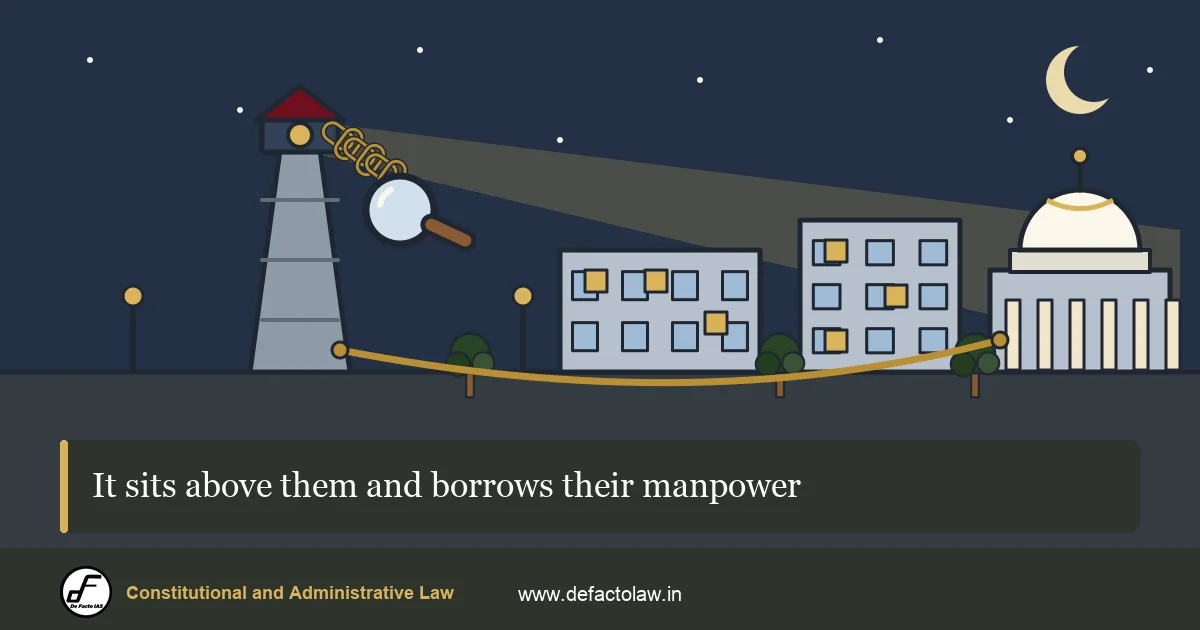
The Lokpal does not replace the older agencies. It sits above them and borrows their manpower. A comparison shows what each one is.
| Point | Lokpal | CVC | CBI |
|---|---|---|---|
| Origin | Statute of 2013, in force 16 January 2014 | Executive resolution, 1964; statute, 2003 | Executive resolution, 1963; powers from the DSPE Act, 1946 |
| Main work | Inquires into corruption, orders investigation, grants sanction | Supervises vigilance and advises Government | Investigates offences, including corruption |
| Reach | Prime Minister, Ministers, MPs and all Union public servants | All India Services officers and Group A officers of the Centre, among others | Cases referred to it or taken up under its own Act |
| Appointment | Committee of Prime Minister, Speaker, Leader of the Opposition, Chief Justice of India or nominee, and a jurist | Committee of Prime Minister, Home Minister and Leader of the Opposition | Director chosen by Prime Minister, Leader of the Opposition and Chief Justice or nominee |
The pieces fit together. The Lokpal may refer complaints to the CVC for preliminary inquiry. For Group A and B officers the CVC reports back to the Lokpal; for Group C and D it proceeds under its own Act, subject to the Lokpal's review. The Act also set up a Directorate of Prosecution inside the CBI, and its Director is appointed on the recommendation of the CVC.
Behind this arrangement is the history that the Supreme Court recounted in its 2026 judgment on Section 17A. After Vineet Narain, the Court asked for a statutory CVC, and the CVC Act, 2003 followed; the Lokpal added a third layer of apex oversight. The CBI works as an investigating arm for whichever body orders it.
Lokayuktas in States
Section 63 puts the State institution on the same footing as the central one. The Act says:
"Every State shall establish a body to be known as the Lokayukta for the State"
The State was to do so by its own law, and the Act set a limit of one year from commencement, though many States had acted earlier. Maharashtra created the first Lokayukta in 1971; Odisha had passed its Act in 1970 but brought it into force only in 1983.
The States were left to shape the office, so it differs from State to State. Some have both a Lokayukta and an Upalokayukta, others only a Lokayukta, and Punjab and Odisha used the title Lokpal. The Governor appoints, usually after consulting the Chief Justice of the High Court and the Leader of the Opposition. Judicial qualifications are required in some States and not in others.
The Chief Minister is within the Lokayukta's jurisdiction in Himachal Pradesh, Andhra Pradesh, Madhya Pradesh and Gujarat, and outside it in Maharashtra, Uttar Pradesh, Rajasthan, Bihar and Odisha. In most States the Lokayukta's recommendations are only advisory.
Accountability at Home and Abroad
The second limb of the 2025 question asked how the Act ensures accountability in public governance, both within and outside India. The sentence reads oddly, and the safe course is to answer the two halves in turn.
Within India, the Act builds accountability in layers. The apex body is independent and multi-member, with judicial and social balance. The agencies investigating a complaint answer to the Lokpal. The public servant is heard at each stage. Time limits stop delay. And the Lokpal itself is answerable: its website must display the status of complaints pending and disposed of, under Section 20(10).
Outside India, the answer is the international commitment that the Act carries. The Statement of Objects ties it to the Convention against Corruption and to the policy of zero tolerance. The Act also reaches abroad through its jurisdiction over bodies that receive foreign donations above ten lakh rupees, and by treating bribe-givers and abettors of corruption as persons whose conduct the Lokpal can examine under Section 14(3).
The Record So Far
The law came before the institution. The Act commenced on 16 January 2014, but the first appointments waited on the Selection Committee, and the Committee needed a recognised Leader of the Opposition. In Common Cause v. Union of India (2017), as described in Kalpana Mehta v. Union of India (2018), the petitioners complained that
"despite the enactment of the law, its provisions had not been implemented."
The Supreme Court declined to read down the Act, holding that amendment lay in the exclusive domain of the legislature and that a Bill was then before a parliamentary committee. The case shows a recurring problem: a statute that depends on one office-holder for its first working step.
The Lokpal has also been drawn into other statutes. Section 17A of the Prevention of Corruption Act requires prior approval before an inquiry into a public servant's official decisions. In Centre for Public Interest Litigation v. Union of India (January 2026), Justice Viswanathan upheld the section but read it so that the grant or refusal of approval depends on a recommendation from the Lokpal or Lokayukta:
"who shall be bound and shall act in accordance with the recommendation insofar as grant or refusal of permission under Section 17A is concerned."
Justice Nagarathna wrote separately that Section 17A should be struck down. The split shows that the Lokpal is being treated as the proper independent screen for allegations against public servants, even though judges disagree on the rest.
Is It Efficacious?
The third part of the 2023 question asks for an assessment, and most of the answer's weight belongs here. A fair view sets the Act's strengths against its limits.
- Strengths: a wide jurisdiction that includes the Prime Minister, a balanced committee, statutory time limits, a hearing at each stage, powers to attach property and a firm link to the CVC and CBI.
- Dependence on others: the Lokpal investigates through agencies such as the CBI, so its force depends on how free those agencies are.
- Constitutional status denied: the Administrative Reforms Commission and the 2011 Standing Committee both asked for it, and the Act is only statutory.
- Procedural limits: the commentaries list the lack of power to proceed on its own motion, no anonymous complaints, heavy penalties for false complaints, a seven-year limitation and a procedure for complaints against the Prime Minister that is not transparent.
- Uneven States: Lokayuktas differ in strength, qualifications and powers, and their recommendations are advisory.
The ARC itself said why constitutional status mattered. It recommended it, in the Supreme Court's words,
"so as to make them independent of political interference."
A good conclusion for the answer is to say what is still missing: the Act promises accountability, but its effect depends on timely appointments, free agencies and States that use the powers they have.
Frequently Asked Questions
Q: When did the Lokpal and Lokayuktas Act, 2013 come into force?
The President assented on 1 January 2014 and the Act came into force on 16 January 2014.
Q: Does the Lokpal have jurisdiction over the Prime Minister?
Yes, subject to Section 14(1)(a): matters of international relations, security, public order, atomic energy and space are excluded, and an inquiry needs approval of two-thirds of the full bench and is held in camera.
Q: How is the Lokpal chosen?
The President appoints on the recommendation of a Selection Committee of the Prime Minister, the Speaker, the Leader of the Opposition, the Chief Justice of India or his nominee, and an eminent jurist.
Q: Must every State have a Lokayukta?
Yes. Section 63 requires every State to establish one by a law of its legislature within a year of commencement.
Sources: Lokpal and Lokayuktas Act, 2013 (sections 3, 4, 11, 12, 14, 20, 23 and 63 and the Statement of Objects and Reasons, as set out in the judgments); Centre for Public Interest Litigation v. Union of India (2026); Special Police Establishment v. Kamta Prasad Mishra (2026); Kalpana Mehta v. Union of India (2018) (quoting Common Cause v. Union of India (2017)); Shri Dinesh Trivedi v. Union of India (1997); commentary on Indian polity (chapters on the Lokpal and Lokayuktas, the Central Vigilance Commission and the CBI).