

On this page 14 sections
Why It Matters
Criminal liability rests on two pillars: the prohibited act (actus reus) and the guilty mind (mens rea). The law of insanity attacks the second pillar directly.
Where the accused, at the time of committing the act, was so profoundly incapacitated by mental disorder as to be unable to form any conception of what he was doing or of its wrongfulness, the preconditions for criminal responsibility are absent. The law does not punish a person who was, in the relevant sense, not present in the act at all.
But the law of insanity is not the law of mental illness generally. Psychiatry and criminal law use overlapping but distinct vocabularies, and the defence available under Section 84 IPC — now reproduced as Section 22 BNS — is defined in legal terms that diverge significantly from clinical diagnosis.
A person may be severely mentally ill and yet not legally insane for the purposes of Section 84. Conversely, the legal test is precise enough that a person whose disorder meets its requirements will be acquitted even if the disorder does not match any conventional diagnostic category.
Understanding Section 84 therefore requires two parallel inquiries: what does the legal test actually require, and how does it relate to — and differ from — the medical understanding of mental illness?
Cases at a glance 46
- Hari Singh Gond v State of Madhya Pradesh
- Vijaya Singh Umed Singh v State
- Siddhapal Kamala Yadav v State of Maharashtra
- S Sunil Sandeep v State of Karnataka
- Ujagar Singh Ganda Singh v State
- Dahyabhai Chhaganbhai Thakkar v State of Gujarat
- Tola Ram v Emperor
- Amrit Bhushan Gupta v Union of India
- Bapu @ Gajraj Singh v State of Rajasthan
- Francis v State of Kerala
- Siddheswari Bora v State of Assam
- Pancha v Emperor
- Kesheorao Bhiosanji Navale v State of Maharashtra
- SK Nair v State of Punjab
- State of Maharashtra v Gourishankar Kawadu Shende
- Kusa Majhi v The State
- Ramachandran v State of Kerala
- Budha Dattu Umavane v State of Maharashtra
- Gour Chandra v State of Orissa
- Raval Mohanbhai Laxmanbhai v State of Gujarat
- Shama Tudu v State
- Ratan Lal v State of Madhya Pradesh
- Basdev v State of Pepsu
- Public Prosecutor v Budipiti Devasikamani
- State of Kerala v Ravi
- State of Madhya Pradesh v Ahmadulla
- Chhagan v State
- Barelal v State
- TN Lakshmaiah v State of Karnataka
- Sheraili Wali Mohammed v State of Maharashtra
- Sukru Sa v State of Orissa
- Mohammad Sarwar v Emperor
- Oyami Ayatu v State of Madhya Pradesh
- Rustam Ali v State
- State of Assam v Inush Ali
- Sannatamma v State of Karnataka
- Dulal Naik v State
- Jai Lal v Delhi Administration
- Bhikari v State of Uttar Pradesh
- Channabasappa v State of Mysore
- Surya Prasad Rout v State of Orissa
- Sanna Eranna v State of Karnataka
- Shaik Ahmed v State of Andhra Pradesh
- State of Karnataka v Jatti
- Bhikari v Uttar Pradesh
- State of MP v Ahmadulla
Section 22 BNS
Section 84 IPC provides:
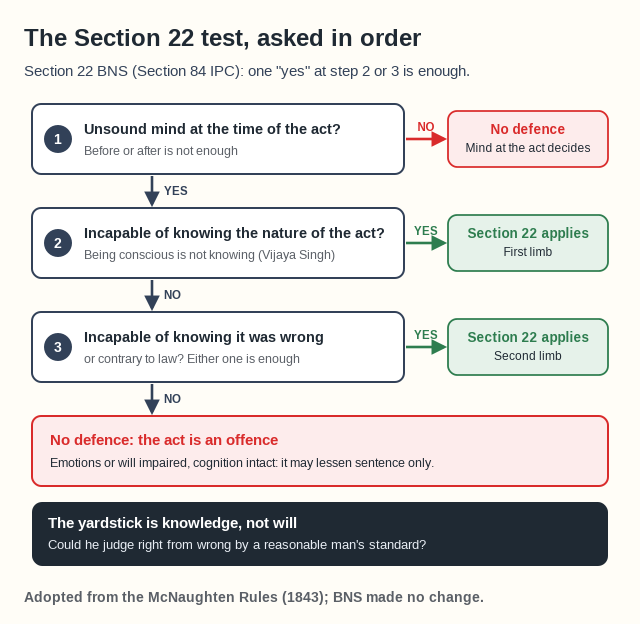
Nothing is an offence which is done by a person who, at the time of doing it, by reason of unsoundness of mind, is incapable of knowing the nature of the act, or that he is doing what is either wrong or contrary to law.
The BNS comparison table confirms that Section 22 BNS (= Section 84 IPC) carries this provision forward without any change. The legal test, the standard of proof, the presumptions, the consequences — all are preserved identically. All judicial interpretation built up under Section 84 IPC applies with full force to Section 22 BNS.
The term 'unsoundness of mind' is not defined in the IPC. The courts have treated the expression as equivalent to insanity (Hari Singh Gond v State of Madhya Pradesh (2008) 16 SCC 109), though the legal content of insanity under Section 84 is distinct from both the popular and the clinical meaning of that term.
Two-Limb Test
The legal test under Section 84 IPC / Section 22 BNS has two alternative limbs, either of which, if satisfied, grounds the defence:
First Limb
The accused, by reason of unsoundness of mind at the time of the act, was incapable of knowing the nature of the act. This means the accused could not understand what he was physically doing — that he was striking a blow, discharging a weapon, or committing whatever act constitutes the offence. The faculty for basic physical comprehension of one's own conduct was absent.
Consciousness of the act does not necessarily imply that the accused was capable of knowing its nature (Vijaya Singh Umed Singh v State AIR 1955 NUC 5636 (MB)).
A person may be aware of physical movements while being entirely incapable of comprehending their nature. A person in the grip of severe delusions may perform acts with apparent purposiveness while having no capacity to understand the actual nature of those acts.
Second Limb
The accused, by reason of unsoundness of mind, was incapable of knowing that what he was doing was either wrong or contrary to law. This second limb is disjunctive: it is sufficient if the accused did not know the act was morally wrong (wrong), or did not know it was legally prohibited (contrary to law). Either suffices.
The test here is not whether the accused recognised the act as bad in some abstract sense, but whether the specific cognitive incapacity — rooted in the unsoundness of mind — prevented the accused from knowing that this particular act was wrong or unlawful.
Where the insanity merely affects the emotions or the will of the person while leaving the cognitive faculties substantially unimpaired, the accused cannot plead exemption, although it may operate in extenuation (KM Thomas (1973) Mad LJ 178).
The standard to be applied for ascertaining whether the accused was of unsound mind is whether he, according to the ordinary standard adopted by a reasonable man, was able to judge whether his act was right or wrong (Siddhapal Kamala Yadav v State of Maharashtra AIR 2009 SC 97).
Cognitive Threshold
The two limbs are connected by the word 'or'. It is therefore sufficient if the accused satisfies either limb. A person who knew the nature of the act but did not know it was wrong or contrary to law is covered.
A person who did not even know the nature of the act is covered even more clearly. A person who knew both the nature of the act and its wrongfulness is not covered, regardless of any mental illness from which he suffered.
This structure is the IPC's adoption — with some modifications — of the McNaughten Rules, formulated by the House of Lords in England in 1843 (McNaughten's Case (1843) 8 ER 718).
The McNaughten Rules provide that to establish a defence on the ground of insanity, it must be clearly proved that, at the time of committing the act, the party accused was labouring under such a defect of reason from disease of the mind as not to know the nature and quality of the act he was doing, or, if he did know it, that he did not know that what he was doing was wrong.
Indian criminal law has adopted this cognitive framework, focusing on knowledge rather than on will or emotion.
Legal vs Medical
What Test Requires
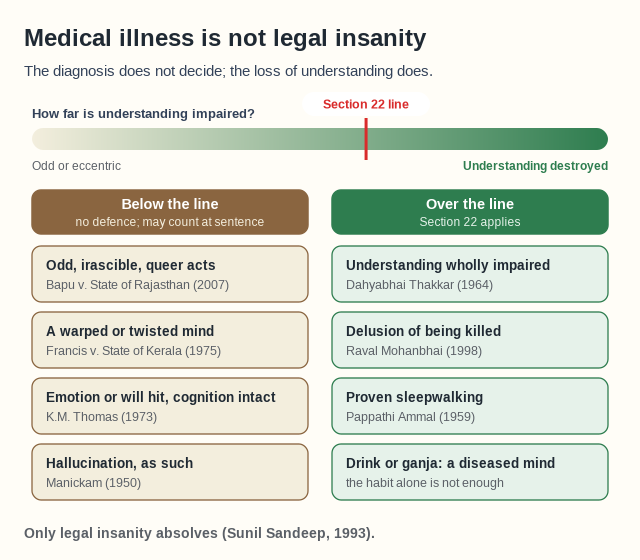
It is only the legal and not the medical insanity that absolves the accused from criminal liability (S Sunil Sandeep v State of Karnataka (1993) Cr LJ 2554).
The legal conception of insanity is different from the medical conception: in the legal case, it has further to be proved that the insanity is of a degree that, because of it, the person is incapable of knowing the nature of the act or that what he is doing is wrong or contrary to law (Ujagar Singh Ganda Singh v State AIR 1954 Pepsu 4).
It is only insanity of a nature that destroys or completely impairs the cognitive faculty of the mind to such an extent that the person is incapable of knowing the nature of his act or that what he is doing is wrong or contrary to law (Dahyabhai Chhaganbhai Thakkar v State of Gujarat AIR 1964 SC 1563).
Cognitive impairment that falls short of this threshold — however clinically significant — does not ground the legal defence.
It is not every person who is mentally deranged (Tola Ram v Emperor AIR 1927 Lah 674) or suffering from mental disease or every kind of medically recognised insanity or disorder that is given immunity from criminal liability (Amrit Bhushan Gupta v Union of India AIR 1977 SC 608).
Not Qualifying
The courts have developed an extensive body of authority identifying conditions that, while clinically recognised, do not meet the Section 84 threshold. The following do not constitute legal insanity sufficient for the defence:
An accused who was conceited, odd, irascible, and had a brain that was not quite right, or who was intellectually or emotionally weakened by physical and mental ailments — these do not ipso facto make him a person of unsound mind (Bapu @ Gajraj Singh v State of Rajasthan (2007) 8 SCC 66).
Indulgence in unusual acts or abnormal or queer behaviour does not, on its own, exempt from criminal liability (Bapu @ Gajraj Singh).
A mere warped or twisted mind does not qualify (Francis v State of Kerala (1975) 3 SCC 825). Every minor mental aberration or abnormality is not covered by the expression 'unsoundness of mind' (Raja Gopala AIR 1952 Mad 289). Every mental imbalance cannot be equated with unsoundness of mind — by itself it does not make a person insane (Ujagar Singh Ganda Singh).
Specifically, the following conditions have been held to fall outside the Section 84 defence:
Hallucination or delusion (Manickam AIR 1950 Mad 576) — in general terms, not automatically qualifying unless rendering the accused incapable of knowing the nature of the act or its wrongfulness; irresponsible impulse (Raja Gopala AIR 1952 Mad 289); impulsive insanity (Siddheswari Bora v State of Assam (1981) Cr LJ 1005 (Gau)); partial mental derangement (Pancha v Emperor AIR 1932 All 233) — unless it destroys or impairs the cognitive faculties in the relevant way; eccentricity of behaviour (Kesheorao Bhiosanji Navale v State of Maharashtra (1979) Cr LJ 403 (Bom)); paranoid thoughts (SK Nair v State of Punjab AIR 1997 SC 1537) — without proof of cognitive incapacity; mental agitation (State of Maharashtra v Gourishankar Kawadu Shende (1965) 68 Bom LR 236); depression (Kusa Majhi v The State (1985) Cr LJ 1460 (DB)); minor mental aberrations or proneness to wild temperament (Ramachandran v State of Kerala (1986) Cr LJ 1222 (DB) (Ker)); over-sensitiveness of mind and ordinary stresses and disappointments of life (Budha Dattu Umavane v State of Maharashtra (1985) Cr LJ 844 (DB) (Bom)); an uncommon ferocity in the crime (Gour Chandra v State of Orissa (1989) Cr LJ 1667 (Ori)).
These conditions may, however, be taken into consideration while deciding on punishment, even if they fall short of the legal threshold for the Section 84 defence.
Qualifying Conditions
- Hallucinations and illusions that kept the accused under constant apprehension of being killed, rendering him incapable of understanding the nature of the act, bring the case within Section 84 (Raval Mohanbhai Laxmanbhai v State of Gujarat (1998) Cr LJ 4325 (Guj); Shama Tudu v State (1987) Cr LJ 618 (DB)). The key is that the delusions must actually destroy the cognitive capacity required by the legal test.
- Proven somnambulism (sleepwalking) constitutes unsoundness of mind for the purposes of the defence (Pappathi Ammal AIR 1959 Mad 239).
- Homicidal tendency is a sign of insanity (Ratan Lal v State of Madhya Pradesh AIR 1971 SC 778).
- Insecurity caused by excessive drinking or excessive smoking of ganja, even if voluntary, may also amount to unsoundness of mind where it induces a diseased state of mind (Basdev v State of Pepsu AIR 1956 SC 488). However, smoking of ganja does not substantiate the plea of insanity in the absence of evidence that it induced a diseased state of mind rendering the accused incapable of understanding the wrongfulness of the act (Public Prosecutor v Budipiti Devasikamani AIR 1928 Mad 196).
In each qualifying case, the connecting thread is the same: the condition must destroy or completely impair the cognitive faculty to the point of incapacity specified in Section 84. The medical label matters less than the functional consequence.
Timing Requirement
One of the most critical — and most frequently overlooked — requirements of Section 84 IPC is that the unsoundness of mind must have existed at the time of committing the offence, not at some remote point in time (Dahyabhai Chhaganbhai Thakkar v State of Gujarat AIR 1964 SC 1563; State of Kerala v Ravi (1978) Cr LJ NOC 182 (DB)).
The burden to prove the mental condition of the accused at the crucial point of time is on the accused (State of Madhya Pradesh v Ahmadulla AIR 1961 SC 998).
Lucid Intervals
Even a person who is generally of unsound mind may have lucid intervals during which he is mentally capable of understanding the nature and wrongfulness of his acts.
The law presumes that every person, even one known to be a lunatic, committed the offence in a lucid interval — unless it appears that the act was committed during a state of derangement (Chhagan v State (1976) Cr LJ 671 (Raj)). This presumption places the burden squarely on the accused to establish that the act was committed during an episode of incapacity, not during a lucid interval.
Circumstantial Evidence
The existence of unsoundness of mind prior to or after the commission of the offence is neither relevant nor per se adequate to bring the General Exception into play (Ratan Lal v State of Madhya Pradesh AIR 1971 SC 778). It is not sufficient to show that the accused was of unsound mind before the commission of the crime or that he became so afterwards (Barelal v State AIR 1960 MP 102).
Such evidence is not, however, entirely irrelevant. Evidence of insanity before or after the offence may be taken into account while deciding whether the accused was of unsound mind at the time of commission (Ratan Lal v State of Madhya Pradesh AIR 1971 SC 778). It is part of the surrounding circumstantial evidence that the court must evaluate holistically.
The entire conduct of the accused from the time of commission of the offence up to the time the session proceedings commenced is relevant for ascertaining whether the plea of insanity is genuine, bona fide, or an afterthought (TN Lakshmaiah v State of Karnataka AIR 2001 SC 3828).
A plea fabricated to escape punishment will carry far less evidential weight than one corroborated by a consistent history of mental disturbance predating the offence.
Conduct Negativing Plea
The courts have identified several categories of post-offence and peri-offence conduct that are inconsistent with the plea of insanity.
Prior Planning
Where the commission of a crime is preceded by careful planning and cool calculation in its execution, the plea of insanity will not be accepted (State of Madhya Pradesh v Ahmadulla AIR 1961 SC 998).
The capacity to plan, to select means, to anticipate obstacles, and to take concealed steps towards a criminal objective is inconsistent with the cognitive incapacity required by Section 84. A person who is incapable of knowing the nature of his act or its wrongfulness cannot simultaneously be capable of planning the act in advance.
Flight After Act
Fleeing from the scene of the crime or taking steps to evade detection after committing it indicates an awareness of wrongdoing — precisely the awareness whose absence grounds the Section 84 defence.
However, the mere fact that the accused did not attempt to run away after committing the offence is not proof of insanity by itself (Sheraili Wali Mohammed v State of Maharashtra AIR 1972 SC 2443). The inference from flight is negative evidence against insanity; its absence is neutral.
Absence of Motive
Absence of motive may be a relevant factor in evaluating the plea of insanity (Dahyabhai Chhaganbhai Thakkar v State of Gujarat AIR 1964 SC 1563). A motiveless killing is a circumstance consistent with mental disturbance.
But absence of motive by itself will not afford the basis for accepting the plea of insanity (Sukru Sa v State of Orissa (1973) Cr LJ 1323 (DB) (Ori)), though it may be a factor for the purpose of sentence (Mohammad Sarwar v Emperor AIR 1930 Nag 63). The absence of an ascertainable motive is one brick in the evidential wall; it is not the wall itself.
Causing death over a trifling matter does not warrant the conclusion of insanity (Oyami Ayatu v State of Madhya Pradesh AIR 1974 SC 216). The trivialness of the provocation is also not determinative.
Brutality or Ferocity
Mere brutality or ferocity of the crime or the character of the crime by itself is not proof of insanity (Rustam Ali v State AIR 1960 All 333; Dahyabhai Chhaganbhai Thakkar v State of Gujarat AIR 1964 SC 1563).
Violence, however extreme, does not establish cognitive incapacity. The offences of many sane criminals are brutal; many mentally disordered acts are comparatively mild. Section 84's test is cognitive, not temperamental.
The mere fact that the accused made a clean breast of the matter and admitted the various allegations of the prosecution would not go to show that he is of unsound mind (Oyami Ayatu v State of Madhya Pradesh AIR 1974 SC 216). Candour at trial is not itself indicative of mental incapacity at the time of the offence.
Irresistible Impulse
The doctrine of uncontrollable or irresistible impulse is not a valid independent defence under Section 84 IPC. Every crime is committed under an impulse; the object of criminal law is to compel or induce persons to control or resist these impulses. Impulsive insanity affects the will and emotions and not the cognitive faculties of a person (State of Kerala v Ravi (1978) Cr LJ NOC 182 (DB)).
An irresistible impulse that affects only the will — leaving intact the cognitive capacity to know the nature of the act and its wrongfulness — does not ground the Section 84 defence. Where the insanity merely affects the emotions or the will while leaving the cognitive faculties substantially unimpaired, the accused cannot plead exemption (KM Thomas (1973) Mad LJ 178).
The doctrine may operate, however, where the irresistible impulse is so severe that on account of such impulse, the accused was incapable of knowing the nature of the act he was doing and that what he was doing was either wrong or contrary to law (State of Assam v Inush Ali (1982) Cr LJ 1044 (Gau)).
In such a case, it is the cognitive consequence of the impulse — the destruction of the knowing faculty — that grounds the defence, not the uncontrollability of the impulse itself.
Intoxication
Voluntary or involuntary intoxication may lead to insanity. Where it does — where the intoxication induces a state of unsoundness of mind in the terms defined by Section 84 — voluntary intoxication that led to unsoundness of mind also operates as an extenuating factor under Section 84 (Basdev v State of Pepsu AIR 1956 SC 488).
The distinction between the intoxication defence and the insanity defence carries one practically significant consequence. If the incapacity to understand the nature of the act or to form the required intent is the result of an inherent defect or infirmity of mind — even if the accused was also intoxicated — the case comes under Section 84, not Section 86 (In re GJ Joseph AIR 1939 Mad 407).
A person with an underlying mental illness who also consumed alcohol does not automatically fall under the intoxication exception; the dominant operative cause of the cognitive incapacity determines which provision applies.
There is a further practical consequence: a person who commits a serious offence and sets up the defence of insanity, unlike the one who takes the plea of intoxication, is sent to a psychiatric hospital as long as he is thought to be dangerous (Sannatamma v State of Karnataka (2004) Cr LJ 2257 (Kant)).
The consequence of acquittal for insanity is, therefore, significantly different from the consequence of acquittal on the ground of intoxication.
Burden of Proof
Presumption of Sanity
The law presumes that every person, until it is proved to the contrary, is sane and capable of understanding the nature of his act and of knowing that what he was doing was either wrong or contrary to law (Dulal Naik v State (1987) Cr LJ 1561 (Cal)).
A court must presume that every person is sane and in full control of all his faculties until the contrary is proved. Even if a person is known to have been a lunatic, the law presumes that the offence was committed in a lucid interval (Chhagan v State (1976) Cr LJ 671 (Raj)).
The general burden of proof that an accused person is in a sound state of mind and the burden to prove the guilt of the accused beyond reasonable doubt is upon the prosecution (Dahyabhai Chhaganbhai Thakkar v State of Gujarat AIR 1964 SC 1563).
The prosecution has only to rely upon this presumption of sanity and to establish the basic facts that constitute the offence charged (S Sunil Sandeep v State of Karnataka (1993) Cr LJ 2554). The prosecution is not required to lead affirmative evidence of sanity; it rides on the presumption.
Accused's Burden
Section 105 of the Indian Evidence Act throws the burden of proving the existence of circumstances bringing the case under Section 84 IPC on the accused (State of Madhya Pradesh v Ahmadulla AIR 1961 SC 998). The accused must rebut the presumption of sanity (Jai Lal v Delhi Administration AIR 1969 SC 15).
However, the burden is not as heavy as on the prosecution (S Sunil Sandeep v State of Karnataka (1993) Cr LJ 2554). It is sufficient if the accused establishes his case with the preponderance of probability (Bhikari v State of Uttar Pradesh AIR 1966 SC 1). Mere possibility, however, is not sufficient to discharge the onus (Channabasappa v State of Mysore AIR 1957 Mys 68).
Establishing the Plea
Insanity may be proved from the circumstances of each case and inference of facts and need not necessarily be proved by scientific or expert evidence (State of Madhya Pradesh v Ahmadulla AIR 1961 SC 998). It may be proved from family history and conduct prior to and after the crime (Jai Lal v Delhi Administration AIR 1969 SC 15).
In order to find whether the accused was by reason of unsoundness of mind incapable of knowing the nature of the act or that he was doing what was wrong or contrary to law, a court may rely not only on the defence evidence but also on what is elicited from prosecution witnesses as well as on circumstantial evidence consisting of the previous history of the accused and his subsequent conduct and also surrounding circumstances such as absence of motive (Pancha v Emperor AIR 1932 All 233).
The pattern of the crime, the circumstances of its commission, the manner and method of execution, the words used by the offender at the time of the offence or immediately before or after, and the behaviour of the offender before and after the commission furnish important clues to ascertain whether the accused had no cognitive faculty to know the nature of the act or its wrongfulness (Surya Prasad Rout v State of Orissa (1982) Cr LJ 931 (Ori)).
Evidence of relations as to the state of mind of the accused may be relevant (Ratan Lal v State of Madhya Pradesh AIR 1971 SC 778). The court must take into account all the material available to it to find out whether the accused was of unsound mind at the time of commission of the offence (Sannatamma v State of Karnataka (2004) Cr LJ 2257 (Kant)).
Investigator's Duty
Although there is no burden cast on the prosecution to negatively establish the accused's sanity, where the accused has a previous history of mental disease, fairness in investigation demands that this aspect be probed into in an unbiased manner, particularly when the accused may not be able to assist in unravelling the necessary facts (Sanna Eranna v State of Karnataka (1983) Cr LJ 619 (DB) (Kant)).
An investigation officer is required to get the accused medically examined when a previous history of insanity or abnormality of mind is revealed to him or brought to his notice. His failure to do so creates a serious infirmity in the prosecution case and the accused becomes entitled to the benefit of the doubt and the consequential acquittal (Bapu @ Gajraj Singh v State of Rajasthan (2007) 8 SCC 66).
Medical Evidence
Where medical evidence is brought in to prove insanity, it is the responsibility of the medical expert to assist the court to come to the right conclusion and not merely to help the party who called him (Shaik Ahmed v State of Andhra Pradesh (1996) Cr LJ 2582 (AP)).
Medical evidence does not bind the court. The court must evaluate it alongside all other evidence and circumstances. The mental condition at the time of the offence is ultimately a question for the court, not for the psychiatrist.
A judge may be entitled to resolve an issue of insanity all by himself although not pleaded by the accused, provided there is appropriate medical evidence (State of Karnataka v Jatti (1992) Cr LJ 3835 (Kant)). The court is not passive in this inquiry.
Before acquitting a person on the ground of insanity, the court must record a categorical finding that the accused was incapable of knowing the nature of the act he committed, or of knowing that what he was doing was either wrong or contrary to law (Pancha v Emperor AIR 1932 All 233). A general or inconclusive finding does not suffice for acquittal.
Effect of Acquittal
Acquittal under Section 84 IPC does not result in the unconditional discharge of the accused.
Where the accused is acquitted on the ground that he was by reason of unsoundness of mind incapable of knowing the nature of the act or its wrongfulness, the Magistrate or the Court is required to order that he be either detained in safe custody in a lunatic asylum or be delivered to his relative or friend who gives surety to the court that the person will be taken care of and prevented from causing injury to himself or to any other person (Sannatamma v State of Karnataka (2004) Cr LJ 2257 (Kant)).
This consequence distinguishes the insanity acquittal from a regular acquittal in a fundamental way. The acquittal is not a finding of innocence; it is a finding that criminal responsibility cannot attach to this particular act by this particular person in his particular condition.
The danger to the public represented by the person of unsound mind who has committed a violent act must be managed, even while criminal punishment is withheld.
Trial Procedure
The Code of Criminal Procedure prescribes an elaborate special procedure for the trial of a person of unsound mind.
During inquiry, if it appears to a Magistrate that the accused is of unsound mind and is consequently incapable of making his defence, the Magistrate is required to conduct an inquiry and try the fact of unsoundness of mind and incapacity. The accused must be examined by the civil surgeon of the district.
The Magistrate or Court must then determine whether the unsoundness of mind renders the accused incapable of entering a defence. If found incapable, trial is postponed, and the accused is released on bail or, if that is not possible, detained in an appropriate facility. Proceedings resume only after the accused ceases to be of unsound mind and becomes capable of making his defence.
There are, therefore, two distinct inquiries: (i) whether the accused is currently fit to stand trial; and (ii) whether the accused was of unsound mind at the time of the alleged offence. Both must be resolved before a final verdict can be entered.
BNS Position
The BNS comparison table is explicit: Section 22 BNS (corresponding to Section 84 IPC) carries the provision forward with no change. The text, the legal test, the two-limb structure, the cognitive threshold, the timing requirement, the burden of proof, and the consequences of acquittal are all identically preserved.
The broader BNS policy of replacing stigmatising terminology for persons with mental illness — replacing 'insane person' with 'person of unsound mind' (Section 27 BNS = Section 89 IPC), replacing 'under the influence of madness' with 'a person of unsound mind' (Section 36 BNS = Section 98 IPC), and replacing 'lunatic' with 'a person of unsound mind' (Section 46 BNS = Section 108 IPC) — does not affect the substantive legal standard of Section 22 BNS.
The heading of Section 22 BNS is 'Act of a person of unsound mind' rather than any formulation using 'insane', but the body of the provision is identical to Section 84 IPC.
All case law decided under Section 84 IPC — including Dahyabhai Chhaganbhai Thakkar, Bapu @ Gajraj Singh, Hari Singh Gond, Bhikari v Uttar Pradesh, TN Lakshmaiah, Ratan Lal, State of MP v Ahmadulla, Pancha v Emperor, and the full body of High Court decisions cited throughout this blog — applies without modification to Section 22 BNS.
Conclusion
The insanity defence under Section 84 IPC / Section 22 BNS is simultaneously one of the most important and one of the most misunderstood provisions in Indian criminal law.
It is important because it gives legal expression to a fundamental moral intuition: a person who truly could not understand what they were doing, or could not comprehend its wrongfulness, stands in a different moral and legal position from a person who knew and chose. It is misunderstood because the provision's legal test diverges sharply from the clinical understanding of mental illness.
The key propositions may be summarised as follows. Section 84 requires cognitive incapacity specifically at the moment of the act — not mental illness generally.
The incapacity must either prevent knowledge of the nature of the act or prevent knowledge of its wrongfulness; affecting only the will or emotions while leaving cognition intact is insufficient. The test is legal, not medical: it is only insanity that destroys or completely impairs the cognitive faculty that absolves from criminal liability.
The presumption of sanity must be rebutted by the accused on the balance of probabilities, through any available evidence — medical, circumstantial, testimonial — but not necessarily through expert evidence alone. And acquittal on grounds of insanity is not unconditional freedom but leads to detention until the court is satisfied that the person no longer poses a danger.
The BNS preserves all of this entirely unchanged. Section 22 BNS is Section 84 IPC in a new statutory home, with no alteration of substance.
Frequently Asked Questions
Q: What is the difference between legal insanity and medical insanity under Indian criminal law?
Legal insanity under Section 84 IPC / Section 22 BNS requires cognitive incapacity of a specific kind — the accused must have been incapable, at the time of the act and by reason of unsoundness of mind, of knowing the nature of the act or that it was wrong or contrary to law. Medical insanity is any clinically recognised mental disorder.
Many medically diagnosed conditions — depression, paranoia, personality disorders, eccentricity — do not meet the legal test because they do not destroy or completely impair the cognitive faculties in the way Section 84 requires. Only legal, not medical, insanity absolves the accused from criminal liability.
Q: Is irresistible impulse a valid defence under Section 84 IPC?
No, not as a standalone defence. The doctrine of uncontrollable or irresistible impulse is not a valid defence because every crime is committed under an impulse and the object of criminal law is to induce persons to resist these impulses.
Impulsive insanity affects the will and emotions, not the cognitive faculties. However, if as a result of an irresistible impulse the accused was actually incapable of knowing the nature of the act or its wrongfulness, then the cognitive incapacity — not the impulse itself — may ground the Section 84 defence.
Q: What standard of proof must the accused meet to establish insanity?
The accused must establish the plea on a preponderance of probability — the civil standard — not beyond reasonable doubt. The burden is on the accused because the circumstances are within his special knowledge.
The accused may rely on any available evidence: family history, conduct before and after the offence, medical records, prosecution witnesses, and circumstantial evidence. Mere possibility, however, is insufficient.
Q: Does a previous history of mental illness automatically establish Section 84?
No. Prior or subsequent insanity is neither relevant nor per se adequate by itself to bring the exception into play. The insanity must have existed at the crucial time of the commission of the offence. Prior history may, however, be relevant circumstantial evidence in deciding whether the accused was of unsound mind at the time.
Courts look at the totality: family history, the pattern of the crime, conduct before and after, and any medical evidence, to determine whether the specific cognitive incapacity existed at the moment of the act.
Q: What happens to an accused who is acquitted on grounds of insanity?
Acquittal on grounds of insanity does not result in unconditional release. The court is required to order that the accused be detained in safe custody in a psychiatric facility or delivered to a relative or friend who gives surety that the accused will be taken care of and prevented from causing injury to himself or others.
This is fundamentally different from an ordinary acquittal: the social danger the accused represents must be managed, even while criminal punishment is withheld.