
On this page 13 sections
The Paris Agreement, adopted by consensus at the twenty-first Conference of the Parties to the UNFCCC in December 2015, is the principal treaty instrument for climate mitigation. Its drafting reflects a deliberate compromise between a legally binding structure and national discretion over the substance of commitments.
This article examines the treaty status of the Agreement, its goals, the nationally determined contribution (NDC) cycle, the transparency framework, the global stocktake, and the facilitative compliance mechanism, before turning to the question of bindingness and India's position.
Treaty Status
Form and Entry
The Agreement was adopted under the UNFCCC framework and is a treaty within the meaning of the Vienna Convention on the Law of Treaties. Its entry into force was conditioned on a double threshold, which was met within a year, an unusually short period for a multilateral treaty.
Article 21(1) provides that the Agreement enters into force on the thirtieth day after at least 55 Parties to the Convention, accounting in total for at least an estimated 55 per cent of total global greenhouse gas emissions, have deposited their instruments of ratification, acceptance, approval or accession.
Ratification
Ratification is the act by which a State confirms its consent to be bound. The notes of De Facto IAS state the general principle.
The act wherein a State confirms or endorses a treaty signed by its representative is termed as 'ratification'. The Vienna Convention, in Art. 2(l)(b), defines 'ratification' as the international gesture where a State solidifies its intention to be legally bound by a treaty on the global platform. Ratification has a prospective nature—it becomes operative from its execution day and does not work retroactively.
Consequently, the commitments of a treaty apply to a ratifying State from the ratification date, not the signing date.
Domestic Process
The same notes describe the Indian position.
Each State, drawing from its domestic norms and practices, has its own ratification mechanisms. In the U.S., the President, with the Senate's nod, ratifies treaties. In the U.K., it's the monarch, steered by the concerned minister's counsel. Whereas in India, the President, heeding the Central Cabinet's guidance, accomplishes ratification.
Signature Duty
Between signature and ratification, a State is subject to the interim obligation of Article 18 of the Vienna Convention.
Pertinently, in the interim between signature and ratification, Art. 18 of the Vienna Convention obliges a State to abstain from actions that might jeopardize the treaty's essence. This principle was highlighted in the case of Certain German Interests in Polish Upper Silesia [PCIJ (1928) Ser. A. No. 7], suggesting that treaty objectives acquire some relevance post-signature.
No Reservations
Article 27 excludes reservations, so that the package of obligations cannot be varied by individual Parties.
"No reservations may be made to this Agreement."
Withdrawal
Article 28 permits withdrawal only after a cooling-off period of three years, with effect one year after notice. The United States notified withdrawal in 2019, which took effect in November 2020, rejoined in 2021, and announced a second withdrawal in January 2025.
Under Article 28(1)–(2), notice of withdrawal is given in writing to the Depositary, and it takes effect on expiry of one year from the Depositary's receipt of the notification, or on such later date as the notification specifies.
Long-Term Goals
Temperature Goal
Article 2 states the purpose of the Agreement in terms of three goals: a temperature limit, adaptation and resilience, and the alignment of finance flows.
Article 2(1) frames the Agreement as enhancing the implementation of the Convention and strengthening the global response to the threat of climate change, in the context of sustainable development and efforts to eradicate poverty. Article 2(1)(a) states the temperature goal in these terms.
"(a) Holding the increase in the global average temperature to well below 2°C above pre-industrial levels and pursuing efforts to limit the temperature increase to 1.5°C above pre-industrial levels …"
Article 2(1)(b) adds the aim of increasing the ability to adapt to the adverse impacts of climate change and foster climate resilience and low greenhouse gas emissions development, in a manner that does not threaten food production. Article 2(1)(c) aims at making finance flows consistent with a pathway towards low greenhouse gas emissions and climate-resilient development.
Global Peaking
Article 4(1) translates the temperature goal into a collective aim of peaking and net balance of emissions and removals.
Under Article 4(1), peaking will take longer for developing country Parties, and the aim is to achieve a balance between anthropogenic emissions by sources and removals by sinks of greenhouse gases in the second half of this century.
Collective Aims
The long-term goals are collective in character. They are not allocated to individual Parties and are not themselves the subject of binding commitments.
The NDC Cycle
Core Obligation
Article 4(2) is the operative provision. It is drafted in two sentences with different verbs, and the distinction lies at the heart of the debate on bindingness.
"Each Party shall prepare, communicate and maintain successive nationally determined contributions that it intends to achieve. Parties shall pursue domestic mitigation measures, with the aim of achieving the objectives of such contributions."
Progression Rule
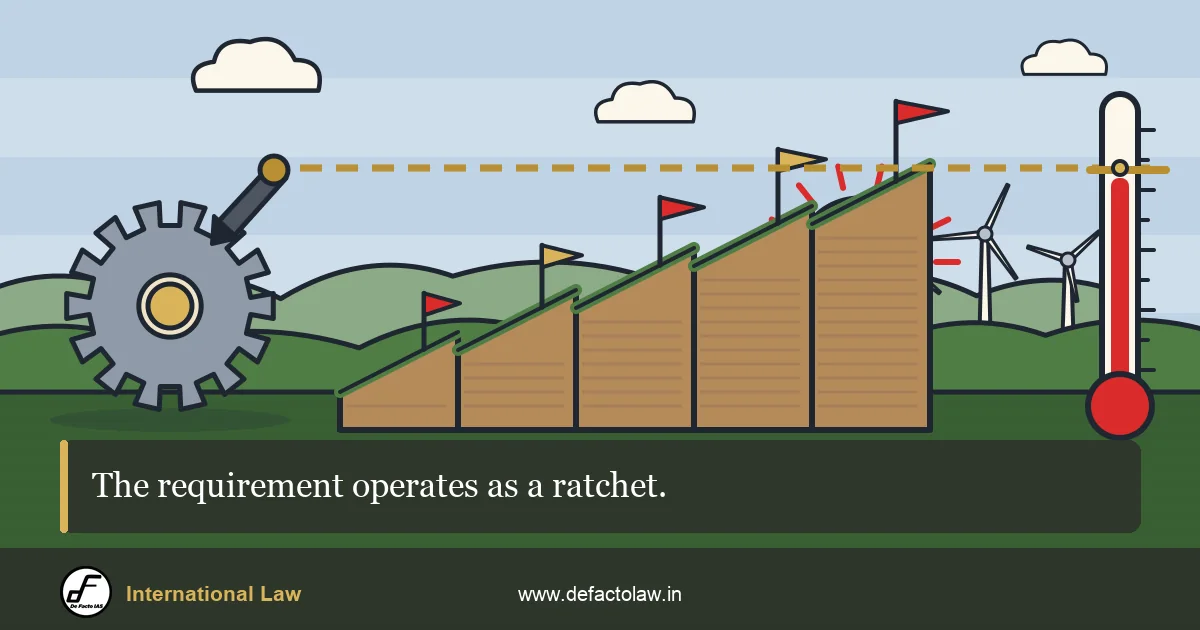
Article 4(3) imposes a qualitative standard on each successive contribution: it must progress beyond the previous contribution and reflect the highest possible ambition. The requirement operates as a ratchet.
"Each Party's successive nationally determined contribution will represent a progression beyond the Party's then current nationally determined contribution and reflect its highest possible ambition …"
The provision ties this ambition to common but differentiated responsibilities and respective capabilities, in the light of different national circumstances.
Five-Year Rhythm
Article 4(9) requires each Party to communicate an NDC every five years, in accordance with decision 1/CP.21 and any relevant decisions of the Conference of the Parties serving as the meeting of the Parties to this Agreement, informed by the outcomes of the global stocktake under Article 14.
Clarity Duty
Each communication must be accompanied by the information necessary to enable others to understand it.
Article 4(8) requires all Parties, in communicating their NDCs, to provide the information necessary for clarity, transparency and understanding, in accordance with decision 1/CP.21 and the relevant decisions of the Conference of the Parties serving as the meeting of the Parties.
Adjustment and Registry
Parties may only adjust an NDC upwards, in the sense of enhancing ambition, and all contributions are recorded in a public registry.
Article 4(11) allows a Party to adjust its existing NDC at any time with a view to enhancing its level of ambition, in accordance with guidance adopted by the Conference of the Parties serving as the meeting of the Parties. Under Article 4(12), communicated contributions are recorded in a public registry maintained by the secretariat.
Accounting
Article 4(13) requires Parties to account for their NDCs. In accounting for emissions and removals, they must promote environmental integrity, transparency, accuracy, completeness, comparability and consistency, and ensure the avoidance of double counting.
Bindingness
Conduct and Result
Legal analysis distinguishes obligations of conduct from obligations of result. Article 4(2) obliges Parties to prepare, communicate and maintain an NDC and to pursue domestic measures: this is binding conduct.
Intention Only
The NDC itself is something a Party "intends to achieve", which signals an expectation, not a duty of result. A Party that adopts measures in good faith but misses its target does not, by that fact alone, breach the Agreement.
Good Faith
Binding obligations of conduct must be performed in good faith, and the ICJ has treated due diligence as the standard of conduct in related contexts. The Paris obligations thus carry a content that is more than hortatory: an NDC that is manifestly inadequate, or domestic measures that are not pursued at all, would raise a question of non-compliance.
"Every treaty in force is binding upon the parties to it and must be performed by them in good faith."
Shall and Should
The Agreement uses a calibrated vocabulary. "Shall" appears for procedural duties and for the finance obligation of developed States; "should" for aspirations such as the leadership of developed countries; and "may" for options. Examining the verb in each provision is the first step in any analysis of the Agreement's obligations.
Kyoto Contrast
The Kyoto Protocol (1997) differed fundamentally. It imposed binding quantified targets on Annex B Parties.
Article 3(1) of the Kyoto Protocol required the Parties concerned, individually or jointly, to ensure that their aggregate emissions of the greenhouse gases listed in Annex A did not exceed their assigned amounts, with a view to reducing overall emissions by at least 5 per cent below 1990 levels in the commitment period 2008 to 2012.
Soft Law Influence
Non-binding instruments may nevertheless influence compliance. The De Facto IAS notes record the effect of non-binding General Assembly resolutions in the interpretation of law, an analogy useful for understanding the standard-setting role of the COP decisions that elaborate the Paris rulebook.
Despite their non-binding nature, General Assembly resolutions can still influence the interpretation and application of international law.
Case law from the ICJ, such as the South West Africa Voting Procedure Case (1955), the Anglo-Norwegian Fisheries Case (1951), and advisory opinions on issues like Namibia and the Western Sahara, demonstrate that the Court may consider these resolutions in their deliberations and even attribute legal effect to them in certain circumstances.
Transparency
Framework
Article 13 establishes the transparency framework, the Agreement's main tool for holding Parties to their NDCs. It combines uniform obligations with flexibility for developing countries.
Article 13(1) establishes an enhanced transparency framework for action and support, with built-in flexibility that takes into account Parties' different capacities, in order to build mutual trust and confidence and promote effective implementation. Article 13(2) provides flexibility in implementation for those developing country Parties that need it in the light of their capacities.
Reporting Duty
Article 13(7) requires each Party to regularly provide two kinds of information. The first is a national inventory report of anthropogenic emissions by sources and removals by sinks, prepared using good practice methodologies accepted by the Intergovernmental Panel on Climate Change. The second is the information necessary to track progress in implementing and achieving its NDC under Article 4.
Review
The information is subject to technical expert review and to a facilitative, multilateral consideration of progress. The reviewers examine, but do not adjudicate; the aim is transparency rather than sanction.
Global Stocktake
Periodic Review
Article 14 establishes the global stocktake, a collective review every five years of progress towards the purpose of the Agreement.
"… shall periodically take stock of the implementation of this Agreement to assess the collective progress towards achieving the purpose of this Agreement and its long-term goals (referred to as the ‘global stocktake’)."
Article 14(1) adds that the review is to be comprehensive and facilitative, considering mitigation, adaptation and the means of implementation and support, in the light of equity and the best available science. Under Article 14(2), the first global stocktake takes place in 2023 and every five years thereafter unless otherwise decided.
Link to NDCs
The outcome of the stocktake informs the next NDCs, completing the ambition cycle. The first stocktake concluded at COP28 in Dubai (2023), which called on Parties to contribute to transitioning away from fossil fuels in energy systems.
Article 14(3) provides that the outcome of the global stocktake shall inform Parties in updating and enhancing, in a nationally determined manner, their actions and support, as well as in enhancing international cooperation for climate action.
Compliance Design
Facilitative Committee
Article 15 creates the compliance mechanism of the Agreement. Its design is deliberately soft.
Article 15(1) establishes a mechanism to facilitate implementation of, and promote compliance with, the Agreement. Article 15(2) defines its institutional character.
"… shall consist of a committee that shall be expert-based and facilitative in nature and function in a manner that is transparent, non-adversarial and non-punitive."
The committee must also pay particular attention to the respective national capabilities and circumstances of Parties.
Reporting
Under Article 15(3), the committee operates under modalities and procedures adopted by the Conference of the Parties serving as the meeting of the Parties at its first session, and reports annually to that body.
Kyoto Compare
The contrast with the Kyoto Protocol is instructive. Article 18 of Kyoto contemplated a compliance system with binding consequences, adopted by amendment, and the Protocol's Compliance Committee had an enforcement branch.
Article 18 of the Kyoto Protocol provided for the approval of appropriate and effective procedures and mechanisms to determine and address cases of non-compliance, including an indicative list of consequences that takes account of the cause, type, degree and frequency of non-compliance. Binding consequences were, however, made subject to a further requirement.
"Any procedures and mechanisms under this Article entailing binding consequences shall be adopted by means of an amendment to this Protocol."
Dispute Resolution
Article 24 applies the dispute settlement provisions of the UNFCCC, which contemplate negotiation, and, if the Parties have so declared, submission to the ICJ or arbitration. In practice no inter-State dispute has arisen under the Agreement.
Article 24 provides that Article 14 of the Convention on settlement of disputes applies mutatis mutandis to the Agreement.
Name and Shame
The architecture therefore relies on transparency, peer pressure, public registries and the reputational cost of falling short, together with the possibility of domestic climate litigation.
Market Mechanisms
Cooperative Approaches
Article 6 permits Parties to cooperate voluntarily in implementing NDCs, including through the transfer of mitigation outcomes.
Article 6(1) recognises that some Parties choose voluntary cooperation in implementing their NDCs, to allow for higher ambition and to promote sustainable development and environmental integrity. Article 6(2) requires Parties engaging in cooperative approaches that use internationally transferred mitigation outcomes to promote sustainable development, ensure environmental integrity and transparency, including in governance, and apply robust accounting to avoid double counting.
Sustainable Development Mechanism
Article 6(4) establishes, for voluntary use by Parties, a mechanism to contribute to the mitigation of greenhouse gas emissions and support sustainable development, under the authority and guidance of the Conference of the Parties serving as the meeting of the Parties. It is supervised by a body that conference designates.
Its aims include promoting mitigation while fostering sustainable development, incentivizing participation by public and private entities authorized by a Party, contributing to reduced emission levels in the host Party, and delivering an overall mitigation in global emissions.
Adaptation and Support
Adaptation Goal
Article 7(1) establishes the global goal on adaptation of enhancing adaptive capacity, strengthening resilience and reducing vulnerability to climate change, with a view to contributing to sustainable development and ensuring an adequate adaptation response in the context of the temperature goal in Article 2.
Finance
Developed States have a mandatory duty to provide finance, but the Agreement does not quantify it; the quantification was left to successive COP decisions.
Article 3 provides that, as NDCs to the global response to climate change, all Parties are to undertake and communicate ambitious efforts as defined in Articles 4, 7, 9, 10, 11 and 13 with a view to achieving the purpose of the Agreement set out in Article 2. These efforts are to represent a progression over time, while recognising the need to support developing country Parties.
Preamble
Common Concern
The preamble links climate action with human rights and equity, a feature relied on by courts and litigants.
The preamble acknowledges climate change as a common concern of humankind. It states that Parties, when taking action, should respect, promote and consider their respective obligations on human rights, the right to development, gender equality, empowerment of women and intergenerational equity.
India
Domestic Position
India's first NDC (2015) was updated in 2022, and India announced a net-zero target for 2070. There is no dedicated climate statute; implementation relies on the Environment (Protection) Act 1986, the Energy Conservation (Amendment) Act 2022, which enabled a domestic carbon market, and sectoral missions.
Treaty Practice
Under the constitutional scheme, the executive makes and ratifies treaties, and under Article 253 Parliament may legislate to implement them. Indian courts read statutes in harmony with India's international commitments, and the Supreme Court in M.K. Ranjitsinh (2024) recognised a right against the adverse effects of climate change.
The Verdict
Structured Flexibility
The Paris Agreement is a legally binding treaty whose binding core is procedural. Its design reflects the lesson of Kyoto that universal participation was more valuable than rigid targets, and it relies on an iterative cycle of pledge, transparency and review to ratchet ambition upward.
Open Question
Whether this model will deliver the temperature goal depends on the ambition of successive NDCs, which current pledges do not yet match. The legal architecture is therefore best understood as an enabling framework, not a guarantee of outcome.
FAQs
Is the Paris Agreement legally binding?
Yes, as a treaty it binds its Parties. However, the binding quality attaches mainly to procedural obligations such as preparing, communicating and maintaining NDCs, pursuing domestic mitigation measures and reporting. The Agreement requires Parties to pursue measures with the aim of achieving their contributions, but it does not oblige them to achieve a particular level of emissions.
What is a nationally determined contribution?
An NDC is a Party's own pledge of climate action under Article 4, set nationally but subject to the requirements that each successive NDC represents a progression and reflects the Party's highest possible ambition, and that it is communicated every five years.
How is compliance with the Paris Agreement enforced?
Article 15 establishes an expert-based committee that is facilitative, transparent, non-adversarial and non-punitive. There is no sanction or penalty mechanism, and the Agreement relies on transparency, peer review and the global stocktake to generate pressure.
Can a State withdraw from the Paris Agreement?
Yes. Under Article 28, a Party may give written notice of withdrawal at any time after three years from the Agreement's entry into force for it, and withdrawal takes effect one year after receipt of notice. No reservations may be made under Article 27.
How did India join the Paris Agreement?
India signed the Agreement in April 2016 and deposited its instrument of ratification on 2 October 2016, following Cabinet approval. In India, treaty ratification is an executive act of the President acting on the advice of the Cabinet, and the Agreement was not accompanied by a separate implementing statute.