
The Trail Smelter arbitration between the United States and Canada, decided in 1938 and 1941, is the foundation of the international law of transboundary pollution. A tribunal of three arbitrators articulated, for the first time in an international award, the principle that a State may not permit its territory to be used so as to injure another State.
This article examines the Convention of 1935, the law applied, the elements of the principle, the regime of control, and the rule's later development from Stockholm to the International Court of Justice.
Case Background
The Smelter
A lead and zinc smelter at Trail, British Columbia, operated from the end of the nineteenth century. By the 1920s it discharged large quantities of sulphur dioxide, which the winds carried down the Columbia River valley across the border into the State of Washington, where farmers complained of damage to crops and timber.
The Joint Commission
The problem was first referred to the International Joint Commission, established under the Boundary Waters Treaty of 1909. After the Commission's report of 1931, the two Governments concluded the Ottawa Convention of 15 April 1935, whose preamble records the dispute.
The preamble records that the United States complained that fumes from the smelter of the Consolidated Mining and Smelting Company at Trail were causing damage in the State of Washington, and that the parties recognised the desirability and necessity of a permanent settlement.
The Convention
Four Questions
Article III of the Convention framed the questions to be decided by the tribunal.
There were four. The first asked whether damage caused by the smelter in Washington had occurred since 1 January 1932 and, if so, what indemnity should be paid. The second and third asked whether the smelter should be required to refrain from causing damage in future and to what extent, and what measures or régime should be adopted or maintained. The fourth asked what indemnity or compensation, if any, should follow from those decisions.
Applicable Law
Article IV governed the choice of law, and directed the tribunal to pursue a just solution.
The tribunal was to apply the law and practice followed in "cognate questions" in the United States together with international law and practice, and to give consideration to the desire of the parties to reach a solution just to all parties concerned.
The Tribunal
The tribunal comprised Judge Charles Warren of the United States, Jan Hostie of Belgium (chairman) and R.A.E. Greenshields of Canada. It delivered a first decision on 16 April 1938 and a final decision on 11 March 1941.
First Award
Damages Awarded
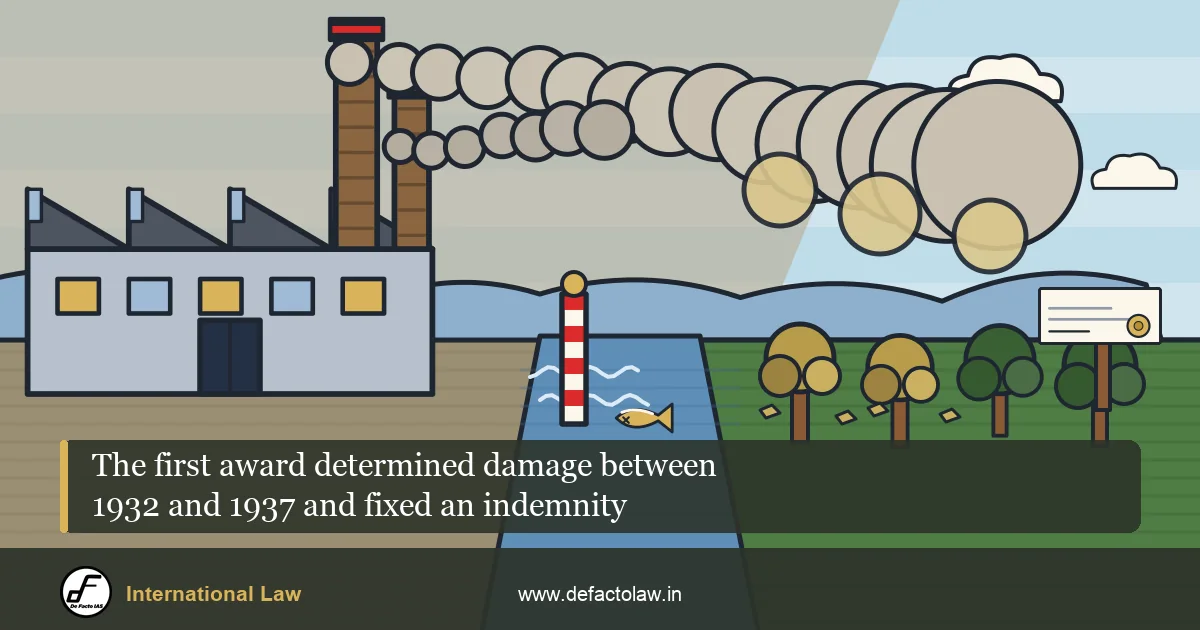
The first award determined damage between 1932 and 1937 and fixed an indemnity. It also held that the United States had not proved injury to livestock, to property in the town of Northport, or to business enterprises.
The tribunal awarded an indemnity of $62,000 for damage to cleared land and to uncleared land other than uncleared land used for timber, and $16,000 for uncleared land used for timber, a total indemnity of $78,000.
Temporary Regime
Since damage might continue, the tribunal established a temporary regime and appointed technical consultants to study the operation of the smelter in relation to meteorological conditions.
The tribunal said that the information then available allowed it to predict "with some degree of assurance" that a permanent régime would effectively prevent future significant fumigations in the United States, without unreasonably restricting the output of the plant.
Law Applied
No Precedent
The tribunal began by surveying the existing authority.
It found that no case of air pollution had been dealt with by an international tribunal. The nearest analogy was water pollution, but no decision of an international tribunal had been cited or found there either.
Analogy
It therefore reasoned by analogy from the decisions of the United States Supreme Court in disputes between States of the Union, which it regarded as in conformity with general rules of international law. It also cited a decision of the Swiss Federal Court between the cantons of Soleure and Argovia.
In that case Soleure sued Argovia to enjoin the use of a shooting establishment which endangered her territory. The Swiss court granted the injunction, reasoning that sovereignty excludes not only the usurpation of another State's sovereign rights but also an actual encroachment which might prejudice the natural use of the territory and the free movement of its inhabitants.
Limits on Demands
The Swiss court nevertheless found that all risk had not been eliminated, because the region was flat and absolutely safe shooting ranges were found only in mountain valleys, and that the communes had a federal duty to provide facilities for military target practice. It held that no more precautions could be demanded for ranges near the boundaries of two cantons than for ranges in the interior of a canton.
Reasonable Controls
The tribunal also took account of scientific progress in the control of fumes.
It noted that the American decrees had gone no further than needed to "diminish materially the present probability of damage" to citizens, and that the great progress made by science in the control of fumes in recent years should be taken into account.
Scholarly Authority
The tribunal cited Professor Eagleton's Responsibility of States in International Law (1928, p. 80) for the proposition that a State owes at all times a duty to protect other States against injurious acts by individuals from within its jurisdiction. It added that international decisions from the Alabama case onward, and earlier ones, rest on the same general principle, which Canada had not questioned.
The Principle
The Holding
In the 1941 award the tribunal stated the principle in one sentence, subject to two qualifications: the case must be "of serious consequence" and the injury must be "established by clear and convincing evidence".
"… no State has the right to use or permit the use of its territory in such a manner as to cause injury by fumes in or to the territory of another or the properties or persons therein …"
Equitable Basis
The tribunal noted that the supporting American decisions were decisions in equity, and that a solution inspired by them, together with the régime it prescribed, would be just to all parties concerned, in the spirit of Article IV, at least as long as the present conditions in the Columbia River Valley continued to prevail.
Canada Responsible
The tribunal attributed the conduct of a private company to the State, and held Canada responsible.
"… the Tribunal holds that the Dominion of Canada is responsible in international law for the conduct of the Trail Smelter."
Apart from the undertakings in the Convention, the award added, it was the duty of the Government of the Dominion to see to it that this conduct was in conformity with Canada's obligation under international law.
Answer to Question 2
In answer to Question 2, the tribunal required the smelter, so long as the present conditions in the Columbia River Valley prevailed, to refrain from causing any damage through fumes in the State of Washington. The damage meant was damage recoverable under the decisions of United States courts in suits between private individuals.
Elements
Serious Consequence
The rule applies only where the case is "of serious consequence". Trivial or reciprocal inconvenience, which neighbouring States must tolerate, falls outside it.
Clear Evidence
The injury must be "established by clear and convincing evidence". The standard is higher than a balance of probabilities and explains why the tribunal rejected claims for livestock and business losses.
Territorial Link
The rule operates on conduct within the territory of one State and effects "in or to the territory of another or the properties or persons therein". Its jurisdictional basis is territorial sovereignty and the correlative duty of respect for the sovereignty of other States.
State Responsibility
The conduct of a private enterprise was attributed to the State because the State has the power to regulate the enterprise and has a duty to do so. The better view is that responsibility arises from the State's failure of regulation, not from the private act as such.
Regime of Control
Permanent Regime
The 1941 award went beyond compensation and imposed a régime on the operation of the smelter, the first example in international practice of a judicial prescription of environmental regulation.
In answer to Question 3, the tribunal decided that a régime or measure of control should be applied to the operations of the smelter and should remain in full force.
Technical Monitoring
The regime relied on meteorological observation and technical supervision, a model of adaptive environmental management.
Under the temporary regime of 1938 the tribunal directed that, before 1 May 1938, the smelter employ a consulting meteorologist adequately trained in the installation and operation of the necessary equipment, the appointment being subject to the approval of the Technical Consultants. It also required sulphur dioxide recorders, stationary and portable, with no more than three stationary recorders.
Performance Duty
The Convention also dealt with performance of the award.
Under Article XII the Governments undertook to take such action as might be necessary to ensure due performance of the obligations undertaken, in compliance with the decision of the tribunal.
Inspection Rights
Part Six of the 1941 decision permitted investigators appointed by either Government, and the members of the Commission provided for in the decision, to inspect the operations of the smelter at all reasonable times. They could also enter and inspect any properties in the State of Washington claimed to be affected by fumes.
Stockholm to Rio
Principle 21
The 1941 principle was generalised in Principle 21 of the Stockholm Declaration (1972), the first global statement of the rule. It pairs the sovereign right of States to exploit their own resources pursuant to their own environmental policies with a duty of restraint.
"… the responsibility to ensure that activities within their jurisdiction or control do not cause damage to the environment of other States or of areas beyond the limits of national jurisdiction."
Principle 22
Principle 22 adds that States shall cooperate to develop further the international law on liability and compensation for the victims of pollution and other environmental damage caused by activities within their jurisdiction or control to areas beyond their jurisdiction.
Rio Principle 2
Principle 2 of the Rio Declaration (1992) reproduces the Stockholm formula, with the sovereign right to exploit resources now exercised pursuant to "environmental and developmental policies".
Notification Duties
The Rio Declaration also develops the procedural dimension of the rule.
Principle 18 requires States to notify other States immediately of natural disasters or other emergencies likely to produce sudden harmful effects on their environment, and calls for every effort by the international community to help States so afflicted. Principle 19 requires prior and timely notification, and relevant information, to potentially affected States about activities that may have a significant adverse transboundary environmental effect, with consultation at an early stage and in good faith.
Risk Transfer
Article 195 of UNCLOS (1982) provides that, in measures to prevent, reduce and control pollution of the marine environment, States must act so as not to transfer damage or hazards, directly or indirectly, from one area to another, or transform one type of pollution into another.
Hazard Relocation
Rio Principle 14 asks States to cooperate effectively to discourage or prevent the relocation and transfer to other States of activities and substances that cause severe environmental degradation or are found to be harmful to human health.
Liability Rules
Rio Principle 13 requires States to develop national law on liability and compensation for the victims of pollution and other environmental damage. States must also cooperate expeditiously and with more determination to develop international law on liability and compensation for the adverse effects of damage caused by activities within their jurisdiction or control to areas beyond their jurisdiction.
Prevention Duty
Corfu Channel
The International Court of Justice grounded the duty on a general principle already stated in Corfu Channel (1949).
"… every State's obligation not to allow knowingly its territory to be used for acts contrary to the rights of other States."
Customary Status
In the Nuclear Weapons opinion, the Court affirmed that the obligation forms part of the corpus of international environmental law.
"… the general obligation of States to ensure that activities within their jurisdiction and control respect the environment of other States or of areas beyond national control is now part of the corpus of international law relating to the environment."
Due Diligence
In Pulp Mills on the River Uruguay (2010), the Court spelled out the standard of conduct the duty requires.
"A State is thus obliged to use all the means at its disposal in order to avoid activities which take place in its territory, or in any area under its jurisdiction, causing significant damage to the environment of another State."
ILC Articles
The International Law Commission codified the duty in its Articles on Prevention of Transboundary Harm from Hazardous Activities (2001).
"The State of origin shall take all appropriate measures to prevent significant transboundary harm or at any event to minimize the risk thereof."
Treaty Law
Marine Environment
Part XII of UNCLOS applies the no-harm rule to marine pollution.
Article 194(2) requires States to take all measures necessary to ensure that activities under their jurisdiction or control are so conducted as not to cause pollution damage to other States and their environment. Pollution arising from incidents or activities under their jurisdiction or control must not spread beyond the areas where they exercise sovereign rights.
Sovereign Right
Article 193 preserves the sovereign right of States to exploit their natural resources pursuant to their environmental policies, but "in accordance with" their duty to protect and preserve the marine environment.
State Responsibility
General Rule
Breach of the no-harm rule engages the ordinary law of State responsibility, as codified by the International Law Commission in 2001.
Article 1 of the ILC Articles on State Responsibility provides that every internationally wrongful act of a State entails the international responsibility of that State. Under Article 2, there is such an act when conduct, by action or omission, is attributable to the State under international law and constitutes a breach of an international obligation of the State.
Reparation
The consequence of responsibility is the obligation of reparation.
In Certain Activities (Costa Rica v. Nicaragua), Compensation, ICJ Reports 2018, para. 42, the Court held that damage to the environment, and the consequent impairment or loss of the ability of the environment to provide goods and services, is compensable under international law.
Criticisms
Dated Context
Critics note that the tribunal's authority rested on a bilateral convention and on American domestic precedent, so that the generality of the rule was asserted rather than demonstrated. The tribunal itself acknowledged the absence of international precedent.
Threshold Problems
The requirement of serious consequence and clear and convincing evidence is demanding. It is poorly adapted to cumulative, diffuse or scientifically uncertain harm, such as acid rain, ozone depletion and climate change, where no single source can be shown to have caused injury to a particular State.
Absolute or Relative
Later practice treats the duty as one of due diligence, not strict liability, consistently with the Soleure decision cited by the tribunal.
Modern Reach
Climate Change
The no-harm rule is the general-law basis on which responsibility for greenhouse gas emissions is now examined, including in the 2024 ITLOS and 2025 ICJ advisory opinions.
Soft Law
The UNFCCC preamble also restates the Stockholm formula.
India
Judicial Reception
Indian courts have drawn on the polluter-pays and precautionary principles and on the doctrine of absolute liability in M.C. Mehta v. Union of India (1987), decided after the Bhopal disaster of 1984, which is the principal domestic example of environmental responsibility exceeding the Rylands v. Fletcher rule.
Transboundary Dimension
India is both an upper riparian and a major emitter, so the rule cuts both ways: it may be a claimant against external sources and a respondent in transboundary water and air disputes.
The Verdict
Enduring Principle
Trail Smelter established that territorial sovereignty includes a duty of restraint as well as a right of use. That principle has proved resilient: it has been restated by treaty, by declaration and by the highest international court, and it remains the starting point of transboundary environmental law.
Answer Map
A strong answer should state the facts and the Convention, quote the 1941 principle with its two qualifications, explain attribution of private conduct to the State, describe the régime, and trace the principle through Stockholm 21, Rio 2, Corfu Channel, Nuclear Weapons and Pulp Mills.
FAQs
What did the Trail Smelter tribunal decide? In its award of 11 March 1941 the tribunal held that, under the principles of international law as well as the law of the United States, no State has the right to use or permit the use of its territory in such a manner as to cause injury by fumes in or to the territory of another when the case is of serious consequence and the injury is established by clear and convincing evidence. Canada was held responsible for the smelter's conduct.
Why is the case important for environmental law? It is the first major international decision on transboundary air pollution and the source of the no-harm rule later codified in Principle 21 of the Stockholm Declaration and Principle 2 of the Rio Declaration.
Was Canada liable although the smelter was privately owned? Yes. The tribunal held that Canada was responsible in international law for the conduct of the Trail Smelter and that the Government had a duty to see that the smelter's conduct conformed to the obligation of Canada under international law.
What is the difference between the no-harm rule and the duty of due diligence? The no-harm rule states the substantive limit on State conduct. Due diligence, as developed in later cases such as Pulp Mills, states the standard of care by which compliance is measured: a State must use all means at its disposal to prevent significant harm, but is not an insurer against all harm.
How is the case relevant to climate change? Scholars invoke the no-harm rule as the general-law foundation for State responsibility for greenhouse gas emissions, though the diffuse and cumulative nature of climate harm makes causation and attribution more difficult than in the single-source facts of Trail Smelter.