
On this page 19 sections
- Roots of the Rule
- Articles 14, 21 and 311
- Administrative or Quasi-Judicial
- Parts of a Fair Hearing
- Content Varies
- When Content Expands
- Why "Exceptions" Misleads
- Statutory Exclusion
- Dispensing With Inquiry
- Emergency and Urgency
- Confidentiality and Witness Safety
- Academic and Mass Cases
- Legislative and Policy Acts
- Hearing After the Decision
- Useless Formality and Prejudice
- Void or Voidable
- Recent Rulings
- Questions Still Open
- Short Answers
Mob violence destroys the ballot papers and boxes of some segments of a constituency before the result is declared. The Election Commission orders a fresh poll across the whole seat, and a candidate asks the court a plain question: could the Commission have cancelled the count without first hearing him? The Commission's side said that notice and hearing would only delay a repoll that the situation demanded.
In Mohinder Singh Gill v. Chief Election Commissioner (1977) the Supreme Court refused to treat speed and fairness as rivals:
"Should the cardinal principle of 'hearing' as condition for decision-making be martyred for the cause of administrative, immediacy? We think not. The full panoply may not be there but a manageable minimum may make-do."
That passage holds the whole subject in small. The maxim audi alteram partem, "hear the other side", is old and firm at its core, yet its shape changes with the facts, and a handful of recognised situations reduce it or remove it.
This article follows the rule from its sources, through its constitutional footing and its working parts, to the situations in which it gives way and the question of what follows when it is broken.
Cases at a glance 17
- Mohinder Singh Gill v. Chief Election Commissioner
- A.K. Kraipak v. Union of India
- Swadeshi Cotton Mills v. Union of India
- Maneka Gandhi v. Union of India
- Union of India v. Tulsiram Patel
- State of Orissa v. Binapani Dei
- K.I. Shephard v. Union of India
- Nigam Prakash Narain v. National Medical Commission
- Managing Director, Electronics Corporation of India v. B. Karunakar
- Hira Nath Mishra v. Principal, Rajendra Medical College
- S.N. Mukherjee v. Union of India
- Dev Dutt v. Union of India
- Jawaharlal Nehru University v. B.S. Narwal
- Bihar School Examination Board v. Subhas Chandra Sinha
- Prag Ice and Oil Mills v. Union of India
- S.L. Kapoor v. Jagmohan
- State Bank of India v. Amit Iron Private Limited
Roots of the Rule
Natural justice is a common-law idea: procedural principles worked out by judges, not written into a statute. Two rules stood at its centre, that no one may be a judge in his own cause and that no one may be condemned unheard. Later cases added further rules, among them the duty to give reasons.
The Supreme Court stated the purpose in A.K. Kraipak v. Union of India (1969):
"The aim of the rules of natural justice is to secure justice or to put it negatively to prevent miscarriage of justice."
The same judgment fixes how the rules sit beside legislation. They operate in areas not covered by a valid law; in the Court's words, "they do not supplant the law of the land but supplement it". A statute that is silent on procedure is read to include them, and a statute that speaks clearly can displace them.
It was once thought that the rules applied only where the authority was required to act judicially. In Swadeshi Cotton Mills v. Union of India (1981) the Court recalled how that view fell, quoting an earlier ruling of its own: "It is too late now to contend that the principles of natural justice need not apply to administrative order or proceedings." The earlier ruling had added that "that heresy was scotched in Ridge v. Baldwin".
Articles 14, 21 and 311
The Constitution does not use the words "natural justice", yet the rule has three constitutional anchors.
Article 21. In Maneka Gandhi v. Union of India (1978) the passport authority impounded a passport "in public interest" and declined to give reasons. The Court read the procedure required by Article 21 as a fair one:
"It must be right and just and fair and not arbitrary, fanciful or oppressive."
It added that "the soul of natural justice is fair play in action". The Passports Act said nothing of a hearing, but the Court held that the silence was not conclusive, because the common law supplies the omission.
Article 14. A decision taken behind a person's back is arbitrary, and arbitrariness offends equality. Union of India v. Tulsiram Patel (1985) put the relation with care:
"Article 14, however, is not the sole repository of the principles of natural justice. What it does is to guarantee that any law or State action violating them will be struck down."
So the rule binds tribunals and bodies outside Article 12 as well, through the common law, while against the State it also carries the force of Article 14.
Article 311(2). For civil servants the Constitution states the rule in terms. A person may not be dismissed, removed or reduced in rank "except after an inquiry in which he has been informed of the charges against him and given a reasonable opportunity of being heard in respect of those charges". Tulsiram Patel called the clause an express statement of the hearing rule, and the same Article carries the best-known exclusion, taken up below.
Administrative or Quasi-Judicial
For a long time the question was whether the authority was acting judicially. State of Orissa v. Binapani Dei (1967) moved the test to the effect of the order. The State held an inquiry into a government servant's date of birth, refixed it so that she stood superannuated, and ordered her compulsory retirement.
The enquiry officer's report was not disclosed to her and she was given no opportunity to meet the evidence used against her. The Court said:
"If there is power to decide and determine to the prejudice of a person, duty to act judicially is implicit in the exercise of such power."
Kraipak then removed the line. Its reasoning is practical:
"Arriving at a just decision is the aim of both quasi-judicial enquiries as well as administrative enquiries."
The Court observed that an unjust administrative decision may do more harm than a quasi-judicial one, and that the line between the two is hard to draw. The facts there were about bias, not hearing: the acting Chief Conservator of Forests of Jammu and Kashmir sat on the board that selected officers for the Indian Forest Service while himself a candidate, and the selection was set aside.
Commentary on the case notes that other limbs of a hearing were not needed in such a selection, since an interview already lets the board see each candidate. That is the first sign that the rule is a bundle of steps and that a court asks which of them the case needs.
The test today is civil consequences. K.I. Shephard v. Union of India (1987) applied the rule to administrative acts that cost people their jobs. Three private banks, Hindustan Commercial Bank, Bank of Cochin and Lakshmi Commercial Bank, were amalgamated with larger banks, and 125 of their employees were left out of the transfer.
The Reserve Bank had argued that scheme-making was legislative in character and that the employees had no right to be heard; the Court held that rules of natural justice apply even when a State agency acts administratively.
Parts of a Fair Hearing
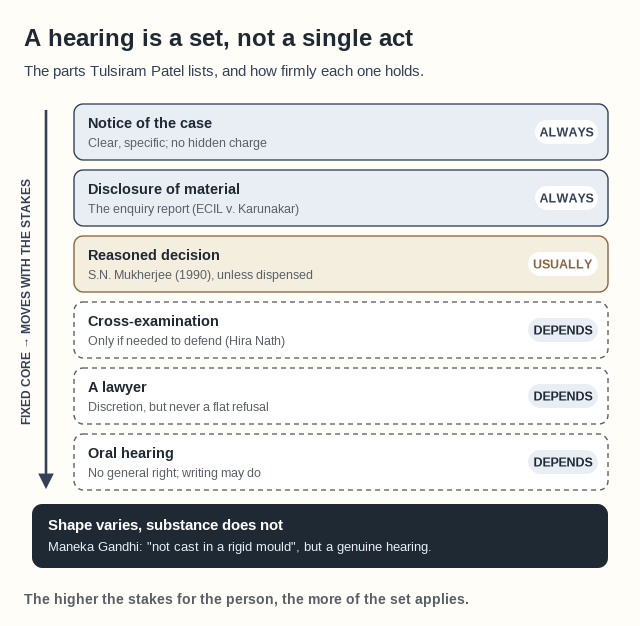
"Hearing" is not one act. Tulsiram Patel sets out the rule at its fullest, and the list is a useful map of the topic. A person against whom an order may be passed must be
"informed of the allegations and charges against him, be given an opportunity of submitting his explanation thereto, have the right to know the evidence, both oral or documentary"
and, in the same passage, to have witnesses examined in his presence and cross-examined, and to lead his own evidence. The Court added at once that "the process of a fair hearing need not, however, conform to the judicial process in a court of law". Each part has its own case law.
Notice of the Case
Without notice nothing else works, since no one can answer a charge he has not seen. The grounds must be clear and specific, and a notice that hides the real case is not a notice at all. The point was decided against the Medical Council in a 2026 appeal.
A doctor had been charged with a fake faculty declaration and had answered the charge fully, backed by passport records showing he was abroad on the day of inspection. After the Council's executive committee sent the file back, the ethics committee found him guilty of something different, that he had not disclosed an earlier inspection at another college. In Nigam Prakash Narain v. National Medical Commission (2026) the Court said:
"There has, indeed, been a breach of principles of natural justice."
It recalled that once an employee has defended a charge successfully, the authority cannot punish him on a different charge without a fresh show cause notice.
Disclosure of Material
A decision-maker may not rely on a document or statement the person has never seen. The enquiry report is the usual battleground. In the leading case on it, the Constitution Bench in Managing Director, Electronics Corporation of India v. B. Karunakar held that where the inquiry officer is not the disciplinary authority, the employee is entitled to a copy of the report before the authority decides on guilt, and that service rules denying it are invalid. The Court also held that non-supply does not by itself void the order; the employee must show prejudice.
The same logic reached bank-fraud proceedings in 2026, discussed below. Disclosure has limits where witnesses face danger, taken up under confidentiality.
Evidence and Cross-Examination
Ideally evidence is taken in the person's presence and he may test it by cross-examination. Courts, however, do not insist on this in administrative adjudication unless the person cannot otherwise put up an effective defence. Hira Nath Mishra v. Principal, Rajendra Medical College (1973) shows the limit. Girl students in a hostel reported a night-time intrusion by male students.
A three-member committee recorded the girls' statements in the absence of the accused, told each accused the substance of the complaint without naming the complainants, and gave them a chance to answer. The students were expelled for two academic sessions. The Supreme Court upheld the procedure.
Legal Representation
Representation by a lawyer is not a free-standing part of natural justice. Where service rules are silent the matter lies in the discretion of the enquiry authority, but that discretion cannot be fettered by a flat refusal. Courts have favoured counsel where livelihood is at stake, the matter is complex, or the employer is represented by a legally trained officer.
Statutes may bar lawyers altogether, as the Industrial Disputes Act does for certain proceedings, and student disciplinary proceedings have usually been closed to them.
Reasoned Decision
Reasons show that the answer was actually weighed. The Constitution Bench in S.N. Mukherjee v. Union of India (1990) laid down the general duty:
"except in cases where the requirement has been dispensed with expressly or by necessary implication, an administrative authority exercising judicial or quasi-judicial functions is required to record the reasons for its decision."
The 2026 bank ruling repeated an older description of what reasons must do: "They should reveal a rational nexus between the facts considered and the conclusions reached." An appellate authority that merely affirms need not write a fresh essay, but the order must stand on the reasons it records and cannot be improved afterwards by affidavit.
Oral Hearing
There is no general right to a personal hearing. A written representation can be enough unless the statute gives an oral one or the matter cannot be fairly presented without it. The 2026 bank ruling, taken up under recent rulings, tests this directly.
Content Varies
The rule is not a fixed ritual. Maneka Gandhi puts it this way:
"The audi alteram partem rule is not cast in a rigid mould and judicial decisions establish that it may suffer situational modifications."
The Court then fixed what cannot move: "the hearing must be a genuine hearing and not an empty public relations exercise". The hearing may be sophisticated, or "very brief and minimal"; it may come before the decision, or "even be a post-decisional remedial hearing". Hira Nath Mishra had said the same: "Rules of natural justice cannot remain the same applying to all conditions."
Mohinder Singh Gill gave the formula that is most often cited, that the content of natural justice "is a dependent variable, not an easy casualty".
What decides the shape? The facts and statute, the nature of the power, the body deciding, and the stakes for the person. Dismissal from service calls for more than a ranking in a selection list, and a ban from borrowing for years calls for more than a routine administrative notice. The core stays: notice of the case and a fair chance to answer.
When Content Expands
The same flexibility works upward. Dev Dutt v. Union of India (2008) arose from an engineer in the Border Roads Engineering Service who missed promotion because his confidential report for one year read "good" when the benchmark was "very good". The entry had never been shown to him. The Court held that the non-communication was arbitrary and so violated Article 14:
"every entry must be communicated to the employee concerned, so that he may have an opportunity of making a representation against it if he is aggrieved."
It said plainly that natural justice grows:
"Thus natural justice has an expanding content and is not stagnant."
The Court added that a court may develop new principles of natural justice in appropriate cases. Dev Dutt is the counterpart of the cases that narrow the rule: the same doctrine produced both results from the facts in front of the Court.
Why "Exceptions" Misleads
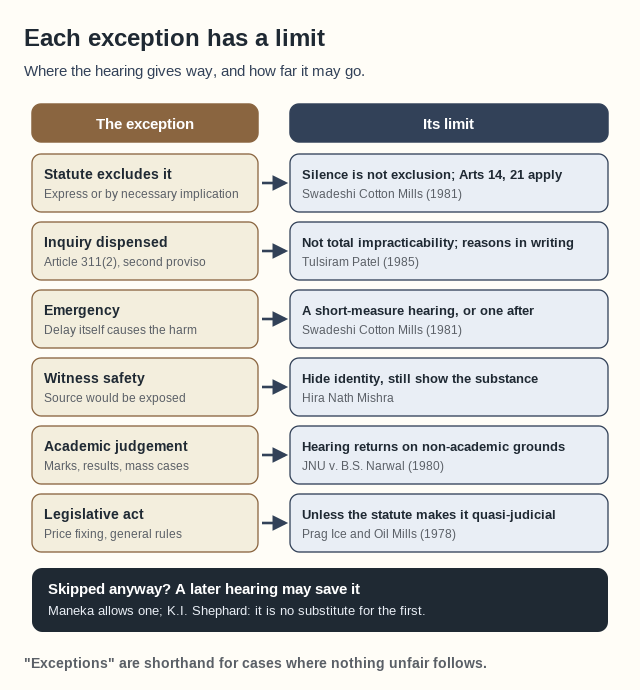
The usual list of exceptions is a convenient summary and nothing more. In Swadeshi Cotton Mills the Court reproduced the earlier view that the "exceptions" are a shorthand for cases in which "nothing unfair can be inferred by not affording an opportunity to present or meet a case".
Where a hearing could serve no fair purpose, or where the legislature has said so, or where speed or safety forbids it, leaving it out is not a departure from fairness. A court also does not accept a bare claim of exclusion. The Court insists on reading the statute, the situation and the stake.
| Ground | Leading case | What was held |
|---|---|---|
| Statute or Constitution | Tulsiram Patel (1985) | Second proviso to Article 311(2) excludes the inquiry; judicial review remains |
| Emergency | Swadeshi Cotton Mills (1981); Mohinder Singh Gill (1977) | Hearing may be cut down to the exigency, not removed without reason |
| Confidentiality | Hira Nath Mishra (1973) | Witnesses not exposed; substance of the evidence disclosed |
| Academic judgment | JNU v. B.S. Narwal (1980) | No hearing before removal for poor academic performance |
| Impracticable numbers | Bihar School Examination Board (1970) | Whole examination cancelled without hearing each examinee |
| Legislative action | Prag Ice and Oil Mills (1978) | Price fixing is legislative; natural justice not required |
Statutory Exclusion
A valid statute may exclude the rule, expressly or by necessary implication. Tulsiram Patel recalled the test from an earlier ruling:
"if on the other hand a statutory provision either specifically or by necessary implication excluded the application of any or all the principles of natural justice then the court cannot ignore the mandate of the legislature"
Whether exclusion is intended depends, as Swadeshi Cotton Mills said, on "the language and basic scheme of the provision", the nature of the power, its purpose and its effect. Silence is not exclusion. Courts try first to read a statute consistently with fairness, since lawmakers are presumed to intend it.
In Swadeshi Cotton Mills itself, the word "immediate" in Section 18AA of the Industries (Development and Regulation) Act did not exclude the rule; it meant only that the Government might act without a prior investigation under Section 15.
The Constitution also excludes the rule in places. Commentary lists Articles 22, 31A, 31B, 31C and 311(2) as examples. Even then, an exclusion that is arbitrary can be tested under Articles 14 and 21.
Dispensing With Inquiry
The second proviso to Article 311(2) is the sharpest exclusion. It allows dismissal, removal or reduction in rank without an inquiry in three cases: after conviction on a criminal charge; where the authority records in writing that it is not reasonably practicable to hold the inquiry; and where the President or Governor is satisfied that it is not expedient in the interest of the security of the State.
The Constitution Bench in Tulsiram Patel upheld the proviso but hedged its use. On the middle clause it said:
"It is not a total or absolute impracticability which is required by clause (b)."
The test is whether a reasonable man, taking a reasonable view of the prevailing situation, would hold the inquiry not practicable. The Court gave examples: witnesses terrorised, the disciplinary authority threatened, or a general atmosphere of violence and indiscipline. It then fenced the power:
"A disciplinary authority is not expected to dispense with a disciplinary inquiry lightly or arbitrarily or out of ulterior motives"
and the finality in Article 311(3) does not bind a court exercising judicial review. The Court also held that the civil servant keeps a departmental appeal, which it called a wider remedy than a mere representation.
Emergency and Urgency
Where delay itself creates the harm, notice and hearing cannot come first. Swadeshi Cotton Mills states the proposition:
"Audi alteram partem rule may be disregarded in an emergent situation where immediate action brooks no delay to prevent some imminent danger or injury or hazard to paramount public interests."
It gave examples: the conditional order under Section 133 of the Code of Criminal Procedure to remove a dangerous public nuisance, action under Section 17 of the Land Acquisition Act, and measures of public safety or health. The same judgment warns against loose use: "The rule cannot be sacrificed at the altar of administrative convenience or celerity". Urgency must be real, not a label.
The mill takeover in that case under Section 18AA was passed on 13 April 1978, as the Government said, because the company's encumbrances on its assets had affected production. The Court held that a "short-measure fair hearing adjusted, attuned and tailored to the exigency of the situation" was still practicable.
Maneka Gandhi similarly accepted that impounding a passport may need to be swift, while holding that this did not wipe out hearing, since a remedial hearing could follow. Mohinder Singh Gill left it to the election tribunal to decide what hearing was possible in the repoll, noting that even a telephone call might do in a crisis.
Confidentiality and Witness Safety
Some proceedings fail if the source is exposed. In Hira Nath Mishra the Court compared the case with the Goonda Acts, which allow evidence to be collected behind a person's back, and said the reason for withholding identity is obvious: "No witness will come forward to give evidence in the presence of the goonda."
Fairness was kept by telling each student the substance of the complaint and allowing a reply, though without revealing the girls' names or giving the committee's report.
Commentary lists other settings: police surveillance registers, and the dropping of an additional High Court judge from confirmation. Courts still lean against secrecy, and the 2026 bank ruling, discussed later, allowed redaction of a forensic report only where disclosure would affect the privacy of third parties, for reasons recorded.
Academic and Mass Cases
Jawaharlal Nehru University v. B.S. Narwal (1980) concerned seven students at the Centre of Russian Studies who were struck off the rolls in January 1976 for unsatisfactory performance, having cleared no core course. The Court held no hearing was needed:
"The very nature of the function of academic adjudication (if the use of the word adjudication is permissible in the context) appears to us to negative any right to an opportunity to be heard."
It added the limits: if the assessment "permitted the consideration of 'non-academic' circumstances also, a right to be heard may be implied", and bias or mala fides change the picture.
The related exclusion is impracticability. In Bihar School Examination Board v. Subhas Chandra Sinha (1970), results at one centre of the 1969 secondary examination were abnormally high against an average of about 50 per cent elsewhere, and the Board cancelled the examination there. The High Court held the candidates should have been heard. The Supreme Court reversed, as the evidence was plain and no one had been charged with unfair means:
"To make such a decision depend upon a full-fledged judicial inquiry would hold up the functioning of such autonomous bodies as Universities and School Boards."
Legislative and Policy Acts
Rules of general application do not require a hearing for each person affected. In Prag Ice and Oil Mills v. Union of India (1978) the Court recalled its earlier ruling on sugar price control:
"Price fixation is more in the nature of a legislative measure even though it may be based upon objective criteria found in a report or other material."
It could not therefore give rise to a complaint that natural justice was ignored, unless the statute made price fixing quasi-judicial. Commentary adds that for a law passed by Parliament no principle of natural justice is attracted, and that the Bhopal gas claims statute was upheld on that reasoning.
The line between a general rule and a measure aimed at identifiable persons is not always clear, as the bank amalgamation scheme in Shephard shows: the Court looked at its effect on named employees, not at its label.
Tulsiram Patel gave the general caution: "The principles of natural justice must be confined within their proper limits and not allowed to run wild."
Hearing After the Decision
Where hearing before action truly cannot be given, Indian law accepts one afterwards. Maneka Gandhi is the source. The Government withheld reasons for impounding the passport, which the Court called "a fatal defect", but the Attorney General then undertook that any representation would be considered. The Court held that this cured the order, since the passport authority could act first and give "an opportunity of hearing, remedial in aim" immediately after.
Swadeshi Cotton Mills went further in one respect and drew a limit in another. It held that Section 18F of the Act, which allowed cancellation of a takeover, gave a post-decisional hearing, but of it the Court said:
"The so-called post-decisional hearing contemplated by Section 18F cannot be-and is not intended to be-a substitute for a pre-decisional hearing."
The takeover order was therefore invalid for want of a prior hearing, yet the Court did not quash it, because the Solicitor-General committed the Government to a full and effective hearing. The Court remitted the matter with a direction to complete it, preferably within three months.
The limit appears more sharply in K.I. Shephard. The Court refused to accept a hearing after the employees had already been thrown out of jobs:
"It is common experience that once a decision has been taken, there is a tendency to uphold it and a representation may not really yield any fruitful purpose."
The employees' representations came after the schemes were framed, and the Court held the normal rule should apply. Commentary adds H.L. Trehan, where the same reasoning struck down service-condition changes made with only a post-decisional hearing. The rule that emerges is that post-decisional hearing is a remedy for true emergencies and low-harm decisions, not a general substitute. In Tulsiram Patel the departmental appeal served that purpose for dismissed civil servants.
Useless Formality and Prejudice
A familiar defence runs: a hearing could have changed nothing, so the breach does not matter. Indian law has two answers. The strict one is in S.L. Kapoor v. Jagmohan (1980), where the Lieutenant Governor of Delhi superseded the New Delhi Municipal Committee without letting it answer the allegations. The Court held the order vitiated for want of hearing, although with the Committee's term almost over it did not order reinstatement. On prejudice it said:
"The non-observance of natural justice is itself prejudice to any man and proof of prejudice independently of proof of denial of natural justice is unnecessary."
The Court noted a narrow reservation. Where on admitted or indisputable facts only one conclusion is possible and under the law only one penalty is permissible, the Court may refuse a writ,
"not because it is not necessary to observe natural justice but because Courts do not issue futile writs."
The Court in Swadeshi Cotton Mills adopted the strict answer, listing cases of "unanswerable charges which, in the event, were completely answered".
The prejudice answer is softer, and recent service cases lean on it. In Karunakar the Court said that failure to supply the inquiry report does not itself void the order, and the employee must show that the report could have made a difference. In Nigam Prakash Narain the Court found a breach, yet noticed that the doctor could not explain why his declaration omitted the earlier inspection.
Its remedy was to ask the Medical Commission to reduce the penalty of three months' removal from the register to a censure, using Article 142, after a decade of litigation. The breach was acknowledged and the punishment still shrank, although the order itself was not undone.
Void or Voidable
The effect of a breach divides courts. One view says an order made without hearing is a nullity. Binapani Dei said so, and Swadeshi Cotton Mills collected the position:
"a quasi-judicial or administrative decision rendered in violation of the audi alteram partem rule, wherever it can be read as an implied requirement of the law, is null and void."
The Court nevertheless refrained from striking down the takeover because of the Government's assurance, and in practice relief is shaped by the facts. Commentary lists decisions in both directions: orders made without hearing held void where hearing was part of a fundamental right restriction or an implied requirement of law; and cases where silence by the person, with no grave injustice, kept the order alive.
A person who knew of his right and did not raise it may lose the point, unless the defect goes to the root. A provision made for one person's benefit may be waived; one made in the public interest may not.
Recent Rulings
Bank Fraud Accounts, 2026
State Bank of India v. Amit Iron Private Limited (2026) asked how far the rule reaches before a bank classifies a borrower's account as fraud. Under the Reserve Bank's Master Directions the bank issues a show cause notice, considers the reply and passes a reasoned order. Borrowers claimed a personal hearing as well.
The Court noted that classification has serious civil consequences: the matter is reported to investigating agencies, and debarment from institutional finance is akin to blacklisting. It still held that no personal hearing was required:
"Oral hearing is bound to convert an administrative process which was intended to be swift, into a protracted one, defeating the very purpose of the exercise."
The Court reasoned that classification rests mainly on documents, that delay would let borrowers dissipate assets, and that notice, supply of evidence, a reply and a reasoned order together "are more than adequate safeguards". Disclosure, however, was not diluted. The audit reports, including the forensic audit report, must be supplied to the borrower:
"We reiterate that the rule is to supply the audit reports, including the forensic audit reports"
with redaction allowed only for third-party privacy, for recorded reasons. The ruling shows the flexibility principle at work in one decision: the oral hearing is dropped, the core stays.
Questions Still Open
Several points remain unsettled. Post-decisional hearing is said to be an exception, yet the line between an emergency that justifies it and a convenience that does not is drawn case by case. The effect of a breach has not been reduced to one rule, because the strict answer in S.L. Kapoor and the prejudice answer in Karunakar coexist.
Reasons are required of quasi-judicial bodies by S.N. Mukherjee, but the extent to which purely administrative decisions must give them remains contested, and commentary notes that an administrative decision may be defended on grounds of efficiency. Oral hearing is the live frontier: the 2026 bank ruling denies it where documents decide the matter, yet the Court itself treated the stakes as grave.
And the growth in Dev Dutt, which brought confidential reports within natural justice, invites further claims against every internal step that shapes a career.
The 2022 paper asked for the significance of the maxim and the exceptions to it.
Short Answers
Q: What does audi alteram partem require at a minimum?
Notice of the case and a real chance to answer it, before a decision that harms the person. What more is needed depends on the statute, the stakes and the situation.
Q: Is there a constitutional basis for the rule?
Yes. Article 21 requires a fair procedure, Article 14 reaches arbitrary decisions, and Article 311(2) states the rule for civil servants.
Q: Can a statute or the Constitution exclude it?
Yes, expressly or by necessary implication, as the second proviso to Article 311(2) does. Silence in a statute does not exclude it.
Q: Is a hearing after the order ever enough?
Sometimes. Maneka Gandhi and Swadeshi Cotton Mills accepted it where prior hearing could not be given, while Shephard and Trehan refused it where employees had already lost their livelihood.
Q: Does a breach always void the order?
No. Some cases call it a nullity, and others require the person to show prejudice, so relief depends on the right breached and the facts.
Sources: Constitution of India, Articles 14, 21, 22, 311, as set out in the judgments below; Mohinder Singh Gill v. Chief Election Commissioner (1977); A.K. Kraipak v. Union of India (1969); State of Orissa v. Binapani Dei (1967); Maneka Gandhi v. Union of India (1978); S.L. Kapoor v. Jagmohan (1980); Swadeshi Cotton Mills v. Union of India (1981); Union of India v. Tulsiram Patel (1985); K.I. Shephard v. Union of India (1987); S.N. Mukherjee v. Union of India (1990); Dev Dutt v. Union of India (2008); Hira Nath Mishra v. Principal Rajendra Medical College (1973); Jawaharlal Nehru University v. B.S. Narwal (1980); Bihar School Examination Board v. Subhas Chandra Sinha (1970); Prag Ice and Oil Mills v. Union of India (1978); State Bank of India v. Amit Iron Private Limited (2026); Nigam Prakash Narain v. National Medical Commission (2026); commentary on the principles of natural justice in administrative law.