
On this page 12 sections
A State legislature, concerned about the proliferation of gambling, passes a law requiring all lottery businesses operating in the State to obtain a licence and pay a fee. Parliament protests: lotteries organised by the State Government fall within its exclusive domain.
Does the State law encroach on Parliament's territory, or is it a legitimate regulation of trade and commerce within the State? The answer turns entirely on the pith and substance of the law — what it is really about, stripped of its label.
This question — which legislature owns a given law — is one the courts face repeatedly in a federal constitution. India's Seventh Schedule distributes legislative subjects across three Lists with painstaking specificity, yet the lists cannot perfectly anticipate every regulation that a modern legislature might devise.
Where one law seems to touch more than one Entry, or where Union and State legislation appear to occupy the same space, the pith and substance doctrine is the principal constitutional tool for resolving the conflict.
Cases at a glance 22
- Vijay Kumar Sharma v. State of Karnataka
- Subramaniyan Chettiar v. Muttuswami Goundan
- Bhikaji Narain Dhakras v. State of M.P
- Southern Pharmaceuticals and Chemicals v. State of Kerala
- Jaora Sugar Mills Pvt. Ltd. v. State of M.P
- United Provinces v. Atiga Begum
- Federation of Hotel and Restaurant Association of India v. Union of India
- Hoechst Pharmaceuticals Ltd. v. State of Bihar
- Ahmedabad Municipal Corporation v. GTL Infrastructure Ltd
- State of Bombay v. Balsara
- Bharat Sanchar Nigam Ltd. v. Union of India
- A.S. Krishna v. State of Madras
- Deep Chand v. State of U.P
- State of W.B. v. Kesoram Industries Ltd
- K.C. Gajapati Narayana Deo v. State of Orissa
- R.S. Joshi v. Ajit Mills Ltd
- Lord Krishna Sugar Mills v. Union of India
- State of M.P. v. Mahalaxmi Fabric Mills Ltd
- All-India Federation of Tax Practitioners v. Union of India
- Godfrey Phillips India Ltd. v. State of U.P
- Kesavananda Bharati v. State of Kerala
- Karnataka Bank Ltd. v. State of A.P
Article 246
Entries as Fields
Article 246 of the Constitution distributes legislative power between Parliament and the State legislatures by reference to three Lists in the Seventh Schedule — the Union List (List I), the State List (List II), and the Concurrent List (List III).
Parliament has exclusive power over List I subjects, the State legislatures have exclusive power over List II subjects, and both may legislate over List III subjects, subject to parliamentary supremacy in the event of repugnancy.
The scope of this distribution, examined in detail under the distribution of legislative powers, rests on a foundational principle: the Entries in the Lists are not themselves the sources of legislative power.
They merely demarcate the fields of legislation — the legislative heads under which laws may be made. — Vijay Kumar Sharma v. State of Karnataka (1990). Power to make a law flows from Article 246 itself; the Entries define the subject matter over which that power may be exercised.
This distinction has a practical consequence: because the Entries are definitional and not power-conferring, the courts must always look through the Entry to the substance of the legislation it purports to support.
A law does not become valid merely because a legislature has invoked the correct Entry in its statement of objects; the question is whether the law, examined in its entirety, is genuinely about the subject described in that Entry.
With Respect To
The operative phrase in Article 246 is "with respect to" — Parliament may make laws "with respect to" matters in List I, and State legislatures may make laws "with respect to" matters in List II. It is precisely this phrase that activates the pith and substance doctrine.
When a question of vires of any enactment is raised, it must be seen whether, "looking at the legislation as a whole, it can be said to be a legislation substantially" — as distinguished from a remote connection — "with respect to any of the entries in the list." — Subramaniyan Chettiar v. Muttuswami Goundan (AIR 1941); Bhikaji Narain Dhakras v. State of M.P. (1955).
A law is "with respect to" a subject when it has a substantial — not merely incidental or peripheral — connection to that subject. If the connection is only remote, the law fails the test. If it is substantial, the law belongs to the Entry in question, and incidental effects on other subjects do not displace that attribution.
True Nature
What Courts Examine
The foundational rule of the pith and substance doctrine is stated with precision in Southern Pharmaceuticals and Chemicals v. State of Kerala (AIR 1981): "The true nature and character of a legislation and not its consequences or economic effects shall determine to which Entry it belongs, in its 'pith and substance'."
Two things follow from this. First, the court looks at what the law substantively does — its operative provisions, its main purpose, its dominant effect — not at what economic or social consequences it might produce.
A law regulating the sale of pharmaceuticals, for instance, may have the secondary economic effect of restricting competition; that economic effect does not transform it into a trade and commerce regulation if its true character is a regulation of public health.
Second, the court looks at the legislation as a whole, not at isolated provisions. It is the overall character of the enactment — the sum of its operative parts read together — that determines its Entry, not the label its sponsor has attached to it.
For the purpose of investigating the substance of an enactment, the court examines two things: (a) the effect of the legislation, and (b) the object or purpose of the Act — meaning the legislative purpose as revealed by its terms and scheme, not the motive of the legislature in enacting it. — Jaora Sugar Mills Pvt. Ltd. v. State of M.P. (AIR 1966).
Substantial Connection
The test requires a substantial connection between the law and the Entry claimed to support it. A remote or tangential connection will not do. Where the connection between the law and an Entry in another legislature's list is substantial, the law falls within that Entry and is outside the competence of the enacting legislature.
Where the connection is remote — where the law's primary substance lies elsewhere and it only touches another Entry incidentally — the incidental encroachment does not affect validity.
This distinction between substantial and remote connection is what separates a law that genuinely belongs to Entry X from a law that merely brushes against Entry X while doing something entirely different. Courts trained in the pith and substance approach do not look for any connection; they look for the dominant one.
Ancillary Powers
Once a law is found to be substantially in respect of a given Entry, the legislative power conferred by that Entry extends to all ancillary matters that may fairly and reasonably be said to be comprehended in that topic of legislation. — United Provinces v. Atiga Begum (AIR 1941).
The pith and substance inquiry is therefore both a limiting and an extending exercise: it may exclude a law from an Entry where its true character lies elsewhere, but once an Entry is established, the legislature's power under it reaches all that is reasonably ancillary to that Entry's subject matter.
Three-Step Approach
The pith and substance doctrine is only one part of a structured judicial approach to apparent conflicts between legislative lists. The Hon'ble Supreme Court has laid down a three-step methodology for handling such conflicts.
Read Lists Together
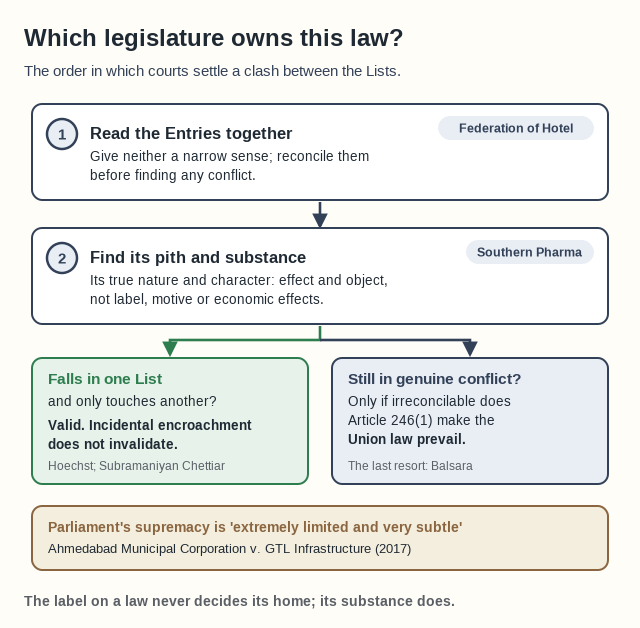
In the case of a seeming conflict between entries in the Union and State lists, "the entries should be read together without giving a narrow or restricted sense to either of them."
The attempt must be to see whether a fair reconciliation can be achieved by giving a somewhat less wide meaning to one Entry without doing violence to its language, while simultaneously giving the other Entry a meaning it can properly bear. — Federation of Hotel and Restaurant Association of India v. Union of India (AIR 1990).
The lists are not written to conflict; they are written to work together in a federal scheme.
The territorial and legislative framework within which Parliament and the State legislatures operate is premised on mutual respect for each other's assigned spheres. The first obligation of the court is to read the Entries in a way that respects both spheres, not to rush to a finding of conflict.
Reconcile First
Conflict between the two lists should be resolved, if at all possible, without invoking the non-obstante clause of Article 246(1), which declares parliamentary supremacy. The principle of parliamentary supremacy "cannot be resorted to unless there is an 'irreconcilable' conflict between entries in the Union and State lists." — Hoechst Pharmaceuticals Ltd. v. State of Bihar (AIR 1983).
No question of conflict between two lists will arise at all if the impugned legislation, by the application of the pith and substance doctrine, appears to fall exclusively under one List, and any encroachment upon another List is only incidental. — Subramaniyan Chettiar v. Muttuswami Goundan (AIR 1941).
The Supreme Court in Ahmedabad Municipal Corporation v. GTL Infrastructure Ltd. (2017) reinforced this approach with particular emphasis, observing that although Article 246 has been understood as laying down parliamentary supremacy, "such supremacy, if any, is extremely limited and very subtle" — and that the Constitution deserves to be interpreted, language permitting, in a manner that does not whittle down State legislative powers and preserves federalism, which is a basic feature of the Constitution.
Non-Obstante Clause
Only when all attempts at reconciliation have genuinely failed — when the conflict is irreconcilable and cannot be resolved by the pith and substance inquiry or harmonious construction — should the court apply Article 246(1) to give Parliament's enactment supremacy over the State's. The non-obstante clause is not the starting point of the analysis; it is the last resort. — State of Bombay v. Balsara (1951).
Incidental Encroachment
A recurring issue in vires challenges is whether a law, while primarily within one legislature's competence, may incidentally trespass into another list. The answer in Indian constitutional law is clear: incidental encroachment does not invalidate.
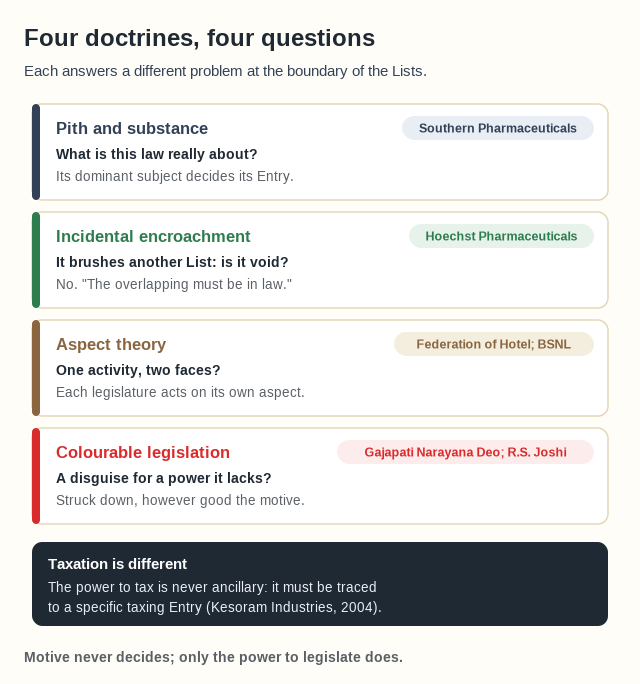
A law "with respect to" a subject may incidentally "affect" another subject, but that is not the same thing as the law being on the latter subject. "There might be overlapping; but the overlapping must be in law." — Hoechst Pharmaceuticals Ltd. v. State of Bihar (AIR 1983).
Put differently: the pith and substance of the law determines its constitutional home. If the substance belongs to Entry X, incidental effects that touch Entry Y do not displace the law from Entry X. The same transaction may, in its different aspects, involve subjects covered by more than one Entry, but the distinctive character of each aspect is not destroyed by the fact of overlap.
Incidental effects on other subjects are the price of a functioning federal legislature; they cannot be used to destabilise every piece of legislation that crosses a subject-matter boundary.
Aspect Theory
A related but distinct doctrine — the aspect theory — complements the pith and substance analysis in particular situations.
The aspect theory holds that "subjects which in one aspect and for one purpose fall within the power of a particular legislature may in another aspect and for another purpose fall within another legislative power." — Federation of Hotel and Restaurant Association of India v. Union of India (1989).
The aspect doctrine deals with legislative competence, not incidental effects. — Bharat Sanchar Nigam Ltd. v. Union of India (2006).
Where the same activity has genuinely two faces — say, gambling as a matter of public order (a State subject) and gambling as a matter of inter-State commerce (a Parliamentary subject) — both legislatures may legislate on the activity, each acting within its own aspect.
There is no conflict because the laws, though touching the same activity, operate on different aspects of it. The validity of each law must be assessed by reference to its own aspect, not by reference to the other legislature's law on a different aspect.
The aspect theory thus recognises that the real world does not divide itself neatly along constitutional lines. Transactions, activities, and persons may simultaneously exhibit aspects belonging to different lists. Both legislatures retain power over their respective aspects; neither can use its aspect to crowd out the other.
Article 254
The pith and substance doctrine has an especially important role to play in the context of repugnancy under Article 254, which governs conflicts between Union and State laws on Concurrent List subjects. Article 254 is only engaged when both laws relate to the same Concurrent subject.
Before the court can even examine whether a State law is repugnant to a Union law, it must first establish — by applying the pith and substance doctrine — that the State law is indeed, in its pith and substance, a law relating to the Concurrent List.
If the State law is found to be covered by an entry in the State List — even though it touches the Concurrent List incidentally — Article 254 has no application. The State legislature has exclusive jurisdiction over State List subjects, and incidental contact with a Concurrent subject does not bring the State law within Article 254's ambit. — A.S. Krishna v. State of Madras (AIR 1957).
Conversely, "there is no question of applying Art. 254, unless the State law is, in its 'pith and substance', a law relating to the Concurrent List." — Deep Chand v. State of U.P. (AIR 1959).
Courts have also emphasised that the invasion by a State legislature into the field of the Union legislature must be of considerable magnitude before the pith and substance of the tax can be said to be a Union subject.
"Unless the court forms an opinion that the extent of the alleged invasion by a State legislature into the field of the Union legislature is so great as would justify the view that in pith and substance the impugned tax is a tax within the domain of the Union legislature, the levy of tax would not be liable to be struck down." — State of W.B. v. Kesoram Industries Ltd. (2004).
Colourable Legislation
Closely related to the pith and substance doctrine is the doctrine of colourable legislation, which applies when a legislature attempts to use the form of one Entry to achieve the substance of an Entry it does not possess.
The idea is that a legislature's transgression of its constitutional limits may be "patent, manifest, or direct" — or it may be "disguised, covered, and indirect." It is to this latter class that the expression "colourable legislation" applies. — K.C. Gajapati Narayana Deo v. State of Orissa (AIR 1954).
Colourable legislation is sometimes called "legislative fraud" — the notion being that although a legislature appears to be acting within its limits, in substance and in reality it has transgressed them, the transgression being veiled by what is, on proper examination, a mere pretence or disguise.
If a law, apparently enacted under one entry in the legislative list, falls, in truth and fact, within the content not of that entry but of one assigned to another legislature, it can be struck down as colourable even though the motive of the legislature was commendable. — R.S. Joshi v. Ajit Mills Ltd. (AIR 1977).
Competence, Not Motive
A critical clarification: the doctrine of colourable legislation has nothing to do with the motive of the legislature. It is, in essence, a question of vires — of power.
If the legislature had the power to make the law, the fact that its motive was questionable is irrelevant; if it lacked the power, the fact that its motive was laudable is equally irrelevant. — K.C. Gajapati Narayana Deo v. State of Orissa (AIR 1954).
The separation of powers demands that constitutional boundaries of legislative competence be enforced regardless of the attractiveness of any particular legislative programme.
Effect and Object
To unravel a plan of fraud on constitutional powers, the court must look to the substance and not merely the form of the Act. For this purpose, it will examine the effect of the legislation and the object or purpose of the Act — while carefully excluding from consideration the private motives or legislative reasoning that led the legislature to exercise its powers.
The same Act may even need to be examined alongside other Acts in order to ascertain the true pith and substance of the impugned legislation. — Lord Krishna Sugar Mills v. Union of India (AIR 1959).
The doctrine of colourable legislation does not apply to subordinate legislation — it applies only to Acts of the legislature itself. — State of M.P. v. Mahalaxmi Fabric Mills Ltd. (1995). Nor does it apply where the legislature is entirely unfettered by constitutional limitations; it becomes relevant only where specific limitations on legislative competence exist.
Taxation
The doctrine of pith and substance applies with particular force — and with some important modifications — in the domain of taxation. This is because the Seventh Schedule treats taxation entries as a categorically distinct class, separate from the general legislative entries.
Distinct Entries
In the scheme of the Lists in the Seventh Schedule, there exists a clear distinction between the general subjects of legislation and heads of taxation. They are separately enumerated. Taxation is not intended to be the main subject of a general entry but is treated as a distinct matter for purposes of legislative competence.
In List I, Entries 1 to 81 describe legislative subjects and Entries 82 to 92C enumerate taxes. In List II, Entries 1 to 44 describe State legislative subjects and Entries 45 to 63 deal with taxes. This architecture of clear separation is deliberate. — State of W.B. v. Kesoram Industries Ltd. (2004).
For taxation entries in particular, the doctrine of pith and substance has an important role to play in deciding the scope of each entry in the three Lists, since "taxation is not intended to be the main subject in which an extended construction can be given" — the test applicable to general entries cannot be applied to taxation entries in the same way. — All-India Federation of Tax Practitioners v. Union of India (2007).
The court must identify the true taxing event — the moment or transaction upon which the tax liability actually crystallises — and assign the tax to the Entry that covers that event, not the Entry whose label the legislature has invoked.
Power to Tax
The second special rule is that under India's constitutional scheme, the power to tax is not an incidental power. Although legislative power generally includes all incidental and subsidiary powers necessary to carry out the main purpose of the legislation, taxation is an exception.
"The power to tax cannot be deduced from a general legislative entry as an ancillary power." — State of W.B. v. Kesoram Industries Ltd. (2004).
This has a concrete implication for pith and substance analysis in tax cases: a State cannot argue that because it has power under a general Entry (say, public health) it may also impose a tax incidentally related to that subject, without a specific taxation Entry to support it.
The general power and the taxing power occupy separate columns in the constitutional architecture, and the latter must always be traced to a specific taxing Entry. The financial relationship between the Centre and States is built on this principle of strict demarcation between fiscal and general legislative competence.
Mutual Exclusivity
The taxing entries in Lists I and II are mutually exclusive; their joint architecture is intended to prevent both overlapping and gaps. "Taxing entries must be construed with clarity and precision so as to maintain such exclusivity, and a construction of a taxation entry which may lead to overlapping must be eschewed." — Godfrey Phillips India Ltd. v. State of U.P. (2005).
If the taxing power has been placed in a particular legislative field, other fields must be construed to exclude it, so that there is no possibility of constitutional trespass.
This rule prevents what might otherwise be a tempting manoeuvre: a State legislature framing a tax nominally under an Entry it possesses (say, Entry 62 of List II for luxuries) while in substance levying a tax on the same taxable event that is covered by an Entry in List I (say, Entry 84 for manufacture).
Courts will pierce the label and identify the true taxing event; if that event falls within Parliament's exclusive domain, the State tax fails. — Godfrey Phillips India Ltd. v. State of U.P. (2005).
Federalism
Running through all of the above — the doctrine itself, the three-step approach, the incidental effects rule, the aspect theory — is a foundational interpretive commitment: federalism is a basic feature of the Constitution.
The theory of basic structure established in Kesavananda Bharati v. State of Kerala (AIR 1973 SC 1461) places federalism among those constitutional features that cannot be amended away. The pith and substance doctrine is one of the principal judicial instruments for giving that commitment practical content.
As the Supreme Court observed in Ahmedabad Municipal Corporation v. GTL Infrastructure Ltd. (2017), the Constitution deserves to be interpreted in a manner that "does not whittle down the powers of the State legislature and preserves federalism while also upholding the Central supremacy contemplated by some of its articles."
Parliamentary supremacy under Article 246(1) is "extremely limited and very subtle"; conflict or encroachment between the lists must be ironed out by the courts, and only on a failure to do so does the non-obstante clause apply.
The pith and substance doctrine is thus not merely a technical canon of statutory interpretation. It is the constitutional guarantee that a federal distribution of power — carefully crafted in the Seventh Schedule — will actually be respected in practice. Without it, any legislature could encroach on the other's domain by the simple device of mislabelling its legislation.
Judicial Review
The courts have been equally careful to define the limits of their own role in vires adjudication. Where validity of a statute is questioned and two interpretations are possible — one making the law valid and the other void — the former must be preferred. — Karnataka Bank Ltd. v. State of A.P. (2008).
There is a presumption in favour of constitutionality; it is for the party challenging validity to demonstrate that the law falls outside the enacting legislature's competence.
In pronouncing on constitutional validity, "the court is not concerned with the wisdom of the law." If a law is within the scope of power conferred on a legislature and violates no restriction on that power, it must be upheld regardless of what the court may think of it.
The court's function under the pith and substance doctrine is to locate the law's true constitutional home, not to evaluate the policy it embodies. Constitutional remedies under Articles 32 and 226 are available to challenge ultra vires legislation, but those remedies engage only the question of power, not the merits of the law.
In taxation particularly, courts are expected to show greater deference — giving the legislature "a greater latitude — like play in the joints" — recognising that fiscal matters "do not admit solutions through any doctrinaire or straitjacket formula." — State of W.B. v. Kesoram Industries Ltd. (2004).
Even here, however, the pith and substance inquiry remains non-negotiable: a taxing statute must be traced to a valid taxing Entry, and no amount of deference will validate a tax whose true character belongs to another legislature's domain.
Conclusion
The pith and substance doctrine performs a function in India's federal constitutional order that is both mundane and indispensable. Mundane, because it asks a straightforward question: what is this law really about?
Indispensable, because without an answer to that question, the entire architecture of the Seventh Schedule — its three lists, its hundreds of entries, its intricate demarcation of Union and State powers — would be reduced to a catalogue that legislators could sidestep by the simple device of mislabelling their work.
By directing courts to look past form, label, and declared purpose to the true nature and character of a law, the doctrine ensures that the constitutional framework for Centre-State relations is enforced with substance, not merely with ceremony.
The aspect theory, the incidental effects rule, and the doctrine of colourable legislation each contribute to this framework in their own way — addressing the situations, respectively, where a subject genuinely has two legislative faces, where a law legitimately brushes against another list, and where a legislature has attempted constitutional fraud through a pretence of competence.
Together, these doctrines constitute the constitutional law of legislative boundaries — the corpus of principles by which India's courts determine, day after day, which legislature is the true owner of each law that comes before them.
Frequently Asked Questions
Q: What is the pith and substance doctrine in Indian constitutional law?
The pith and substance doctrine is a principle of constitutional adjudication used to determine the true legislative competence behind an enactment.
When the validity of a law is challenged on the ground that it belongs to another legislature's exclusive domain, courts examine the true nature and character of the legislation — its dominant purpose and operative effect — rather than its form, label, or economic consequences.
If the law's pith and substance falls within the enacting legislature's assigned Entry, it is valid, even if it incidentally affects a subject assigned to the other legislature.
Q: How does the pith and substance doctrine differ from the aspect theory?
The pith and substance doctrine asks which legislature a given law truly belongs to: it locates the dominant subject of the legislation. The aspect theory operates differently — it recognises that the same activity or subject may have two genuine aspects, each falling under a different legislature's competence.
Where both legislatures act on their respective aspects, there is no conflict. Pith and substance resolves the question of which legislature owns a particular law; the aspect theory accommodates the reality that two legislatures may concurrently legislate on different faces of the same subject.
Q: What is colourable legislation and how does the pith and substance doctrine address it?
Colourable legislation arises when a legislature, lacking power to enact a law in substance, disguises it as a law within its competence by using the form or label of a permitted Entry. The doctrine of colourable legislation strikes down such laws by looking past the disguise to the true substance of the enactment.
Motive is irrelevant — the question is purely one of constitutional power. If the law's true subject, revealed by its pith and substance, belongs to another legislature's domain, it is invalid, however laudable the legislature's purpose may have been.
Q: Why is the power to tax treated differently from general legislative power under the pith and substance doctrine?
The Constitution's Seventh Schedule treats taxation entries as categorically distinct from general legislative entries — they are separately enumerated in each List. The Supreme Court in State of W.B. v. Kesoram Industries Ltd. (2004) held that the power to tax is not an incidental power: it cannot be deduced from a general legislative entry and must always be traced to a specific taxing Entry.
Courts therefore apply pith and substance analysis to identify the true taxing event, and if that event falls within the exclusive taxing domain of the other legislature, the tax fails — regardless of which general Entry the enacting legislature has cited.
Q: When does Parliament's supremacy under Article 246(1) apply?
Article 246(1) makes Parliament supreme when its legislative domain conflicts with the State legislature's domain.
However, the non-obstante clause in Article 246(1) applies only as a last resort — after the court has: (a) read the Lists together without narrowing either; (b) attempted to reconcile the apparent conflict; and (c) applied the pith and substance doctrine to see whether the law belongs exclusively to one List.
Parliamentary supremacy is invoked only when genuine, irreconcilable conflict between the lists persists after these steps. The courts have repeatedly emphasised that federal balance is a basic feature of the Constitution and that the State legislature's powers must not be whittled down unnecessarily.