

On this page 14 sections
A mob of ten men storms a rival's house. Two of them fire pistols. Three swing axes. Five stand at the gate, weapons raised but unused. The two who fired are convicted of murder. What of the remaining eight?
If the prosecution invokes Section 34 IPC (common intention), it must prove a shared mental design — a prior meeting of minds — in which each of the eight consciously agreed to the criminal enterprise that ended in murder.
If it invokes Section 149 IPC (common object), it must prove membership in an unlawful assembly of five or more persons, pursuing one of five enumerated objects, with knowledge that murder was likely to be committed in prosecution of that object. The accused at the gate may escape Section 34 if no prior concert is proved; they may not so easily escape Section 149.
This difference — between a provision requiring an agreed criminal plan and one requiring only informed membership in a dangerous assembly — is not merely doctrinal.
It determines who gets convicted of murder in a group attack, how many acquittals are needed to collapse the charge, and what the prosecution must prove to hold every participant liable. Understanding it is indispensable for every criminal practitioner and law student.
Cases at a glance 41
- Suresh v State of Uttar Pradesh
- Nanak Chand v State of Punjab
- Sheo Mahadeo Singh v State of Bihar
- Hemchandra Jha v State of Bihar
- Surinder Singh v State of Punjab
- Ram Tahal v State of Uttar Pradesh
- Chittarmal v State of Rajasthan
- Virendra Singh v State of Madhya Pradesh
- Rishideo Pande v State of Uttar Pradesh
- Hanuman Prasad v State of Rajasthan
- Gopi Nath v State of Uttar Pradesh
- Dani Singh v State of Bihar
- Masalti v State of Uttar Pradesh
- Gangadhar Behera v State of Orissa
- Rajendra Shantaram Todankar v State of Maharashtra
- Chanda v State of Uttar Pradesh
- Bhagwan Singh v State of Madhya Pradesh
- Amzad Ali v State of Assam
- Vithal Bhimashab Koli v State of Maharashtra
- Moti Das v State of Bihar
- Willie (William) Slaney v State of Madhya Pradesh
- Bhudeo Mandal v State of Bihar
- Amar Singh v State of Punjab
- Hamlet v State of Kerala
- Sat Pal v State of Punjab
- Krishna Govind Patil v State of Maharashtra
- Akbar Sheikh v State of West Bengal
- Abdul Hamid v State of Uttar Pradesh
- Amerika Rai v State of Bihar
- Lalji v State of Uttar Pradesh
- Chandra Bihari Gautam v State of Bihar
- Bunnilal Chaudhary v State of Bihar
- Shambhunath Singh v State of Bihar
- Nawab Ali v State of Uttar Pradesh
- Sukha v State of Rajasthan
- Bhimrao v State of Maharashtra
- Jaswant Singh v State of Haryana
- Khacheru Singh v State of Uttar Pradesh
- Karnail Singh v State of Punjab
- Jagir Singh v State of Punjab
- Piara Singh v State of Punjab
Structural Contrast
Before examining the substance of each provision, the structural difference must be stated plainly, for it shapes everything that follows.
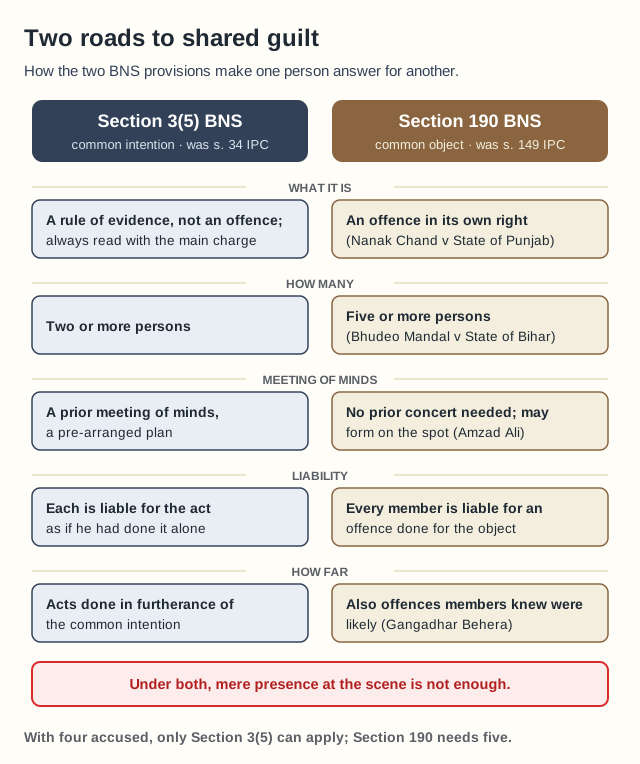
Section 34 IPC establishes a rule of evidence — it does not create a substantive offence but creates joint and constructive liability for a crime committed in furtherance of common intention (Suresh v State of Uttar Pradesh AIR 2001 SC 1344).
It operates alongside a substantive charge (say, murder under Section 302) and enables each participant to be held liable for the totality of the act as if he had done it alone. There is no such thing as an offence under Section 34 alone; it must always be read with a principal offence.
Section 149 IPC, by contrast, creates a substantive offence (Nanak Chand v State of Punjab AIR 1955 SC 274). Being a member of an unlawful assembly is itself punishable under Section 143 IPC.
Section 149 then provides the mechanism by which each member becomes vicariously liable for offences committed by any other member in prosecution of the common object — making the underlying offence (murder, grievous hurt, etc.) attributable to all members (Sheo Mahadeo Singh v State of Bihar AIR 1970 SC 1492).
An accused charged under Section 302 read with Section 149 is not charged under a rule of evidence; he is charged under a provision that creates the substantive basis for group liability through assembly membership.
This structural distinction has important procedural consequences, which the subsequent sections develop.
Common Intention
Two Postulates
The Supreme Court in Suresh v State of Uttar Pradesh AIR 2001 SC 1344 identified two indispensable postulates for Section 34 to operate: (i) the criminal act, consisting of a series of acts, must have been done not by one person but by more than one person; and (ii) the doing of every such individual act, cumulatively resulting in the commission of the criminal offence, must have been in furtherance of the common intention of all such persons.
When both aspects are proved, each such person is liable for the criminal act as if it were done by him alone.
Common intention and participation of the accused in the criminal act are sine qua non of the constructive criminal liability created by Section 34 (Hemchandra Jha v State of Bihar (2008) 11 SCC 303). Unless common intention and participation are both present, Section 34 does not come into play (Surinder Singh v State of Punjab (2006) 13 SCC 533).
Prior Concert
A common intention must be anterior in time to the commission of the crime, showing a pre-arranged plan and prior concert (Ram Tahal v State of Uttar Pradesh AIR 1972 SC 254). Common intention denotes action in concert and necessarily postulates a pre-arranged plan implying a prior meeting of minds (Chittarmal v State of Rajasthan AIR 2003 SC 796).
The dominant feature of common intention is a simultaneous consensus of the minds of persons participating in a criminal action to bring about a particular result (Virendra Singh v State of Madhya Pradesh (2010) 8 SCC 407).
The Supreme Court has consistently held that this consensus may form on the spot — there need not be a long interval of time between its formation and the commission of the act (Rishideo Pande v State of Uttar Pradesh AIR 1955 SC 331) — but its formation, however instantaneous, must precede the criminal act.
The crucial test is that the plan must precede the act constituting the offence (Suresh v State of Uttar Pradesh AIR 2001 SC 1344). The intention of each one of the group must be known to and shared by the rest of them (Hanuman Prasad v State of Rajasthan (2009) 1 SCC 507).
Participation
Beyond common intention, Section 34 requires that each co-accused participate in the criminal act in furtherance of the shared design. An act — whether overt or covert, substantial or peripheral — is indispensable. Where a person has a common intention with others for the accomplishment of a crime but does no act in furtherance of it, Section 34 will not be invoked (Suresh v State of Uttar Pradesh AIR 2001 SC 1344).
However, the act need not be an assault or a physically violent act; a covert act (such as standing guard, luring the victim, or signalling the approach of the target) is sufficient, as is, in certain circumstances, an illegal omission (Gopi Nath v State of Uttar Pradesh AIR 2001 SC 2493).
Unlawful Assembly
Five Objects
An assembly of five or more persons is designated an 'unlawful assembly' if the common object of its members falls within any of the five clauses of Section 141 IPC:
- to overawe by criminal force, or show of criminal force, the Central or any State Government, Parliament, a State Legislature, or any public servant in the exercise of lawful power;
- to resist the execution of any law or legal process;
- to commit any mischief, criminal trespass, or other offence;
- by means of criminal force or show of criminal force to any person, to take or obtain possession of any property, or deprive any person of the enjoyment of any right of way, water, or other incorporeal right; or
- by means of criminal force or show of criminal force to compel any person to do what he is not legally bound to do, or to omit to do what he is legally entitled to do.
The expression 'common intention' is undefined and thereby has unlimited operation under Section 34, while 'common object' under Section 149 cannot go beyond these five enumerated objects (Dani Singh v State of Bihar (2004) Cr LJ 3328 (SC)). This is an important limitation: Section 149 liability is confined to objects falling within Section 141's enumerated categories.
Constructive Criminality
Section 149 IPC provides that if an offence is committed by any member of an unlawful assembly in prosecution of the common object of that assembly, or such as the members of that assembly knew to be likely to be committed in prosecution of that object, every person who is a member of the assembly at the time of the commission of that offence is guilty of that offence.
The liability under Section 149 is vicarious in character and is based on membership, not on individual participation in the offence (Masalti v State of Uttar Pradesh AIR 1965 SC 202).
The principle is that every person who is a member of an unlawful assembly, engaged in prosecuting its common object, is responsible for the offence which fulfils or tends to fulfil the object — although he had no individual intention to commit the offence (Sheo Mahadeo Singh v State of Bihar AIR 1970 SC 1492).
Two Clauses
Section 149 operates through two clauses of different scope. The first clause covers offences committed in prosecution of the common object — offences done with a view to accomplish the very thing the assembly set out to do. The offence must be connected immediately with the common object (Gangadhar Behera v State of Orissa AIR 2002 SC 3633).
The second clause extends liability to offences which, though not directly in prosecution of the common object, members of the assembly knew were likely to be committed. This knowledge limb is broader than the prosecution limb and may fasten liability on members even for acts that go beyond the original design, provided the likelihood of such acts was within their knowledge.
The two clauses vary in degree of certainty: the first is more specific; the second embraces acts beyond the common object where prior knowledge of likelihood is established (Rajendra Shantaram Todankar v State of Maharashtra AIR 2003 SC 1110).
Central Distinction
This is the fulcrum on which the entire comparison rests. Common object does not require prior concert and a common meeting of minds before the attack (Chanda v State of Uttar Pradesh (2004) 5 SCC 141; Bhagwan Singh v State of Madhya Pradesh AIR 2002 SC 1621; Gangadhar Behera v State of Orissa AIR 2002 SC 3633).
It is enough if each member has the same object in view, they are five or more in number, and they act as an assembly to achieve such object (Gangadhar Behera v State of Orissa AIR 2002 SC 3633).
Common objects may develop instantaneously, and being a question of fact, may always be inferred and deduced from the facts and circumstances of a case (Amzad Ali v State of Assam AIR 2003 SC 3587).
This structural difference carries profound practical consequences. Under Section 34, if the prosecution cannot establish that the accused had a pre-arranged plan — if the evidence shows only that they happened to be at the scene and joined in without any prior meeting of minds — the Section 34 charge fails.
Under Section 149, by contrast, members may arrive at the scene separately and without any prior arrangement, yet become members of an unlawful assembly when they join together to assault the deceased and the common object develops co instanti — on the spot, at that very instant (Vithal Bhimashab Koli v State of Maharashtra AIR 1983 SC 179).
Indeed, an assembly which was not unlawful when it assembled may subsequently become unlawful (Moti Das v State of Bihar AIR 1954 SC 657). The common object has to be ascertained from the acts and language of the members and from all surrounding circumstances, and the time of its formation is not material (Gangadhar Behera v State of Orissa AIR 2002 SC 3633).
No active participation of a member is required in the commission of an offence committed in prosecution of the common object — such participation is an essential element of an offence committed in furtherance of common intention (Willie (William) Slaney v State of Madhya Pradesh AIR 1956 SC 116).
Number Requirement
Section 149 operates only when there is an assembly of five or more persons. This numerical threshold, absent entirely from Section 34, has significant implications. An assembly of four people, however violent, cannot constitute an unlawful assembly and cannot attract Section 149 liability.
There must be an assembly of five or more persons having a common object and the doing of acts by the members must be in pursuance of that object (Bhudeo Mandal v State of Bihar AIR 1981 SC 1219). Section 34, having no such minimum number requirement, can operate with as few as two persons.
Effect of Acquittals
The number requirement intersects critically with the problem of acquittals.
Where the prosecution alleges that a specified number of persons alone participated, and after acquittal of some the remaining accused are fewer than five, they may not be convicted under Section 149 for any offence — the fundamental condition of a five-person unlawful assembly cannot be satisfied (Amar Singh v State of Punjab AIR 1987 SC 826). The conviction based on Section 149 would collapse entirely.
However, where the evidence shows that apart from the named accused there were also unnamed or unidentified members who were part of the assembly, the conviction of named accused may be sustained even if all named co-accused are acquitted — provided the evidence supports the inference that unnamed participants made up the requisite number (Hamlet v State of Kerala (2003) 10 SCC 108).
The prosecution must not only name accused but must also establish the existence of the assembly as a body of five or more.
Under Section 34, by contrast, the acquittal of one co-accused does not automatically collapse the charge against the other. Where the prosecution case is that two specific persons acted together, the acquittal of one leaves the other liable only for his individual act (Sat Pal v State of Punjab AIR 1996 SC 201).
But where the case involves unnamed participants, even one remaining named accused may be convicted for jointly acting with unnamed others (Krishna Govind Patil v State of Maharashtra AIR 1963 SC 1413).
No Overt Act
Mere Presence
Under both Section 34 and Section 149, mere presence at the scene is insufficient to ground criminal liability. A mere innocent person in an assembly of persons, or a bystander, is not a member of an unlawful assembly (Bhagwan Singh v State of Madhya Pradesh AIR 2002 SC 1621).
No common object can be inferred from mere presence unless there are direct or circumstantial indicators of sharing the common object (Akbar Sheikh v State of West Bengal (2009) 7 SCC 415). A person is not guilty of a crime merely because he was present unless his complicity may be inferred by some act or by way of constructive liability (Abdul Hamid v State of Uttar Pradesh AIR 1991 SC 339).
Active Mind
What Section 149 requires beyond mere physical presence is proof that the accused was not a mere passive spectator but shared the common object and was present with an active mind in furtherance of that object (Amerika Rai v State of Bihar AIR 2011 SC 1379).
Once a court comes to a finding that the accused had constituted an unlawful assembly and committed the crime, it is not open to the court to examine which members actively participated and to acquit those who did not — membership in the assembly with the common object suffices (Lalji v State of Uttar Pradesh AIR 1989 SC 754).
This is the critical contrast with Section 34. Under Section 34, participation in a criminal act — doing something in furtherance of the common intention — is indispensable. Under Section 149, membership with the common object is sufficient.
Once the unlawful assembly is established and the common object proved, every member is liable for offences committed in prosecution of that object, whether or not he individually struck a blow, fired a shot, or did anything more than stand as part of the assembly. It is no defence to say that a person did not with his own hands commit the offence (Lalji v State of Uttar Pradesh AIR 1989 SC 754).
The practical consequence is stark: under Section 149, the man standing at the gate with a raised weapon — who commits no individual act of violence — is as liable for the murder committed inside the house by his co-members as the man who fired the shot, provided he was a member of the assembly with the relevant common object.
Knowledge Limb
Likelihood vs Possibility
The second clause of Section 149 extends liability to offences which, though not directly in prosecution of the common object, the members of the assembly knew to be likely to be committed. The word 'knew' implies something more than a mere possibility and may not be made to bear the sense of 'might have been known' (Gangadhar Behera v State of Orissa AIR 2002 SC 3633).
The knowledge of the consequential action in furtherance of the initial common object is sufficient (Chandra Bihari Gautam v State of Bihar AIR 2002 SC 1836), but a mere possibility of the commission of an offence does not enable the court to draw an inference that the likelihood of commission was within the knowledge of every member (Rajendra Shantaram Todankar v State of Maharashtra AIR 2003 SC 1110).
Such knowledge of likelihood must be reasonably attributed to the accused to justify conviction (Bunnilal Chaudhary v State of Bihar (2006) 10 SCC 639).
The distinction between Section 149's prosecution limb (direct and actual pursuit of the common object) and the knowledge limb (acts beyond the object but within members' knowledge) is therefore one of degree: both require more than a remote possibility, but the knowledge limb requires proof that the commission of the further offence was a foreseeable — not certain — consequence of the assembly's activity.
Variable Knowledge
An important dimension of Section 149 is that the knowledge possessed by each member of what is likely to be committed may vary not only according to the information at his command but also according to the extent to which he shares the community of object (Gangadhar Behera v State of Orissa AIR 2002 SC 3633).
The effect of Section 149 may therefore be different on different members of the same unlawful assembly (Shambhunath Singh v State of Bihar AIR 1960 SC 725).
A member who joined the assembly for a limited purpose and shared the common object only to a limited extent may have a different — and narrower — scope of knowledge than the instigator. Courts must individualise the knowledge assessment rather than applying a single uniform standard to all members.
No vicarious criminal liability can be fastened on a person who, before the commission of the offence, goes away and ceases to be a member of the unlawful assembly (Nawab Ali v State of Uttar Pradesh (1974) 4 SCC 600). Withdrawal from the assembly before the offence is committed takes the withdrawing member outside the scope of Section 149.
Formation and Abandonment
The common object under Section 149 is not static. It may be formed at the beginning of the assembly or during the course of an incident, on the spot or at any stage by all or a few members — with the other members joining and adopting it subsequently.
Once formed, it need not remain the same; it may be modified, altered, or abandoned at any stage (Gangadhar Behera v State of Orissa AIR 2002 SC 3633).
This flexibility is one of the most practically important features of Section 149. An assembly that began with a lawful purpose can transform into an unlawful assembly during events. Where five or more persons exceed the original lawful object and each has the same unlawful intention in mind and they act together, they thereby form an unlawful assembly (Sukha v State of Rajasthan AIR 1956 SC 513).
Even where members arrive on the scene separately and without prior arrangement, they become members of an unlawful assembly when they join together in assault and the common object develops co instanti (Vithal Bhimashab Koli v State of Maharashtra AIR 1983 SC 179).
Members of the original unlawful assembly who only shared the original common object of committing a lesser offence may not be liable to a subsequent change in the common object of some members when the assembly splits (Bhimrao v State of Maharashtra AIR 2003 SC 1493). Liability follows the object each member actually shared at each stage.
Overlap and Substitution
Both Section 34 and Section 149 deal with vicarious or constructive liability (Jaswant Singh v State of Haryana AIR 2000 SC 1833). In given factual situations, both may apply — where there is both a prior meeting of minds and an unlawful assembly of five or more — and the charge may be framed under both, read with the substantive offence.
Where Section 149 cannot be made out (e.g., for want of five persons), Section 34 may still operate if common intention and participation are proved. Non-applicability of Section 149 is no bar in convicting an accused if the evidence discloses commission of an offence in furtherance of the common intention of all (Chittarmal v State of Rajasthan AIR 2003 SC 796).
In a case originally charged for a common object offence where an unlawful assembly is not established, Section 34 may still be invoked if the evidence to prove common intention is the same as the evidence that would have proved common object (Khacheru Singh v State of Uttar Pradesh AIR 1956 SC 546).
Substitution of Section 149 by Section 34 or vice versa is permissible where the facts to be proved and the evidence to be adduced are the same, since failure to charge under one will not result in prejudice in such cases (Karnail Singh v State of Punjab AIR 1954 SC 204).
Where, however, the facts required to establish common object differ materially from those needed to establish common intention, substitution ought not to be permitted (Jagir Singh v State of Punjab AIR 1968 SC 43).
Practical Stakes
Framing the Charge
In practice, the choice between Section 34 and Section 149 — or the decision to charge under both — is one of the most consequential decisions a prosecutor makes.
A charge framed under Section 302 read with Section 149 requires the prosecution to establish: (a) an unlawful assembly of five or more; (b) a common object falling within Section 141; and (c) murder committed in prosecution of that object or within the knowledge of the members.
A charge under Section 302 read with Section 34 requires: (a) more than one person; (b) a common intention; and (c) participation in the criminal act.
The lower evidential threshold for Section 149 — no prior concert needed, no specific overt act by every accused needed — often makes it the stronger charge in spontaneous group violence. The higher threshold for Section 34 — requiring a proved meeting of minds — makes it harder to sustain in cases where the assembly came together unexpectedly.
Partial Acquittals
The different consequences of partial acquittals under each provision are among the most practically significant aspects of this distinction:
Under Section 149, the acquittal of co-accused reducing the remaining convicted accused to fewer than five will, in the typical case, cause the entire Section 149 conviction to collapse — there is no longer a valid unlawful assembly (Amar Singh v State of Punjab AIR 1987 SC 826).
The prosecution must have established the existence of unnamed participants to survive this scenario (Hamlet v State of Kerala (2003) 10 SCC 108).
Under Section 34, the acquittal of one co-accused does not mechanically relieve the other — but where the prosecution's case is confined to specifically named individuals acting together, and all but one are acquitted, that remaining individual is liable only for his own act (Sat Pal v State of Punjab AIR 1996 SC 201; Piara Singh v State of Punjab (1980) 2 SCC 401).
Scope of Liability
Section 34's reach is unlimited in terms of the objects it can cover — it operates wherever there is a shared criminal design, whatever the nature of that design. Section 149's reach is confined to the five objects specified in Section 141.
No vicarious criminal liability under Section 149 can be fastened for pursuing an object that does not fall within the five enumerated categories. This limitation is practically important in cases where the assembly's purpose involves commercial disputes, land occupation, or other matters that may not squarely fit the five objects.
Landmark Cases
Willie (William) Slaney v State of Madhya Pradesh AIR 1956 SC 116 is the foundational authority on the structural contrast: Section 149 creates constructive criminal liability through membership (no active participation required), while participation in the criminal act is an essential element of the offence committed in furtherance of common intention under Section 34.
Chittarmal v State of Rajasthan AIR 2003 SC 796 restated the key proposition: common intention denotes action in concert and necessarily postulates the existence of a pre-arranged plan implying a prior meeting of minds, while common object does not necessarily require proof of prior meeting of minds or pre-concert.
Non-applicability of Section 149 is no bar to conviction under Section 34 if the evidence establishes common intention.
Masalti v State of Uttar Pradesh AIR 1965 SC 202 established the test for appreciating evidence in large-scale group violence: quality of evidence over quantity of witnesses; the conviction under Section 149 may be sustained even where some accused who caused injuries are identified and others are not, since Section 149 operates by reason of membership in the assembly, not by specific attribution of individual acts.
Gangadhar Behera v State of Orissa AIR 2002 SC 3633 provided the most comprehensive modern restatement of the common object doctrine — its formation on the spot, its modifiability, and the contrast between the prosecution limb and the knowledge limb of Section 149.
Jaswant Singh v State of Haryana AIR 2000 SC 1833 summarised the key differences: both provisions deal with vicarious criminal liability, but under Section 34 emphasis is on physical presence and promotion or facilitation of the crime; under Section 149 mere membership in the unlawful assembly with a common object may be sufficient.
BNS Transition
Section 3(5) BNS
Section 3(5) of the Bharatiya Nyaya Sanhita, 2023 is the direct counterpart of Section 34 IPC. The comparison prepared by IPS officer Anil Kishore Yadav records: "Section is included as sub-section in BNS sans heading. No other change." The provision is now one of a series of general explanatory sub-sections within Section 3 BNS.
The text is unchanged; the entire body of Section 34 jurisprudence — including the prior concert requirement and its relaxation — remains fully operative. For offences committed on or after 1 July 2024, charges under common intention should cite Section [substantive offence] BNS read with Section 3(5) BNS.
BNS Sections 189-190
The unlawful assembly provisions are significantly restructured — but not substantively altered — under the BNS. Section 189 BNS is a consolidated provision encompassing all the unlawful assembly sub-provisions. Its sub-sections correspond to the various IPC provisions as follows:
Section 189(1) BNS corresponds to Section 141 IPC (definition of unlawful assembly). The five objects are now designated as clauses (a), (b), (c), (d) and (e) rather than 'first, second, third, fourth, fifth', but the substance is unchanged.
Section 189(2) BNS corresponds to Section 142 IPC (being a member of an unlawful assembly). Included as sub-section; no substantive change.
Section 189(3) BNS corresponds to Section 145 IPC (joining or continuing in an unlawful assembly knowing it has been commanded to disperse).
Section 189(4) BNS corresponds to Section 144 IPC (joining an unlawful assembly armed with deadly weapons).
Section 190 BNS — the critical provision — corresponds to Section 149 IPC (every member of an unlawful assembly guilty of offence committed in prosecution of the common object). The comparison records: "No change." Every judicial pronouncement on Section 149 IPC continues to govern under Section 190 BNS.
Rioting Change
Section 191(3) BNS, corresponding to Section 148 IPC (rioting while armed with a deadly weapon), introduces one notable enhancement: the upper limit of imprisonment is increased from three years to five years. This change is relevant in cases where a Section 149 charge is accompanied by rioting charges, as the enhanced punishment for armed rioting now signals a stronger legislative stance on organised group violence.
Conclusion
The distinction between common intention under Section 34 IPC (Section 3(5) BNS) and common object under Section 149 IPC (Section 190 BNS) is not a distinction between two similar provisions with different labels. It is a distinction between two fundamentally different theories of joint criminal liability, each resting on a different philosophical foundation.
Common intention rests on the idea that persons who agree to commit a crime together bear equal responsibility for the totality of what is done pursuant to that agreement. The agreement — however briefly formed — is what separates the co-conspirator from the bystander.
Common object rests on a different and more expansive idea: that persons who knowingly join a dangerous assembly directed at an unlawful purpose take responsibility for what that assembly does, because everyone must be taken to have intended the probable and natural result of the combination of acts in which they joined (Willie (William) Slaney v State of Madhya Pradesh AIR 1956 SC 116).
Section 34 demands the tighter, more intimate connection of a shared plan. Section 149 demands only the informed choice to remain part of an assembly one knows to be dangerous. Between these two standards lies a considerable stretch of territory — and the practitioner's art, in any group violence prosecution, lies in accurately mapping the facts onto one provision or the other.
With the Bharatiya Nyaya Sanhita, 2023 now in force, the substantive content of both provisions is preserved without change. The structural reorganisation — common intention into Section 3's general explanations, unlawful assembly into Section 189, and Section 149's group liability into Section 190 — alters the citation but not the doctrine.
Frequently Asked Questions
Q: What is the single most important difference between Section 34 and Section 149 IPC?
The most important difference is whether prior concert is required. Section 34 IPC requires a pre-arranged plan — a prior meeting of minds — shared by all co-accused before the commission of the act.
Section 149 IPC, by contrast, does not require any prior concert or common meeting of minds before the attack (Chittarmal v State of Rajasthan AIR 2003 SC 796). Under Section 149, the common object may form on the spot, among persons who came together without prior arrangement, provided they are five or more in number and the object falls within Section 141.
Q: Does Section 149 IPC require an overt act by each member of the unlawful assembly?
No. Under Section 149, liability arises by reason of membership in the unlawful assembly with the common object — not from individual participation in the offence.
It is no defence to say that a person did not with his own hands commit the offence committed in prosecution of the common object (Lalji v State of Uttar Pradesh AIR 1989 SC 754). By contrast, under Section 34, some act in furtherance of the common intention — however peripheral or covert — is indispensable for each co-accused.
Q: What happens to a Section 149 charge if acquittals reduce the number of convicted accused to fewer than five?
If the prosecution case is that only a specified number of named persons participated, and after acquittals the remaining convicted accused are fewer than five, the Section 149 charge cannot be sustained — the fundamental requirement of an assembly of five or more persons is not met (Amar Singh v State of Punjab AIR 1987 SC 826).
The accused can then only be held liable for their individual acts. However, if the prosecution established the involvement of unnamed or unidentified persons, the minimum of five may still be satisfied even with acquittals of named co-accused (Hamlet v State of Kerala (2003) 10 SCC 108).
Q: Can both Section 34 and Section 149 be charged simultaneously?
Yes. Both provisions may apply on the same facts — where there is both a proved common intention and an unlawful assembly of five or more with a common object. The charge may be framed under the substantive offence read with both provisions in the alternative.
If the facts required to establish common object and common intention are the same — which they frequently are — substitution of one provision for the other does not cause prejudice and is permissible (Karnail Singh v State of Punjab AIR 1954 SC 204). Where the facts required differ materially, substitution may not be permitted (Jagir Singh v State of Punjab AIR 1968 SC 43).
Q: What are the BNS equivalents of Section 34 and Section 149 IPC?
Section 34 IPC corresponds to Section 3(5) of the Bharatiya Nyaya Sanhita, 2023 — incorporated as a sub-section within the general explanations of Section 3 BNS, with no substantive change. Section 149 IPC corresponds to Section 190 BNS — also with no substantive change.
For offences committed on or after 1 July 2024, charges should cite Section [substantive offence] BNS read with Section 3(5) BNS (for common intention) or Section 190 BNS (for common object), as applicable.