
On this page 19 sections
- Road to 1988
- Public Duty Defined
- Who Is a Public Servant
- Closed List, Wide Reach
- From Gratification to Undue Advantage
- Section 7 Clause by Clause
- The Taking Is the Offence
- Another Person, Third Party
- Bribe-Giver and Company
- Criminal Misconduct, Section 13
- Proof of Demand
- The Section 20 Presumption
- Trap and Hand-Wash
- Who May Investigate
- Approval Under Section 17A
- The 2026 Split
- Sanction to Prosecute
- Open Questions
- Short Answers
A public servant, S, asks a person, P, for five thousand rupees to process P's routine ration card application on time. The application was in order and would have been processed anyway. Parliament decided that this is still bribery, and it wrote the example into the statute itself as the illustration to Section 7 of the Prevention of Corruption Act, 1988.
That small example carries the whole design of the Act. The offence lies in the taking, not in what is done afterwards: the offence is complete on the taking, not on the favour. This article reads the Act as a statute: its history, the definitions of public duty and public servant, the offences in Chapter III clause by clause, the way courts decide whether a bribe was demanded, and the safeguards on investigation and prosecution.
Cases at a glance 19
- Subramanian Swamy v. Manmohan Singh
- P.V. Narasimha Rao v. State
- State of Gujarat v. Mansukhbhai Kanjibhai Shah
- R.S. Nayak v. A.R. Antulay
- Sita Soren v. Union of India
- State by Lokayuktha Police v. K. Rangayya
- CBI v. Baljeet Singh
- Sanofi India Ltd. v. CBI
- State of West Bengal v. Anil Kumar Dey
- Neeraj Dutta v. State
- B. Jayaraj v. State of A.P
- P. Satyanarayana Murthy v. District Inspector of Police
- M. Narsinga Rao v. State of A.P
- State of Punjab v. Madan Mohan Lal Verma
- Bharat Raj Meena v. CBI
- K. Shanthamma v. State of Telangana
- Subramanian Swamy v. Director, CBI
- Centre for Public Interest Litigation v. Union of India
- Manzoor Ali Khan v. Union of India
Road to 1988
Before 1988 the law of bribery sat in two places. The Indian Penal Code had its own sections 161 to 165A on public servants taking gratification, and a separate Prevention of Corruption Act of 1947 dealt with criminal misconduct. The 1947 Act borrowed its definition of a public servant from Section 21 of the Penal Code.
The Supreme Court has recorded what happened next. The 1947 Act was amended in 1964 on the recommendations of the Santhanam Committee, but it was still felt to be inadequate. A fresh Bill was passed by both Houses and received the President's assent on 9 September 1988, coming into force the same day. The Court described its purpose in these words:
"The Act enacts the legislative policy to meet corruption cases with a very strong hand."
The Statement of Objects and Reasons lists the Bill's main moves. It states that the Bill
"envisages widening the scope of the definition of the expression public servant"
It also took the penal code offences into the new Act with heavier punishment, made the trial court's order upholding sanction final in stated circumstances, and provided for day-to-day trial with limits on stays and interlocutory revisions. Sections 161 to 165A of the Penal Code were then omitted by section 31 of the 1988 Act, with effect from 9 September 1988.
The Act is organised so that Chapter III lists the offences and Chapter IV deals with investigation. It was rewritten by the Prevention of Corruption (Amendment) Act, 2018 (Act 16 of 2018), which substituted Sections 7, 8, 9, 10, 12, 13 and 14 and added Section 17A, all with effect from 26 July 2018.
The Court reads the whole statute in one spirit. In Subramanian Swamy v. Manmohan Singh (2012), as quoted in the 2026 decision on Section 17A, it said:
"any anti-corruption law has to be interpreted and worked out in such a fashion as to strengthen the fight against corruption."
Public Duty Defined
Two defined terms support the whole Act. The first is public duty, defined in Section 2(b) as
"a duty in the discharge of which the State, the public or the community at large has an interest."
The Explanation to that clause says that "State" includes a corporation established by or under a Central, Provincial or State Act, an authority or body owned, controlled or aided by the Government, and a Government company. The test is the interest of the community in the duty, not the employer of the person who performs it.
Who Is a Public Servant
Under the 1947 Act, a public servant was whoever fell within the long list in Section 21 of the Penal Code, which ran from military officers to persons in government service or pay. The 1988 Act builds its own list in Section 2(c). It begins with the familiar categories:
- Government and public bodies: any person in the service or pay of the Government, or paid by it by fees or commission for a public duty; of a local authority; or of a corporation, an aided or controlled body, or a Government company;
- Courts: any Judge, any person authorised by a court to perform a duty in connection with the administration of justice, and any arbitrator to whom a matter is referred;
- Elections: a person holding an office by virtue of which he prepares, publishes, maintains or revises an electoral roll or conducts an election;
- Institutions: office-bearers of aided co-operative societies engaged in agriculture, industry, trade or banking; members and employees of Service Commissions and Boards; university teachers and staff, and persons who help conduct examinations; and office-bearers or employees of educational, scientific, social or cultural institutions receiving public financial assistance;
- Office-holders: clause (viii), any person who holds an office by virtue of which he is authorised or required to perform any public duty.
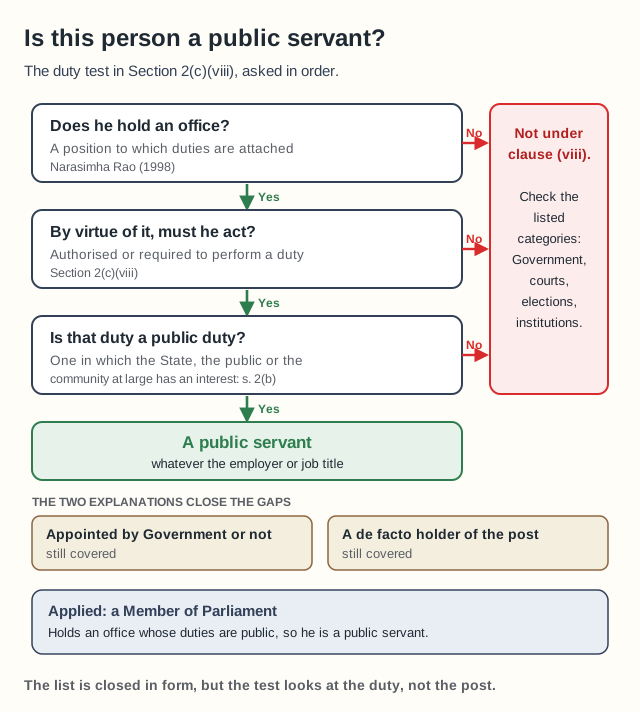
Two Explanations follow. The first says that persons falling under these clauses are public servants whether appointed by the Government or not. The second reaches
"every person who de facto discharges the functions of a public servant"
as the Supreme Court paraphrased it, so that a defect in the right to hold the post does not take a person out of the Act.
The Office-Holder Clause
Clause (viii) is the widest, and the Court has dissected it. It asks four things: does the person hold an office; by virtue of that office is he authorised or required to perform a duty; and is that duty a public duty. In a case on a private bank's chairman, the Court put the rule in a sentence:
"a person who holds an office by virtue of which he is authorised or required to perform any public duty, is a public servant"
"Office" has an ordinary meaning in this context. The Constitution Bench in P.V. Narasimha Rao v. State (CBI/SPE) (1998) adopted the view that an office is no more than a position to which certain duties are attached.
The same approach reaches people who would never be called officials. In State of Gujarat v. Mansukhbhai Kanjibhai Shah (2020), a trustee of the charitable trust sponsoring a deemed university was accused of demanding Rs. 20 lakh to let a student sit the final MBBS examination. The High Court had discharged him, holding that a deemed university is not a university.
The Supreme Court refused to import the technical definition of the University Grants Commission Act into the Corruption Act, because the two statutes are not in pari materia, and observed:
"The purpose under the PC Act was to shift focus from those who are traditionally called public officials, to those individuals who perform public duties."
The Court held that a deemed university falls within the university clause, set the discharge aside and sent the case to trial. It did not decide whether the trustee was in fact a public servant, saying that this required a detailed appreciation of evidence.
Legislators as Public Servants
For the Penal Code, the Court had held in R.S. Nayak v. A.R. Antulay (1984) that a Member of a Legislative Assembly was not a public servant under the clauses examined. The question returned under the 1988 Act in P.V. Narasimha Rao.
The facts were these. In July 1993 a no-confidence motion was moved against a minority government in the Lok Sabha. The government was short of the majority by 14 votes; the motion was lost, 251 voting in favour and 265 against. A complaint to the CBI alleged that members of the Jharkhand Mukti Morcha and others had been bribed to vote against the motion, and cases were registered under the 1988 Act.
On the public servant question, the Court held that
"a Member of Parliament holds an office and by virtue of such office he is required or authorised to perform duties and such duties are in the nature of public duties"
Its conclusion was brief: "A member of Parliament is a public servant under Section 2 (c) of the Prevention of Corruption Act, 1988." The Court then dealt with the awkward consequence that no authority could be identified to sanction the prosecution of a Member.
It held that the court could take cognizance without sanction, but that until Parliament made provision, the prosecuting agency must obtain the permission of the Chairman of the Rajya Sabha or the Speaker of the Lok Sabha before filing a charge-sheet.
The first part of that judgment, which gave a legislator immunity for a bribe connected with a vote, has since gone. In Sita Soren v. Union of India (2024), a seven-judge Bench was asked about a Jharkhand MLA who was accused of taking a bribe to vote for an independent candidate in the 2012 Rajya Sabha election, and who had voted for her own party's candidate instead.
The Court said: "We disagree with and overrule the judgment of the majority on this aspect." The holding that a legislator is a public servant under the 1988 Act was not touched by this.
Closed List, Wide Reach
UPSC's 2025 paper asked whether the definition of a public servant is only illustrative and not exhaustive. The statute and the cases answer in two parts.
In form, Section 2(c) says that a public servant "means" the persons listed; it does not say "includes". The list is closed, and Narasimha Rao accordingly had to fit a Member of Parliament into clause (viii) instead of declaring him a public servant at large.
In reach, the list is generous because its tests are functional. Clause (viii) asks for the duty, not the post; clause (iii) turns on public control or aid; the Explanations remove technical defects. A deemed university, an aided society or an examiner falls inside because of what the person does.
From Gratification to Undue Advantage
The central word of Section 7 changed in 2018. The older text punished a person "being, or expecting to be a public servant" who accepted, obtained, agreed to accept or attempted to obtain "any gratification whatever, other than legal remuneration", as a motive or reward for doing or forbearing to do an official act, or for showing favour or disfavour.
The old Explanations show how wide that word was. Gratification was
"not restricted to pecuniary gratifications or to gratifications estimable in money"
and "legal remuneration" meant everything the Government or the organisation was willing to let its servant accept, not only what he could lawfully demand. A person who received a gratification as a reward for something he did not intend or could not do was also covered, as was a public servant who induced someone to believe that his influence had obtained a title for him.
The 2018 text replaced "gratification" with "undue advantage" and tied it to the improper performance of public duty. The Act defines the new term in its definitions clause. In the cases the phrase is used in the same breadth as before: the advantage obtained, accepted or attempted, from any person, for the public servant or for someone else. What makes it "undue" follows the older Explanations: it is something the public servant is not permitted to accept.
Section 7 Clause by Clause
The substituted Section 7 is headed "Offence relating to public servant being bribed" and covers any public servant who does one of three things. The first limb, clause (a), reads:
"obtains or accepts or attempts to obtain from any person, an undue advantage, with the intention to perform or cause performance of public duty improperly or dishonestly"
The clause continues with "or to forbear or cause forbearance to perform such duty either by himself or by another public servant". Clause (b) catches a public servant who obtains, accepts or attempts to obtain an undue advantage as a reward for the improper or dishonest performance of a public duty, or for forbearing to perform it.
Clause (c) catches a public servant who performs, or induces another public servant to perform, a public duty improperly or dishonestly, or to forbear, "in anticipation of or in consequence of accepting an undue advantage from any person".
The punishment is imprisonment for not less than three years and up to seven years, and fine.
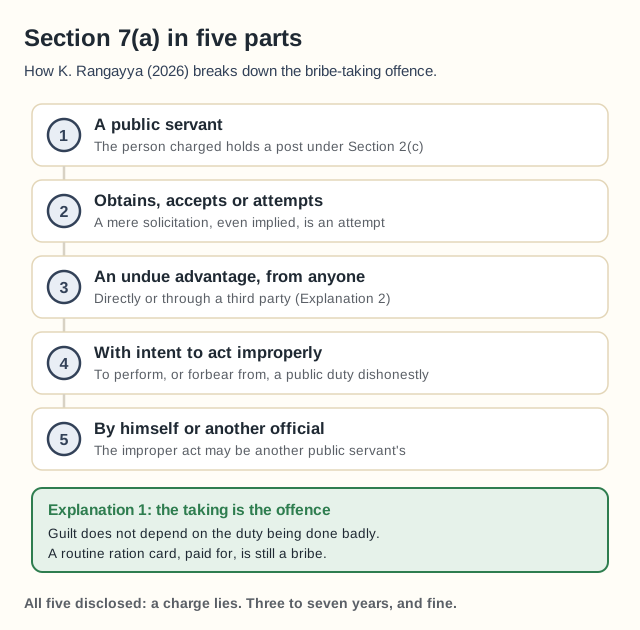
In State by Lokayuktha Police v. K. Rangayya (2026), the Court split clause (a) into five parts: the person charged is a public servant; he obtains, accepts or attempts to obtain an undue advantage; from any person; with the stated intention to perform or forbear improperly; and the performance or forbearance is by himself or by another public servant. If these parts are disclosed, the public servant can be charged under Section 7(a).
The Old and the New
| Point | Section 7 before 2018 | Section 7 after 2018 |
|---|---|---|
| Who | A person "being, or expecting to be a public servant" | Any public servant |
| What is taken | Gratification other than legal remuneration | Undue advantage |
| Link to the duty | A motive or reward for an official act, or for showing favour or disfavour | Intention that a public duty be performed improperly; reward for doing so; or inducing another public servant to do so |
| For whom | For himself or for any other person | For himself or another person, directly or through a third party (Explanation 2) |
| Favour not done | Covered by Explanation (d): a motive or reward for what he does not intend or cannot do | Explanation 1 and its illustration: the taking itself is the offence |
| Punishment | Six months to seven years, and fine | Three to seven years, and fine |
The Taking Is the Offence
Explanation 1 to Section 7 states the principle plainly:
"the obtaining, accepting, or the attempting to obtain an undue advantage shall itself constitute an offence even if the performance of a public duty by public servant, is not or has not been improper."
That is why a ration card clerk who is paid for an application that was in order is guilty. In Sita Soren the Court read the illustration and said that it shows
"the offence of bribery crystallizes on the exchange of the bribe and does not require the actual performance of the act."
The same Bench applied the principle to the legislator who accepts a bribe and then votes the other way. The offence, it said, "is complete at the point in time when the legislator accepts the bribe". The older text had the same feature through its Explanation (d); the 2018 amendment placed it in an express Explanation and an illustration.
Another Person, Third Party
Explanation 2 closes the middleman's loophole. For Section 7, the words "obtains", "accepts" and "attempts to obtain" cover a public servant who takes an undue advantage for himself or for another person, by abusing his position, by using personal influence over another public servant, or by other corrupt or illegal means. And:
"it shall be immaterial whether such person being a public servant obtains or accepts or attempts to obtain the undue advantage directly or through a third party"
Rangayya is the leading illustration. A police sub-inspector in Bellary district seized a man's two-wheeler and mobile phone in March 2023 on a charge of illegally moving ration rice. On a visit in May, the sub-inspector mentioned a private person, who then demanded Rs. 50,000 on his behalf.
On 1 June, the sub-inspector told the complainant to "do something" for his men, and a constable then asked for Rs. 5,000, reduced to Rs. 3,000. At the trap on 9 June the money was recovered from yet another person, not from the sub-inspector. The High Court quashed the FIR, since he had demanded and received nothing himself.
The Supreme Court reversed. It treated the sub-inspector's direction to the complainant to do something for the other officers as
"a veiled demand for illegal gratification or undue advantage for these persons who were closely associated with him officially"
and said the High Court had read in a requirement the statute does not contain:
"The PC Act does not countenance any such straitjacketed formulation limiting to acts of demand and acceptance of bribe by the official himself as explained by expansive provision of Explanation 2."
To support the width of "attempt", the Court quoted an earlier decision to the effect that the word implies
"no more than a mere solicitation, which, again, may be made as effectually in implicit or in explicit terms"
The Court was careful about the stage. It was deciding only whether the allegations, taken at face value, disclose an offence, and it said its remarks did not bear on guilt, which the trial would decide.
The same principle cuts both ways. In CBI v. Baljeet Singh (2026), a Joint Commissioner of Income Tax and his Inspector were charged with demanding Rs. 5 lakh from a firm's partner. The Inspector was caught after a trap with Rs. 2 lakh in marked notes, and the Joint Commissioner was elsewhere in the office.
The Supreme Court restored the Inspector's conviction under Section 7, because the demand was spoken to by the complainant and the trap was fully corroborated. It left the Joint Commissioner acquitted. The only evidence against him was the complainant's report that the Inspector demanded on his behalf, and the Court said:
"There can be no reliance placed on such statement made by the co-accused and there can be no conviction entered into on that account."
The charge of conspiracy under the Penal Code was not proved. The Inspector's sentence of four years was reduced to one year, with fine, because of his age.
Bribe-Giver and Company
The bribe-giver has her own offences in Chapter III. Section 8, substituted in 2018, is headed "Offence relating to bribing of a public servant". Section 9 is the offence of bribing a public servant by a commercial organisation, and Section 10 makes the person in charge of a commercial organisation guilty of the offence. Section 12 is the punishment for abetment of offences.
Section 9(1) is built on a model of failure to prevent. It makes the commercial organisation punishable with fine
"if any person associated with such commercial organisation gives or promises to give any undue advantage to a public servant"
when the intent is to obtain or retain business or an advantage in the conduct of business. A proviso gives the organisation a defence if it proves that it had adequate procedures in place to prevent such conduct by persons associated with it.
The Supreme Court examined corporate liability in Sanofi India Ltd. v. CBI (7 September 2026). The charge-sheet alleged that a scientific officer at the Bhabha Atomic Research Centre conspired with pharmaceutical companies to buy medicines at inflated rates, and that he took illegal gratification of Rs. 42,750 without consideration, an offence under Section 11, which the company abetted.
No employee of the company had been arraigned. The company asked for the proceedings to be quashed on that ground.
The appeal was dismissed. The Court held that a corporation can be prosecuted for offences requiring mens rea, and that
"neither identification nor arraignment of a natural person can be read in as a prerequisite"
for quashing. The allegations must still show that some natural person acted on behalf of the corporation, that the action is referable to the offence, and that mens rea is not patently absurd. The Court cited Section 9 as an example of a legislature acting outside the usual attribution rules, and observed that "Whether such measures ought to be undertaken is the prerogative of the legislature."
Criminal Misconduct, Section 13
Section 13 was substituted in 2018 and now has two clauses. A public servant commits criminal misconduct
"if he intentionally enriches himself illicitly during the period of his office"
or, under clause (a), if he dishonestly or fraudulently misappropriates or converts for his own use property entrusted to him or under his control as a public servant, or allows any other person to do so. Explanation 1 raises a presumption of illicit enrichment where he has been in possession of
"pecuniary resources or property disproportionate to his known sources of income which the public servant cannot satisfactorily account for"
The punishment is imprisonment of not less than four years and up to ten years, and fine.
The old Section 13(1)(d) is no longer there. It made it an offence to obtain for oneself or another a valuable thing or pecuniary advantage by corrupt or illegal means, or by abusing one's position as a public servant, or without public interest while holding office. Cases decided before 2018 therefore speak of "obtainment" under Section 13(1)(d), while under the new text obtaining an undue advantage is part of Section 7 itself.
Other provisions in the chapter include Section 11 (taking an undue advantage without consideration from a person concerned in a proceeding or business transacted by the public servant), Section 14 (habitual offender) and Section 15 (attempt), with Section 16 on matters relevant to fixing the fine. Section 18A applies the Criminal Law Amendment Ordinance, 1944 to attachment.
In State of West Bengal v. Anil Kumar Dey (2025) the Court held that this does not take away the police power to freeze accounts under Section 102 of the Code of Criminal Procedure.
Proof of Demand
The offence may be short in the statute, but the trial is long in evidence. The leading statement of law is the Constitution Bench decision in Neeraj Dutta v. State (Govt. of NCT of Delhi) (2022). It was convened to settle an apparent conflict: B. Jayaraj v. State of A.P. (2014) and P. Satyanarayana Murthy v. District Inspector of Police (2015) had held that inferences could not stand in for the complainant's proof of demand, while an older three-judge decision, M. Narsinga Rao v. State of A.P., had sustained a conviction on other evidence.
The Earlier Cases
In Jayaraj, a Mandal Revenue Officer was accused of demanding Rs. 250 to release rationed goods to a fair price shop. The complainant turned hostile and said the money was a licence-renewal fee. Tainted notes were recovered, but there was no other proof of demand.
The Court held that mere possession and recovery without proof of demand "will not bring home the offence under Section 7", and added that the presumption in Section 20 cannot arise without proof of acceptance, which in turn depends on proof of demand.
Satyanarayana Murthy was a case where the complainant had died before trial; the Assistant Director in question was accused of demanding Rs. 1,000, scaled down to Rs. 500, to renew the recognition of a typewriting institute.
In State of Punjab v. Madan Mohan Lal Verma (2013) the Court spelled out the allocation of burdens: the foundational facts must come first.
"before the accused is called upon to explain how the amount in question was found in his possession, the foundational facts must be established by the prosecution."
It also reminded trial courts that the complainant in a trap case is not a neutral witness:
"The complainant is an interested and partisan witness concerned with the success of the trap and his evidence must be tested in the same way as that of any other interested witness."
What the Constitution Bench Held
The Bench's conclusions, in the order that matters at trial, are these.
- Sine qua non: proof of demand and acceptance "as a fact in issue by the prosecution is a sine qua non in order to establish the guilt of the accused public servant";
- Offer first: where the bribe-giver offers and the public servant accepts, it is acceptance under Section 7 and no prior demand is needed, but the offer must be proved;
- Demand first: where the public servant demands and the giver pays, it is obtainment and the demand must be proved;
- Mere receipt: receipt without anything more is not an offence;
- Circumstances: demand and acceptance can be proved by direct oral or documentary evidence or by circumstantial evidence;
- Presumption of fact: a court may infer demand and acceptance only when the foundational facts are proved, and the accused may rebut the inference.
On a complainant who turns hostile or dies, the Bench said that demand can be proved through another witness or by circumstantial evidence, and
"The trial does not abate nor does it result in an order of acquittal of the accused public servant."
It answered the reference accordingly: in the absence of the complainant's evidence, an inference of guilt can be drawn from other evidence led by the prosecution. The Bench did not apply this to the individual cases; it sent them back for listing before the appropriate Bench.
The Bench had before it the pre-2018 text, and the law has been applied since to later charges. In Bharat Raj Meena v. CBI (16 September 2026), the Court, as it summarised the Constitution Bench, said that "where the prosecution itself fails to establish the foundational facts, the presumption does not arise." It acquitted a Railway Protection Force officer accused of collecting bribes for transfers through subordinates, and it held that "lingering reasonable doubts" remained.
The Section 20 Presumption
Section 20, as set out in Neeraj Dutta before its amendment, provides that where an accused is proved to have accepted or obtained or agreed to accept or attempted to obtain any gratification or valuable thing from any person, it shall be presumed, unless the contrary is proved, that he did so as a motive or reward of the kind mentioned in Section 7. Section 20(3) lets the court decline to draw the presumption if the thing is
"so trivial that no inference of corruption may fairly be drawn"
The Constitution Bench separated this from the discretionary inference about demand, saying that "Section 20 mandates the court to raise a presumption that the illegal gratification was for the purpose of a motive or reward as mentioned in the said Section." It held that the presumption is a presumption of law, rebuttable, that it does not apply to old Section 13(1)(d)(i) and (ii), and that
"the former is a mandatory presumption while the latter is discretionary in nature"
Rebuttal is judged on probability, not beyond reasonable doubt, as Madan Mohan Lal Verma explains. The accused must show, directly or from circumstances, that the money was accepted for some reason other than a motive or reward.
Trap and Hand-Wash
Most prosecutions begin as trap cases. The complaint is verified, notes are numbered and treated with phenolphthalein powder, an independent witness accompanies the complainant, and the hands are washed in sodium carbonate solution after the exchange; pink water is the sign of contact.
The cases show where such prosecutions fail. In Madan Mohan Lal Verma, an Income Tax Inspector was alleged to have demanded Rs. 25,000 for not reopening an assessment. The High Court acquitted him on the basis that the powder on his hands could have come from a handshake.
The Supreme Court did not accept the High Court's reasoning on the complainant's criminal background, but it dismissed the State's appeal, because the Executive Magistrate who joined the trap party had received his direction before the complainant said he had gone to the police. That showed the prosecution had not disclosed the genesis of the case correctly.
K. Shanthamma v. State of Telangana (2022) concerned a Commercial Tax Officer accused of demanding Rs. 3,000 for an assessment order. The complainant's evidence on demand was found to be unreliable because it had improved on his earlier statements, and the conviction was set aside. Rangayya later explained that such decisions rest on a full trial and do not govern the quashing stage.
Who May Investigate
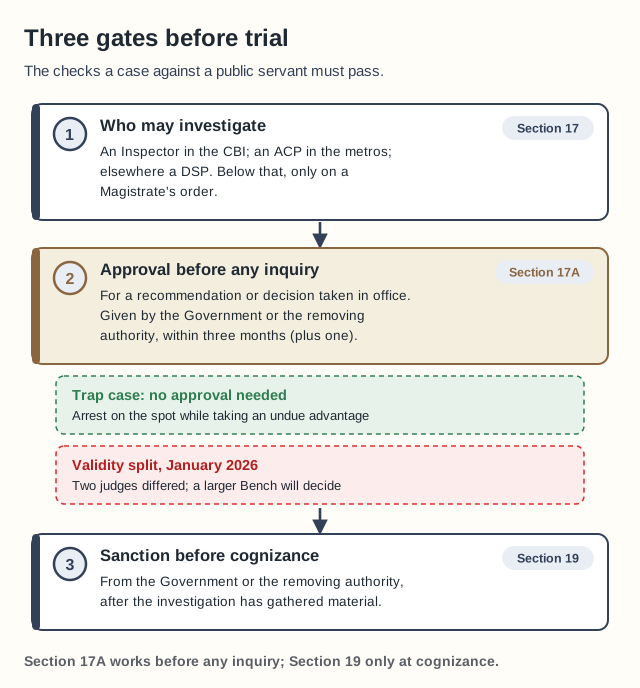
Chapter IV protects public servants from investigation by junior police officers. Section 17 begins with a non-obstante clause and bars a police officer below stated rank from investigating an offence under the Act, or arresting without warrant, without the order of a Magistrate.
The ranks are an Inspector of Police in the Delhi Special Police Establishment; an Assistant Commissioner of Police in the metropolitan areas; and elsewhere a Deputy Superintendent of Police or an officer of equal rank. The Supreme Court describes the section as
"a safeguard in the matter of investigation to be conducted against a public servant"
There are two provisos. The State Government may authorise an Inspector by general or special order to investigate. And an offence under clause (b) of Section 13(1) shall not be investigated without the order of a police officer not below the rank of Superintendent of Police.
Approval Under Section 17A
Section 17A was added in 2018. Its first part reads:
"No police officer shall conduct any enquiry or inquiry or investigation into any offence alleged to have been committed by a public servant under this Act"
where the offence is
"relatable to any recommendation made or decision taken by such public servant in discharge of his official functions or duties"
unless there is previous approval. The approving authority is the Union Government for a person employed in connection with its affairs, the State Government for State employees, and for anyone else the authority competent to remove him. The authority must decide within three months, extendable by a month for reasons recorded in writing.
The first proviso keeps the trap case outside the section:
"no such approval shall be necessary for cases involving arrest of a person on the spot on the charge of accepting or attempting to accept any undue advantage for himself or for any other person"
Why the Section Is Contested
Section 17A has two ancestors that failed. The first was the Single Directive, an executive instruction that required the CBI to get approval before inquiring into decision-making officers; it was quashed in Vineet Narain on 18 December 1997. The second was Section 6A of the Delhi Special Police Establishment Act, inserted in 2003 to put a similar requirement, for officers of joint secretary rank and above, into a statute.
A Constitution Bench of five judges struck it down in Subramanian Swamy v. Director, CBI (2014), holding it invalid as violating Article 14. On trap cases, the Court's earlier reasoning in Vineet Narain was that
"no other factor is relevant and the level or status of the offender is irrelevant"
and the Constitution Bench declared:
"Corruption is an enemy of the nation and tracking down corrupt public servants and punishing such persons is a necessary mandate of the PC Act, 1988."
The Law Commission's 254th Report had examined the 2013 Amendment Bill and a form of Section 17A requiring the approval of the Lokpal for Union employees. The Act as passed in 2018 did not follow that route, leaving the approval to the Government or the removing authority. For the institution that would have done the approving, see the article on the Lokpal and Lokayuktas Act, 2013.
The 2026 Split
In Centre for Public Interest Litigation v. Union of India (13 January 2026), a challenge to Section 17A under Articles 14 and 21 reached two judges, who disagreed.
Justice Viswanathan upheld the section. He read it as valid, subject to the condition that grant or refusal of approval must follow the recommendation of the Lokpal or Lokayukta, and said:
"The singular object is to protect bona fide recommendations and decisions taken by officials and bureaucrats."
Justice Nagarathna would have struck it down. Among her reasons was that
"Section 17A is merely an attempt to reintroduce in a different form Single Directive 4.7(3) as well Section 6A of the DSPE Act, 1946"
and that the classification by level of duties offends Article 14. Because the two views could not be reconciled, the order recorded:
"Having regard to the divergent opinions expressed by us"
and sent the matter to the Chief Justice of India for a Bench to consider afresh. No majority has struck the section down, and none has settled the condition proposed by Justice Viswanathan. Section 17A is therefore still in force.
Sanction to Prosecute
Investigation is one safeguard and sanction is another. Section 19 requires previous sanction of the competent authority before a court takes cognizance of an offence against a public servant; the competent authority is the Government concerned for its own employees, or the authority entitled to remove him.
The Court has compared it with Section 197 of the Code of Criminal Procedure: both operate at the stage of cognizance, after the investigating agency has collected material, unlike Section 17A, which operates before any inquiry.
In Manzoor Ali Khan v. Union of India (2015), as quoted in the 2026 decision, the Court said:
"while it is not possible to hold that the requirement of sanction is unconstitutional, the competent authority has to take a decision on the issue of sanction expeditiously"
Sanction challenges are common in appeals. In Bharat Raj Meena the appellant argued that fifty-two documents, including the FIR, had not been sent to the sanctioning authority; the Court acquitted on the evidence and did not examine the point.
Open Questions
Demand after 2018. The Constitution Bench read the pre-2018 text, where acceptance, obtainment and criminal misconduct sat in separate sections. The new Section 7 puts "obtains or accepts or attempts to obtain" in one place, and Rangayya says mere solicitation is an attempt. How far the framework in Neeraj Dutta carries over to Sections 7(b) and 7(c), which speak of a reward and of inducing others, has not been settled in terms.
Section 17A. The question that the two judges could not settle in January 2026 is a live one: whether an approval filter for decisions taken in office survives Article 14, and whether the Lokpal's recommendation is a workable condition.
Quashing and trial. Rangayya says that a High Court must not conduct a mini-trial on an FIR, and that the trial standard in Shanthamma applies only after evidence. The line between the two is bound to be tested again whenever a trap fails on the subordinate's side.
Companies. Sanofi shows that a company can be prosecuted without naming a director, but the Court said a systematic study of corporate liability is needed and that Section 9 is one model among several.
Short Answers
Q: Does a public servant commit an offence if the work was routine and would have been done anyway?
Yes. Explanation 1 to Section 7 says that obtaining, accepting or attempting to obtain an undue advantage is itself an offence, even if the performance of the duty is not improper, and the Act's own illustration uses a routine ration card application.
Q: Is the PC Act definition of public servant closed or open?
The list in Section 2(c) is closed in form but wide in reach, because clause (viii) and the Explanations test the duty and the real holding of the post.
Q: Must the public servant take the money personally?
No. Explanation 2 to Section 7 covers an advantage for another person, directly or through a third party, as Rangayya shows. But a bribe collected by a subordinate is proved against the senior only by evidence of his own demand or participation, as Baljeet Singh shows.
Q: Is prior approval under Section 17A needed in a trap case?
No. Its first proviso excludes cases of arrest on the spot on the charge of accepting or attempting to accept an undue advantage.
Sources: Prevention of Corruption Act, 1988 as amended by the Prevention of Corruption (Amendment) Act, 2018, Sections 2, 7, 8, 9, 13, 17, 17A, 18A, 19 and 20, as set out in the judgments below; Statement of Objects and Reasons of the 1988 Bill, as reproduced in commentary on the Indian Penal Code (offences by public servants); P.V. Narasimha Rao v. State (CBI/SPE) (1998); Subramanian Swamy v. Director, CBI (2014); B. Jayaraj v. State of A.P. (2014); State of Punjab v. Madan Mohan Lal Verma (2013); K. Shanthamma v. State of Telangana (2022); Neeraj Dutta v. State (Govt. of NCT of Delhi) (2022); State of Gujarat v. Mansukhbhai Kanjibhai Shah (2020); Sita Soren v. Union of India (2024); State of West Bengal v. Anil Kumar Dey (2025); Centre for Public Interest Litigation v. Union of India (2026); CBI v. Baljeet Singh (2026); State by Lokayuktha Police v. K. Rangayya (2026); Sanofi India Ltd. v. CBI (2026); Bharat Raj Meena v. CBI (2026); P. Satyanarayana Murthy v. District Inspector of Police (2015).