
On this page 11 sections
A patent confers a temporary monopoly that allows the inventor to recoup research costs, but the same monopoly may keep a life-saving medicine beyond the reach of those who need it. The TRIPS Agreement, Annex 1C of the Marrakesh Agreement of 1994, is the instrument through which this tension is regulated in international law.
This article examines the objectives and flexibilities of TRIPS, the Doha Declaration of 2001, the law of compulsory licensing, the Paragraph 6 System and Article 31bis, and the position of India under the Patents Act 1970.
Cases at a glance
TRIPS Objectives
Objectives
Article 7 states the objectives of the Agreement in terms of a balance of rights and obligations.
"The protection and enforcement of intellectual property rights should contribute to the promotion of technological innovation and to the transfer and dissemination of technology, to the mutual advantage of producers and users of technological knowledge…"
Principles
Article 8 expressly recognises the right of Members to adopt measures to protect public health, and, together with Article 7, supplies the interpretive context for the Agreement's flexibilities.
Article 8(1) allows Members, when formulating or amending their laws, to adopt measures "necessary to protect public health and nutrition" and to promote the public interest in sectors of vital importance, provided the measures are consistent with the Agreement.
Article 8(2) adds that appropriate measures, again consistent with the Agreement, may be needed to prevent the abuse of intellectual property rights by right holders, or practices that unreasonably restrain trade or adversely affect the international transfer of technology.
Scope of Obligations
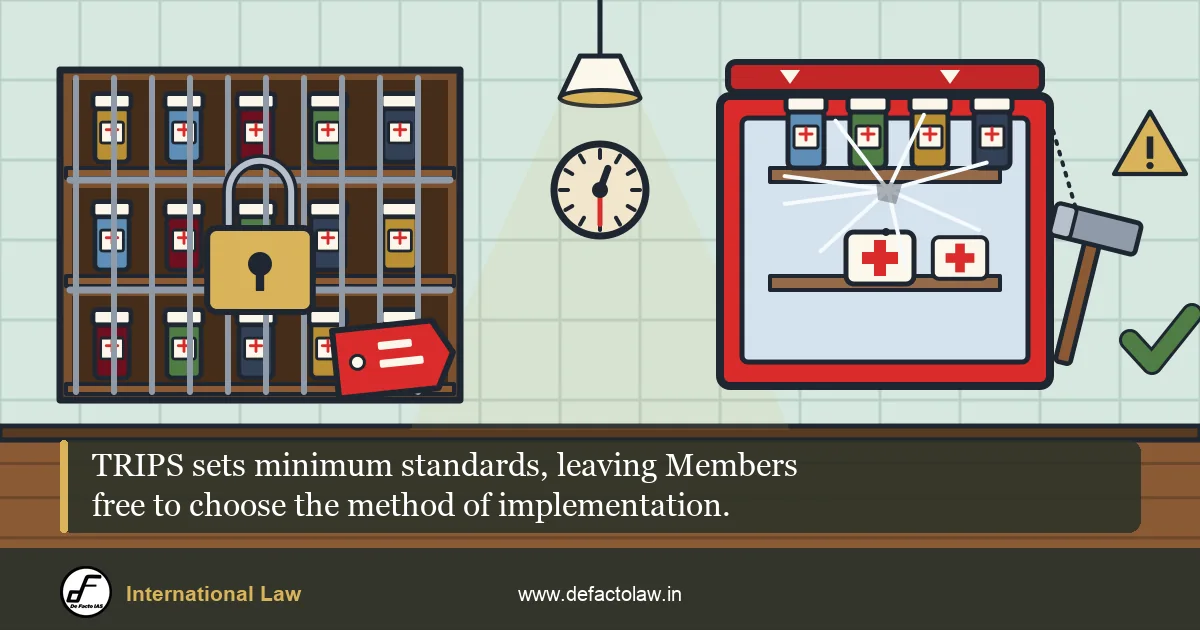
TRIPS sets minimum standards, leaving Members free to choose the method of implementation.
Article 1(1) obliges Members to give effect to the Agreement, but leaves them free, though not obliged, to implement more extensive protection so long as it does not contravene TRIPS. Members are also free to determine the appropriate method of implementation within their own legal system and practice.
Minimum Standards
TRIPS requires patents in all fields of technology, including pharmaceuticals, thereby ending the earlier freedom of many States to exclude medicines from patent protection.
Article 27(1) provides that, subject to paragraphs 2 and 3, patents shall be available for any inventions, whether products or processes, in all fields of technology, provided that they are new, involve an inventive step and are capable of industrial application.
India used the transition period that TRIPS gave developing countries. Until 2005 its Patents Act 1970 granted no product patents for medicines, and product applications filed in the meantime were kept aside until the law changed. In Novartis AG v. Union of India (2013) the Supreme Court described the position of the 1997 application for the cancer drug Glivec:
"the law in India with regard to product patent was in a transitional stage and the appellant’s application lay dormant under an arrangement called “the mailbox procedure”."
Patent Term
Article 33 provides that the term of protection shall not end before the expiration of twenty years counted from the filing date.
Patent Rights
Under Article 28(1)(a), the owner of a product patent has the exclusive right to prevent third parties, without the owner's consent, from making, using, offering for sale, selling or importing the product.
Built-In Flexibilities
Public Health Exclusion
Article 27(2) permits Members to exclude inventions from patentability to protect human, animal or plant life or health.
The exclusion must be necessary to protect ordre public or morality, including human, animal or plant life or health, or to avoid serious prejudice to the environment, and cannot rest merely on the fact that the exploitation is prohibited by the Member's law.
Limited Exceptions
Article 30 allows Members to provide limited exceptions to the exclusive rights conferred by a patent, provided the exceptions do not unreasonably conflict with a normal exploitation of the patent or unreasonably prejudice the legitimate interests of the patent owner, taking account of the legitimate interests of third parties.
Other Use
Article 31 governs "other use without the authorization of the right holder", which includes both government use and compulsory licences granted to third parties.
Article 31 lays down that, where such use is permitted, including use by the government or by third parties it authorises, the conditions listed in the Article must be respected.
Article 31 Conditions
Prior Negotiation
Article 31(b) requires efforts to obtain a voluntary licence, but contains an important waiver.
Under Article 31(b), use may be permitted only if the proposed user has first made efforts, without success within a reasonable period, to obtain authorisation from the right holder on reasonable commercial terms.
A Member may waive this requirement in a national emergency, in other circumstances of extreme urgency, or for public non-commercial use.
Scope and Remuneration
Under Article 31(c), the scope and duration of the use must be limited to the purpose for which it was authorised; for semi-conductor technology it may be only for public non-commercial use or to remedy a practice found anti-competitive after judicial or administrative process.
Under Article 31(d) and (e), the use must be non-exclusive and non-assignable, except with that part of the enterprise or goodwill which enjoys the use. On remuneration, Article 31(h) provides:
"(h) the right holder shall be paid adequate remuneration in the circumstances of each case, taking into account the economic value of the authorization."
Domestic Market Limit
Article 31(f) was the provision that frustrated countries without manufacturing capacity, since a licensed producer could supply only predominantly its own market.
"(f) any such use shall be authorized predominantly for the supply of the domestic market of the Member authorizing such use."
Judicial Review
Article 31(i) requires that the legal validity of any decision authorising such use be subject to judicial review or other independent review by a distinct higher authority in that Member.
Licensing Abuse
Article 40(1) recognises that some licensing practices that restrain competition may have adverse effects on trade and may impede the transfer and dissemination of technology. Article 40(2) preserves the freedom of Members to specify in their legislation licensing practices or conditions that may in particular cases constitute an abuse of intellectual property rights with an adverse effect on competition in the relevant market.
Anti-Competitive Practice
Under Article 31(k), Members need not apply the conditions in subparagraphs (b) and (f) where the use remedies a practice determined, after judicial or administrative process, to be anti-competitive.
Pre-Doha Conflict
AIDS Crisis
By the late 1990s the HIV/AIDS epidemic had made the cost of antiretroviral therapy a global emergency. Branded triple therapy cost many thousands of dollars per patient per year, far beyond the means of most developing countries.
South Africa
South Africa's Medicines and Related Substances Control Amendment Act 1997 authorised parallel imports and generic substitution. Thirty-nine pharmaceutical companies challenged it in the Pretoria High Court, but withdrew their case in April 2001 after sustained international criticism.
Generic Offer
In February 2001 the Indian generic manufacturer Cipla offered a triple-therapy regimen at a fraction of the prevailing price. The episode demonstrated that generic competition, authorised by the use of flexibilities, could lower prices dramatically.
Doha Declaration
Gravity of Crisis
At the Fourth Ministerial Conference at Doha in November 2001, developing countries secured a separate declaration on TRIPS and public health.
In paragraphs 1 to 3 the Declaration recognises the gravity of the public health problems afflicting many developing and least-developed countries, especially those resulting from HIV/AIDS, tuberculosis, malaria and other epidemics.
It stresses that TRIPS must be part of wider national and international action on these problems, and recognises both that intellectual property protection is important for the development of new medicines and the concerns about its effects on prices.
Core Statement
Paragraph 4 is the operative statement of principle.
"We agree that the TRIPS Agreement does not and should not prevent members from taking measures to protect public health."
Paragraph 4 goes on to affirm that TRIPS can and should be interpreted and implemented in a manner supportive of members' right to protect public health and to promote access to medicines for all, and reaffirms the right of members to use, "to the full", the flexibility provisions of the Agreement.
Indian courts have read the Declaration as part of the law's background. In Novartis the Supreme Court set it out in full while tracing how India came to amend its Patents Act in 2005.
Doha Flexibilities
Interpretation Rule
Paragraph 5(a) restates the customary rule of treaty interpretation, now applied to TRIPS in the light of its object and purpose.
Paragraph 5(a) requires each provision of TRIPS to be read in the light of the object and purpose of the Agreement as expressed in its objectives and principles. This tracks the general rule in Article 31(1) of the Vienna Convention on the Law of Treaties (1969):
"A treaty shall be interpreted in good faith in accordance with the ordinary meaning to be given to the terms of the treaty in their context and in the light of its object and purpose."
Licence Grounds
Paragraph 5(b) confirms the freedom of each Member as regards compulsory licences.
"Each member has the right to grant compulsory licences and the freedom to determine the grounds upon which such licences are granted."
National Emergency
Paragraph 5(c) leaves each member the right to determine what constitutes a national emergency or other circumstances of extreme urgency, and it is understood that public health crises, including those relating to HIV/AIDS, tuberculosis, malaria and other epidemics, can represent such an emergency.
Exhaustion
Paragraph 5(d) confirms the freedom of Members to adopt their own regime of exhaustion of rights, which governs parallel importation.
Under it, the TRIPS provisions relevant to exhaustion leave each member free to establish its own regime for such exhaustion "without challenge", subject to the MFN and national treatment provisions of Articles 3 and 4.
Paragraph Six
The Gap
The Declaration also identified the problem that Article 31(f) left unsolved and instructed the TRIPS Council to find an expeditious solution and report to the General Council before the end of 2002.
"We recognize that WTO members with insufficient or no manufacturing capacities in the pharmaceutical sector could face difficulties in making effective use of compulsory licensing under the TRIPS Agreement."
LDC Transition
Article 66(1) exempts least-developed country Members, in view of their special needs and constraints, from applying TRIPS other than Articles 3, 4 and 5 for ten years from the date of application under Article 65(1). The Council for TRIPS must, on duly motivated request, accord extensions of this period.
LDC Extension
Paragraph 7 extended the transition period for least-developed countries in respect of pharmaceutical patents.
Under paragraph 7, least-developed country members are not obliged, with respect to pharmaceutical products, to implement or apply Sections 5 and 7 of Part II of TRIPS or to enforce rights under those Sections until 1 January 2016.
2003 Decision
The solution came on 30 August 2003 in a Decision of the General Council, which waived Article 31(f) for exports of pharmaceutical products.
Paragraph 1(a) of the Decision defines a "pharmaceutical product" as any patented product, or product made through a patented process, of the pharmaceutical sector needed to address the public health problems recognised in paragraph 1 of the Declaration. Paragraph 2 contains the waiver itself:
"The obligations of an exporting Member under Article 31(f) of the TRIPS Agreement shall be waived with respect to the grant by it of a compulsory licence…"
Notification Conditions
Under paragraph 2(a), the eligible importing Member must notify the Council for TRIPS, specifying among other things the names and expected quantities of the product needed.
Remuneration
Paragraph 3 requires adequate remuneration under Article 31(h) to be paid in the exporting Member, taking into account the economic value to the importing Member of the use authorised. Where a compulsory licence is also granted in the importing Member for the same products, that Member's Article 31(h) obligation is waived for products for which remuneration is paid in the exporting Member.
Anti-Diversion
Paragraph 4 requires eligible importing Members to take reasonable measures within their means, proportionate to their administrative capacities and the risk of trade diversion, to prevent re-exportation of the imported products, so that they serve the public health purposes underlying their importation.
Developed country Members must, on request and on mutually agreed terms, provide technical and financial cooperation to a developing or least-developed importing Member that has difficulty implementing this.
Technology Transfer
Paragraph 7 records that Members recognise the desirability of promoting the transfer of technology and capacity building in the pharmaceutical sector to overcome the problem identified in paragraph 6 of the Declaration.
Permanent Amendment
The Protocol of 6 December 2005 inserted Article 31bis into TRIPS, converting the waiver into a permanent amendment. It entered into force on 23 January 2017, and is the first amendment of a WTO multilateral agreement.
The amendment adds a new Article 31bis, together with an Annex and Appendix, giving the legal basis for special compulsory licences exclusively for the production and export of affordable generic medicines to members that cannot manufacture sufficient quantities domestically.
Limited Use
The system has been used rarely. Its most cited use is the export of a triple-combination HIV medicine from Canada to Rwanda in 2008. Critics point to the procedural complexity of the notification and licensing steps, and favour direct use of Article 31 or domestic production.
India's Law
Patents Act
The Patents Act 1970, as amended in 2005, provides in section 84 for compulsory licences where public requirements are unmet, the invention is unaffordable, or it is not worked in India. Section 92 covers national emergency, and section 92A export to countries lacking manufacturing capacity.
Section 3(d)
Section 3(d) of the Patents Act excludes from patentability the mere discovery of a new form of a known substance unless it results in enhanced efficacy. In Novartis AG v. Union of India (2013), the Supreme Court upheld the refusal of a patent on the beta crystalline form of imatinib mesylate (Glivec) under this provision, rejecting what it regarded as evergreening.
The Court read "efficacy" narrowly for medicines:
"in the case of a medicine that claims to cure a disease, the test of efficacy can only be “therapeutic efficacy”."
It held that a 30 per cent increase in bioavailability was not enough by itself; whether it improves therapeutic efficacy must be claimed and proved by research data. Section 3(d) is thus India's main use of the room TRIPS leaves Members to define what counts as an invention.
Natco Licence
In 2012 the Controller of Patents granted India's first compulsory licence to Natco Pharma for Bayer's cancer drug sorafenib (Nexavar), on the grounds that the drug was unaffordable and not worked in India. The decision was upheld on appeal and by the Bombay High Court.
Constitutional Basis
The right to life under Article 21 has been interpreted to include the right to health, and Article 47 directs the State to raise the level of nutrition and public health. These provisions support the exercise of TRIPS flexibilities as a matter of domestic constitutional policy.
The Supreme Court has spelt out the State's duty. In Paschim Banga Khet Mazdoor Samity v. State of West Bengal (1996), where a man with head injuries was turned away by several government hospitals, it held:
"Article 21 imposes an obligation on the State to safeguard the right to life of every person. Preservation of human life is thus of paramount importance."
Earlier, in Vincent Panikurlangara v. Union of India (1987), a public interest petition against harmful drugs, the Court said that
"maintenance and improvement of public health have to rank high as these are indispensable to the very physical existence of the community"
Access to affordable medicines, the concern behind the Doha Declaration, sits within that duty.
Current Debates
TRIPS-Plus
Bilateral and regional free trade agreements frequently contain TRIPS-plus provisions, such as data exclusivity and patent term extension, which restrict the use of flexibilities. India has resisted such provisions in its trade negotiations, because of the importance of its generic industry to access to medicines worldwide.
COVID-19 Waiver
In October 2020 India and South Africa proposed a temporary waiver of certain TRIPS obligations for COVID-19 products. After protracted negotiation, the Twelfth Ministerial Conference (Geneva, June 2022) adopted a more limited decision on vaccines, which clarified the use of compulsory licensing but did not extend to diagnostics and therapeutics.
Rights Perspective
The right to health in the International Covenant on Economic, Social and Cultural Rights and the broader human rights framework are invoked to argue that TRIPS should be interpreted in a manner that does not impede access to essential medicines.
The duty has limits. In State of Punjab v. Ram Lubhaya Bagga (1998), on reimbursement of medical expenses, the Supreme Court accepted that the State must ration what it can provide:
"No State of any country can have unlimited resources to spend on any of its project. That is why it only approves its projects to the extent it is feasible."
The same tension runs through TRIPS: compulsory licences and price controls widen access, but a Member must still weigh them against incentives for research and its own capacity.
The role of international law in managing international trade, intellectual property rights, and global health issues has also gained significant prominence.
The Verdict
Balance Restored
The Doha Declaration did not amend TRIPS; it clarified that the Agreement's existing flexibilities are legitimate and may be used. Its legal significance lies in its status as an authoritative interpretive statement by all WTO members, which adjudicators must take into account under the customary rules of interpretation.
Remaining Challenges
The principal obstacles to access to medicines lie less in the text of TRIPS than in its implementation: political pressure, TRIPS-plus commitments and the complexity of licensing procedures. A candidate should therefore present TRIPS and public health not as a settled compromise but as an evolving balance.
FAQs
What is the Doha Declaration on TRIPS and Public Health?
It is a Ministerial Declaration adopted on 14 November 2001 which affirms that the TRIPS Agreement does not and should not prevent members from taking measures to protect public health, and that each member has the right to grant compulsory licences and to determine the grounds on which they are granted.
What is a compulsory licence?
It is an authorisation granted by the State to a third party, or to the government, to use a patented invention without the consent of the patent holder, subject to the conditions in Article 31 of TRIPS, including adequate remuneration to the right holder.
What is the Paragraph 6 System and Article 31bis?
Paragraph 6 of the Doha Declaration instructed WTO members to find a solution for countries with insufficient manufacturing capacity. The General Council Decision of 30 August 2003 waived the Article 31(f) limit on export-oriented licences, and the 2005 Protocol made the solution permanent through a new Article 31bis, which entered into force on 23 January 2017.
How does India use TRIPS flexibilities?
India's Patents Act 1970 provides for compulsory licences (sections 84 and 92) and, through section 3(d), restricts patents on new forms of known substances unless enhanced efficacy is shown. The Natco v. Bayer licence of 2012 for the cancer drug sorafenib is the leading example.
Does a national emergency have to be declared before a compulsory licence is issued?
No. Under Article 31(b) the requirement of prior negotiation with the patent holder may be waived in a national emergency, extreme urgency or public non-commercial use, and the Doha Declaration confirms that each member may determine what constitutes a national emergency.