
On this page 13 sections
Distinct Crime
Criminal law typically focuses its attention on the person who commits the prohibited act. But the person who commands, encourages, assists, or schemes — who stands behind the act and brings it into being without directly performing it — is also morally and legally implicated in the harm.
Abetment is a separate and distinct offence, provided the thing abetted is an offence (V Shesha Ayyar v Venkatasubba Chetty AIR 1924 Mad 487). Abetment does not in itself involve the actual commission of the crime abetted — it is a crime apart (Barendra Kumar Ghosh v Emperor AIR 1925 PC 1).
Three distinct modes of criminal participation constitute abetment under Section 107 IPC: instigation, criminal conspiracy to commit an act, and intentional aiding. Of the three, instigation is both the most commonly charged and the most jurisprudentially developed.
It is also the mode whose elements have been most carefully analysed by the Supreme Court — most influentially in Sanju @ Sanjay Singh Sengar v State of Madhya Pradesh AIR 2002 SC 1998, which established the standard governing words uttered in anger, in quarrels, and in the heat of the moment.
Cases at a glance 30
- V Shesha Ayyar v Venkatasubba Chetty
- Barendra Kumar Ghosh v Emperor
- Sanju @ Sanjay Singh Sengar v State of Madhya Pradesh
- Faguna Kanta Nath v State of Assam
- Kartar Singh v State of Punjab
- Sohan Raj Sharma v State of Haryana
- Ramesh Kumar v State of Chhattisgarh
- Damodar Krishna Kamii v State
- Chitresh Kumar Chopra v State
- Gangula Mohan Reddy v Andhra Pradesh
- Brij Lal v Prem Chand
- State of Punjab v Iqbal Singh
- Praveen Pradhan v State of Uttaranchal
- Bachchan Lal v State
- Baby John v State
- Swamy Prabaladdas v State of Madhya Pradesh
- Sanju v State of Madhya Pradesh
- Ram Singh v State
- Muthammal v Maruthatla
- Raghunath Dass v Emperor
- Jainul Haque v State of Bihar
- Pawan Kumar v State of Haryana
- Gurbachan Singh v Satpal Singh
- Kaliya Perumal v State of Tamil Nadu
- M Mohan v State
- Gangula Mohan Reddy v State of Andhra Pradesh
- Jamuna Singh v State of Bihar
- Sanju v State of MP
- Q: What is the Sanju v State of MP standard?
- Sanju @ Sanjay Singh Sengar v State of MP
Three Modes
Section 107 IPC defines abetment of a thing as occurring when a person:
- (i) Instigates any person to do that thing; or
- (ii) Engages with one or more other persons in any conspiracy for the doing of that thing, if an act or illegal omission takes place in pursuance of that conspiracy and in order to the doing of that thing; or
- (iii) Intentionally aids, by any act or illegal omission, the doing of that thing.
Explanation 1: A person who, by wilful misrepresentation, or by wilful concealment of a material fact which he is bound to disclose, voluntarily causes or procures, or attempts to cause or procure a thing to be done, is said to instigate the doing of that thing.
Explanation 2: Whoever, prior to or at the time of the commission of an act, does anything in order to facilitate the commission of that act, and thereby facilitates the commission thereof, is said to aid the doing of that act.
Section 45 BNS (= Section 107 IPC): One change recorded in the BNS comparison table — the words 'Court of justice' are replaced by 'Court'. This affects the illustration to the section but leaves the main provision substantively unchanged. The three modes of abetment, both Explanations, and all judicial interpretation under Section 107 IPC apply to Section 45 BNS.
Abetment under the IPC involves active complicity of a person prior to the commission of the offence (Faguna Kanta Nath v State of Assam AIR 1959 SC 673). To abet is to give aid, to assist, to command, to procure, to counsel, to encourage, to induce, to assist, or to set another on to commit (Kartar Singh v State of Punjab (1994) 3 SCC 569).
Statutory Text
A person instigates another to do a thing when they actively suggest or stimulate the other to perform the act.
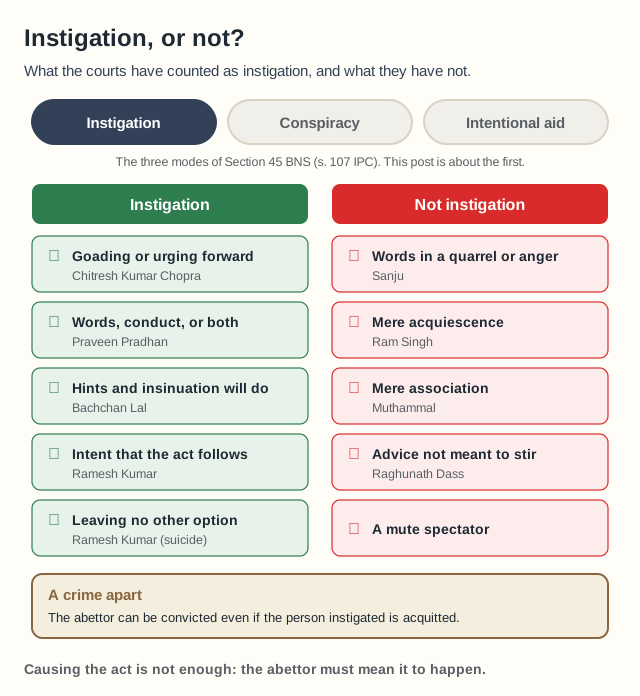
The word 'instigate' denotes incitement or urging or advising or provoking (Sohan Raj Sharma v State of Haryana AIR 2008 SC 2108) to do some drastic or inadvisable action — to stimulate, incite (Sanju @ Sanjay Singh Sengar v State of Madhya Pradesh AIR 2002 SC 1998), goad, urge forward or to provoke to do an act (Ramesh Kumar v State of Chhattisgarh AIR 2001 SC 3837).
A person is said to instigate another to an act when he actively suggests or stimulates him to the act by means of language, direct or indirect, whether it takes the form of express solicitation, hints, insinuation or encouragement (Damodar Krishna Kamii v State AIR 1955 Bom 61).
To constitute 'instigation', a person who instigates another has to provoke, incite, urge or encourage the doing of an act by the other by 'goading' or 'urging forward' (Chitresh Kumar Chopra v State (Government of NCT Delhi) AIR 2010 SC 1446).
These judicial glosses collectively build a picture of instigation as an active, directional mental influence — not passive, not accidental, but positively aimed at producing the act in the mind of the person instigated.
Elements of Instigation
Active Suggestion
Instigation requires active engagement — not observation, not passive consent, not mere knowledge of what another intends. The instigator must positively set the other person in motion toward the act, whether by encouragement, direction, or calculated inducement. Abetment involves a mental process of instigating a person (Gangula Mohan Reddy v Andhra Pradesh (2010) 1 SCC 750).
Form Immaterial
The law does not require that instigation must be in any particular form or that it must be only in words and may not be by conduct (In re G Ananthachari AIR 1938 Mad 996). Instigation may be accomplished through words, actions, symbolic communications, silences laden with meaning, or a combination.
A person may abet suicide by words (Brij Lal v Prem Chand AIR 1989 SC 1661), or conduct (State of Punjab v Iqbal Singh AIR 1991 SC 1532), or both (Praveen Pradhan v State of Uttaranchal (2012) 9 SCC 734).
Hints and Insinuation
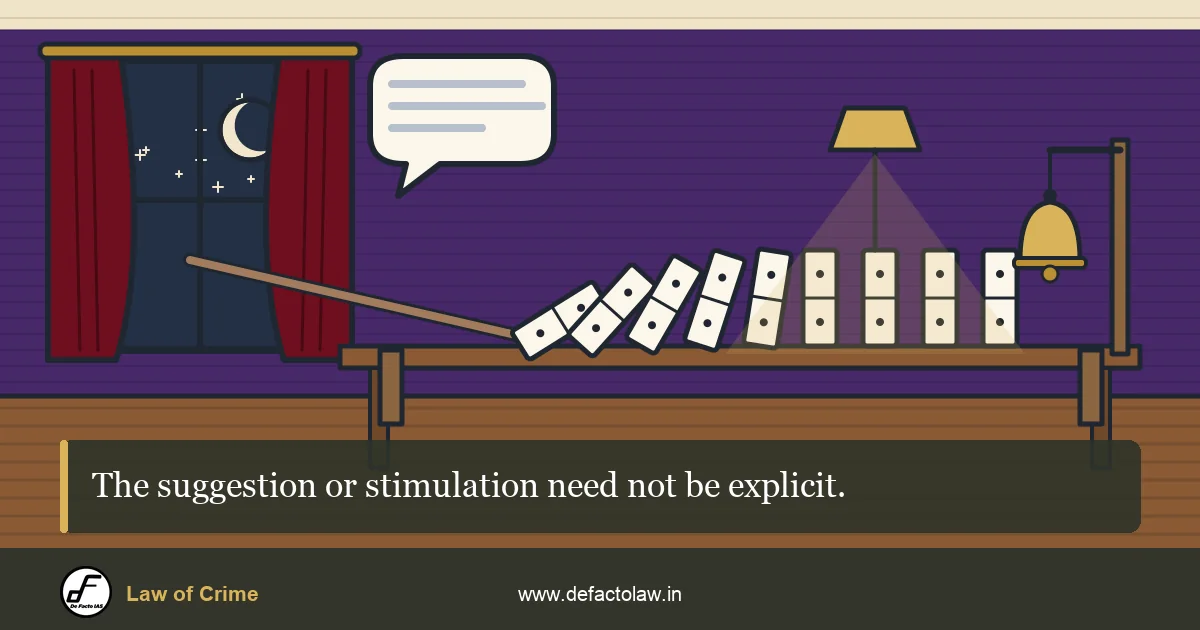
The suggestion or stimulation need not be explicit. It may operate through hints, insinuations, or indirect encouragement. It is not necessary in law to prove the actual words used for the incitement (Bachchan Lal v State AIR 1957 All 184). The substance of the communication is what matters, not the precise form in which it was delivered.
Reasonable Certainty
To satisfy the requirements of instigation, it is not necessary that actual words must be used to that effect, or that what establishes instigation must necessarily and specifically be suggestive of the consequences; yet a reasonable certainty to incite the consequences must be spelt out (Bachchan Lal v State AIR 1957 All 184).
The communication, assessed objectively in its full context, must carry a reasonably certain incitement to the specific consequence — not merely a remote possibility that the communication could have influenced someone somewhere to do something.
Reference to Act
An instigation must have reference to the thing that has been done and not to the thing that is likely to be done by the person who has been instigated (Baby John v State AIR 1953 Tra Co 251).
This is a specificity requirement: instigation must be directed at the particular act charged, not at some general class of acts of which the offence was a member. The court evaluating the instigation charge looks backward — did the accused's communication constitute an incitement toward this specific act?
Mens Rea
Abettor's Intention
Presence of mens rea is a necessary concomitant of instigation (Sanju @ Sanjay Singh Sengar v State of Madhya Pradesh AIR 2002 SC 1998). The offence of abetment by instigation depends upon the intention of the person who abets and not upon the act which is done by the person who has abetted (Ramesh Kumar v State of Chhattisgarh AIR 2001 SC 3837).
The abettor's liability is assessed by reference to what was in the abettor's mind — not by whether the abetted act occurred, or by the precise form the act took, or by the intention of the person who actually committed the act.
This is a fundamental asymmetry: the abetted person's conduct is evidence of what happened, but it is not determinative of whether instigation occurred. Two people can commit the same act with different mental states; the existence of instigation turns on the communicator's mental state, not the actor's.
Mental Process
Abetment involves a mental process of instigating a person or intentionally aiding a person in doing a thing (Gangula Mohan Reddy v Andhra Pradesh (2010) 1 SCC 750). The mental process required is one of intention — the intent to provoke, incite, urge, or encourage the doing of the act.
A person who communicates something that happens to be causatively connected to another's subsequent harmful act, but who did not intend by that communication to bring about the act, has not abetted by instigation.
Sanju Standard
Standard Stated
Sanju @ Sanjay Singh Sengar v State of Madhya Pradesh AIR 2002 SC 1998 is the Supreme Court's most-cited authority on the boundary between abetment by instigation and words that, though causatively connected to a subsequent act, were not spoken with the requisite mens rea.
The standard it establishes — applicable across the full range of abetment charges but most frequently applied in abetment of suicide cases — is this:
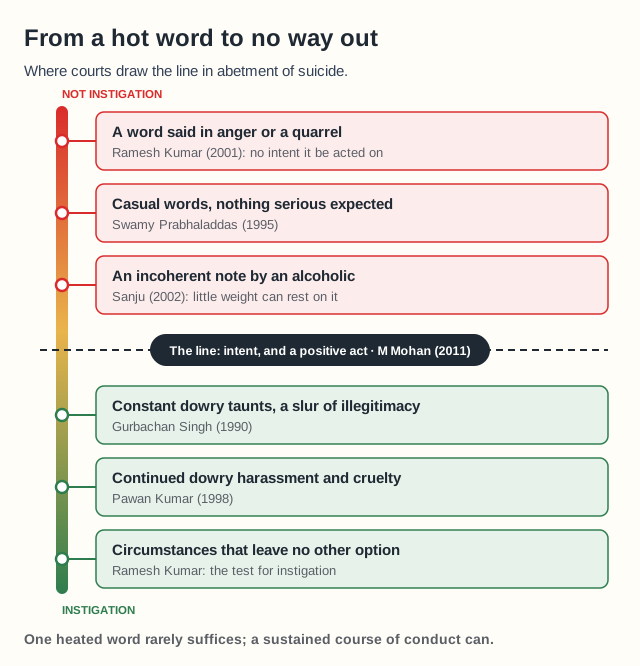
The words uttered in a quarrel, or on the spur of the moment, or uttered in a fit of anger or emotion without intending the consequences to follow, may not be understood to have been uttered with mens rea and may not be held to be instigation (Sanju @ Sanjay Singh Sengar v State of Madhya Pradesh AIR 2002 SC 1998).
This single proposition gathers three distinct factual patterns — quarrel words, spur-of-the-moment utterances, and anger or emotion words — and draws the same conclusion about all three: without the intent that the consequences follow, such words do not constitute instigation.
Ramesh Kumar
The Sanju standard builds directly on the earlier formulation in Ramesh Kumar v State of Chhattisgarh AIR 2001 SC 3837, where the Supreme Court stated: a word uttered in the fit of anger or emotion, without intending the consequences to actually follow, may not be said to be instigation.
Ramesh Kumar involved a husband who, in the course of a domestic quarrel, said words to his wife that were subsequently cited as having instigated her suicide. The court's reasoning was that domestic quarrels routinely generate heated language that neither party intends to be acted upon, and that treating every such utterance as criminal instigation would be both unjust and unworkable.
A person is said to have instigated another to commit suicide when he, by his acts or omissions or a continued course of conduct, created such circumstances that the other was left with no other option except to commit suicide (Ramesh Kumar v State of Chhattisgarh AIR 2001 SC 3837).
This is the positive formulation — the high standard that must be met. The contrast with the Sanju negative formulation is instructive: neither isolated angry words nor an isolated emotional outburst meets this test. What meets it is a sustained, deliberate course of conduct that systematically strips the victim of alternatives.
The Test
Swamy Prabaladdas v State of Madhya Pradesh (1995) Supp 3 SCC 438 contributed another dimension to the Sanju standard: where words are casual in nature, often employed in the heat of the moment between quarrelling people, and nothing serious is expected to follow thereafter, the act does not reflect the requisite mens rea on the assumption that these words would be carried out in all events.
The objectively assessed context — whether a reasonable person in the accused's position would have expected the words to be acted upon — is central to the mens rea inquiry.
Suicide Note
The Sanju case also raised a practical evidentiary point about suicide notes. Where a suicide note is incoherent, and admittedly the deceased was an alcoholic, much reliance may not be placed on it (Sanju v State of Madhya Pradesh AIR 2002 SC 1998).
The evidence relied upon to establish instigation must itself be reliable — a disturbed, impaired, or incoherent account of the reasons for suicide cannot bear the weight of a criminal conviction for instigation.
When the material on record and the facts and circumstances of the case lead to the conclusion that the deceased was responsible for his own death, and there was a total absence of any of the ingredients constituting abetment, it is not proper to hold another person responsible for abetting the suicide (Sanju @ Sanjay Singh Sengar v State of Madhya Pradesh AIR 2002 SC 1998).
Not Instigation
Mere Acquiescence
A mere acquiescence or permission does not amount to instigation (Ram Singh v State (1997) Cr LJ 1406 (P&H)). A person who knows of another's intent and does not object, or who gives a passive go-ahead without actively encouraging, has not instigated. Instigation requires positive, active stimulation — not mere tolerance of another's choice.
Mere Association
A mere association of the accused with the perpetrator of an offence does not make him an abettor unless it is shown that he instigated or had intention either in aiding or in commission of the offence (Muthammal v Maruthatla (1981) Cr LJ 833 (Mad)).
Being present, being known to the principal, or having some relationship with the principal does not translate into instigation without evidence of active, intentional encouragement.
Advice Per Se
Advice per se may not necessarily be instigation. However, advice may become an instigation if it is found that it is advice which is meant actively to suggest or stimulate the commission of an offence (Raghunath Dass v Emperor AIR 1920 Pat 502).
The distinction is between general counsel or opinion on the one hand, and advice specifically designed to set the recipient in motion toward the commission of an offence on the other. Advice that crosses the line into active stimulation is instigation; advice that does not cross that line is not.
Weak Evidence
In cases where a person is accused of abetting by exhortation, it must be kept in mind that evidence of exhortation is, in the very nature of things, a weak piece of evidence (Jainul Haque v State of Bihar AIR 1974 SC 45).
Exhortation — verbal encouragement, cheering-on — is inherently difficult to distinguish from general social commentary or cheerleading that falls short of instigation. Courts approach such evidence with appropriate caution.
Mute Presence
In order to render a person liable as an abettor, it is necessary that the abettor must be something more than a mute spectator. Witnessing, observing, and being present are insufficient. An active role in inspiring, encouraging, or directing the act is essential to liability for instigation.
Suicide Instigation
The abetment of suicide provision — Section 306 IPC (Section 108 BNS — no change) — is where the Section 107 instigation doctrine has been most intensively developed and applied.
No Option Left
The Ramesh Kumar formulation captures the highest standard of instigation applicable in abetment of suicide cases: a person is said to have instigated another to commit suicide when, by acts or omissions or a continued course of conduct, the accused created such circumstances that the deceased was left with no other option except to commit suicide.
This 'no other option' standard reflects the gravity of the offence — instigation to suicide requires more than a single heated word; it requires a sustained and deliberate course of conduct that progressively narrows the victim's alternatives until self-destruction appears to be the only exit.
Continued Cruelty
Courts have recognised specific patterns of conduct as meeting the sustained-instigation standard:
Continued mental cruelty and harassment in relation to dowry demand constitutes grave and serious provocation sufficient to constitute abetment of suicide (Pawan Kumar v State of Haryana AIR 1998 SC 958).
Constant taunting about the amount of dowry and insinuation that a woman was carrying an illegitimate child are sufficient to constitute instigation (Gurbachan Singh v Satpal Singh AIR 1990 SC 209).
These cases demonstrate that it is not a single utterance but the accumulated effect of sustained, targeted conduct that meets the instigation threshold in the suicide context. A course of daily harassment, repeated humiliation, persistent accusations without basis — these collectively create the circumstances that amount to instigation.
Positive Act
Some active role in the commission of suicide by the accused needs to be proved to hold him responsible for abetting it (Kaliya Perumal v State of Tamil Nadu (2003) Cr LJ 300 (Mad)). Without a positive act on the part of the accused to instigate or aid in committing suicide, the conviction cannot be sustained (M Mohan v State (2011) 3 SCC 626).
The accused must be shown to have done something — made a specific communication, adopted a particular course of conduct — that positively drove the victim toward the suicide. Passive unhappiness in a relationship, general marital discord, and vague interpersonal tension that eventually contributes to a suicide does not meet this requirement.
There has to be an intention, through an active act or direct act, to lead the deceased to commit suicide seeing no other option or to push the deceased into such a position that he committed suicide (Gangula Mohan Reddy v State of Andhra Pradesh AIR 2010 SC 327).
Misrepresentation
Section 107 IPC's Explanation 1 codifies an important extension of instigation: a person who, by wilful misrepresentation, or by wilful concealment of a material fact which he is bound to disclose, voluntarily causes or procures, or attempts to cause or procure a thing to be done, is said to instigate the doing of that thing.
This extension recognises that inducement to commit an act can operate through information control — through giving a false picture of reality or withholding information that, if known, would have led the person to choose differently.
A person who induces another to commit an act through deliberate deception or deliberate suppression of material facts has instigated that act as fully as one who verbally urged it. The key words are 'wilful' — both the misrepresentation and the concealment must be deliberate, not accidental or negligent.
Crime Apart
In the case of abetting by instigation, it is immaterial for the conviction of an abettor whether the person instigated committed an offence or not (Faguna Kanta Nath v State of Assam AIR 1959 SC 673). To constitute the offence of abetment, it is not necessary that the act abetted must be committed (Faguna Kanta Nath).
A person can be convicted of abetting an offence even when the person alleged to have committed the offence in consequence of the abetment has been acquitted (Jamuna Singh v State of Bihar AIR 1967 SC 553).
This independence of abetment from the principal offence has profound practical implications. The abettor's liability crystallises at the moment the instigation is complete — not when the instigated act is performed.
Where the instigated person is acquitted because of individual defences, lack of evidence about their personal state of mind, or procedural reasons, that acquittal does not pull down the abetment conviction.
The exception is intentional aiding: where the charge is abetment by intentional aid, the acquittal of the principal more directly undermines the abetment charge, since the aid must have facilitated an act that actually occurred (Jamuna Singh v State of Bihar AIR 1967 SC 553).
BNS Changes
Section 45 BNS
The BNS comparison table records that Section 45 BNS (= Section 107 IPC) replaces the words 'Court of justice' with 'Court' — consistent with the BNS's systematic replacement of this term throughout the Code. The substantive provision defining the three modes of abetment and both Explanations is preserved without change.
Section 46 BNS
Section 46 BNS (= Section 108 IPC, definition of 'abettor') replaces the word 'lunatic' with 'a person of unsound mind' — a dignity-respecting modernisation consistent with the BNS's broader project of removing stigmatising language from the Code. The substantive law governing who may be an abettor is unchanged.
Section 48 BNS
The BNS adds a new provision — Section 48 BNS — with no direct IPC equivalent: "A person abets an offence within the meaning of this Sanhita who, without and beyond India, abets the commission of any act in India which would constitute an offence if committed in India."
This provision addresses the extra-territorial dimension of abetment, bringing within the BNS's reach persons who instigate, conspire for, or aid offences to be committed on Indian soil from foreign jurisdictions.
Section 57 BNS
Section 57 BNS (= Section 117 IPC): The punishment for abetting commission of an offence by the public or by more than ten persons is increased from three years to seven years imprisonment. This significant escalation reflects the BNS's enhanced focus on organised and mass-scale criminal activity.
Conclusion
The central lesson of Sanju v State of MP and the cases that surround it is that causative connection is necessary but not sufficient for instigation. Many utterances, under the right circumstances, could be said to have contributed to another person's decision to act. But criminal liability for instigation requires something more: the abettor must have intended by the communication to bring about the act.
Words spoken in anger, in the heat of a quarrel, in an emotional outburst — words that every quarrelling couple or every frustrated superior has spoken at some point — are not instigations, even if the person who heard them subsequently acts on them. The law demands that the speaker have meant the words as incitement, not merely as the venting of immediate emotion.
This requirement of mens rea in instigation is the doctrine's most important protection against overcriminalisation. Without it, every domestic quarrel, every heated argument, every expression of frustration at another's behaviour would potentially constitute criminal abetment.
With it, the law draws the line at deliberate, intentional incitement — and leaves the accidental, the impulsive, and the emotionally reactive in the space where they belong: not as crime, but as the ordinary human turbulence of which life is made.
Frequently Asked Questions
Q: What are the three modes of abetment under Section 107 IPC?
Section 107 IPC (Section 45 BNS) provides three modes of abetment: (i) instigation — actively suggesting or stimulating another to do an act; (ii) criminal conspiracy — engaging with others in a conspiracy for the doing of an act, if an act or illegal omission takes place in pursuance thereof; and (iii) intentional aiding — aiding, by any act or illegal omission, the doing of the act.
Q: What does 'instigation' mean under Section 107 IPC?
Instigation means actively suggesting or stimulating another person to perform an act — by goading, urging forward, provoking, inciting, or encouraging the doing of the act. It may be through words or conduct, directly or indirectly. It does not require any particular form, but it must carry a reasonable certainty of inciting the consequence, and it must be backed by the intent to bring about the act.
Q: What is the Sanju v State of MP standard?
The Supreme Court in Sanju @ Sanjay Singh Sengar v State of MP AIR 2002 SC 1998 held that words uttered in a quarrel, on the spur of the moment, or in a fit of anger or emotion without intending the consequences to follow, cannot be held to be instigation.
The requisite mens rea — the intent that the act actually follow — must be established; words causatively connected to a subsequent act are not instigation without that intent.
Q: Can a person be convicted of abetment by instigation if the principal offender is acquitted?
Yes. In cases of abetment by instigation and conspiracy, it is immaterial whether the person instigated committed the offence or was acquitted. The abettor's liability is independent, crystallising at the moment the instigation is complete. The principal's acquittal does not automatically undermine the abetment conviction.
Q: What does the BNS change about the abetment provisions?
Section 45 BNS (= Section 107 IPC) replaces 'Court of justice' with 'Court'. Section 46 BNS (= Section 108 IPC) replaces 'lunatic' with 'a person of unsound mind'. Section 48 BNS (new) expressly covers abetment outside India for offences to be committed in India. Section 57 BNS increases the imprisonment for abetting commission by more than ten persons from three to seven years.