
On this page 14 sections
International trade law is the most densely institutionalised branch of international economic law. Its modern architecture descends from the General Agreement on Tariffs and Trade (GATT) of 1947, a provisional treaty that operated for nearly half a century without a formal organisation, and from the Marrakesh Agreement of 1994, which replaced it with the World Trade Organization (WTO).
This article traces the evolution from GATT to WTO, the core legal principles of the multilateral trading system, the structure of the Marrakesh Agreement, the provisions on development, and India's position.
GATT Origins
Havana and Geneva
The post-war order was to rest on the IMF, the World Bank and an International Trade Organization (ITO). The ITO's Havana Charter (1948) was never ratified, and the tariff treaty negotiated at Geneva in 1947, applied provisionally from 1 January 1948, became the permanent framework of trade law.
The Objectives
The preamble of the GATT 1947 states the objectives in economic terms. The contracting parties recognise that trade relations should aim at raising standards of living, ensuring full employment and a large and steadily growing volume of real income and effective demand, developing the full use of the world's resources and expanding the production and exchange of goods.
They declare themselves desirous of contributing to these objectives through reciprocal and mutually advantageous arrangements for the substantial reduction of tariffs and other barriers to trade, and for the elimination of discriminatory treatment in international commerce.
Contracting Parties
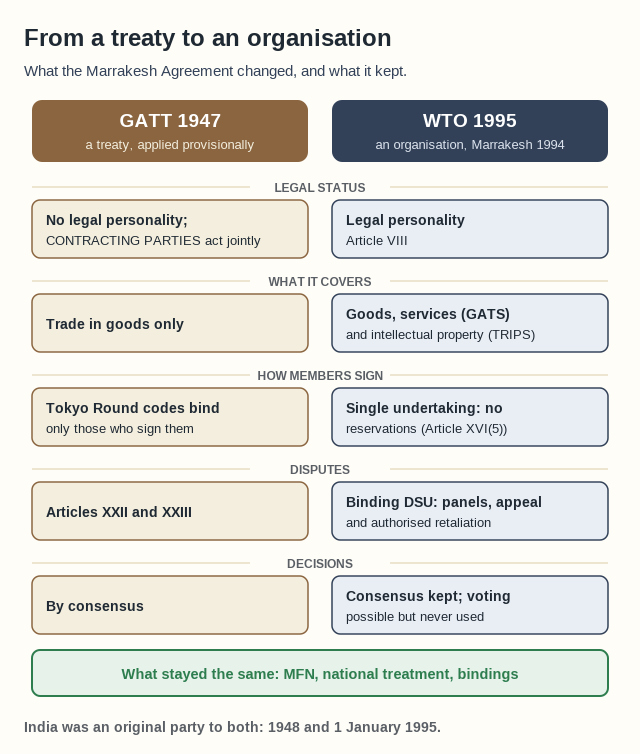
India was one of the twenty-three original contracting parties. The GATT had no legal personality and was not an organisation; its decisions were taken by the CONTRACTING PARTIES acting jointly, and its dispute settlement rested on Articles XXII and XXIII.
Rounds of Negotiation
Trade liberalisation proceeded through successive rounds of tariff negotiation: Geneva (1947), Annecy (1949), Torquay (1951), Geneva (1956), Dillon (1960–61), Kennedy (1964–67), Tokyo (1973–79) and the Uruguay Round (1986–94). The Tokyo Round produced codes on non-tariff barriers, such as subsidies and technical standards, which were binding only on signatories.
Core Principles
Most-Favoured Nation
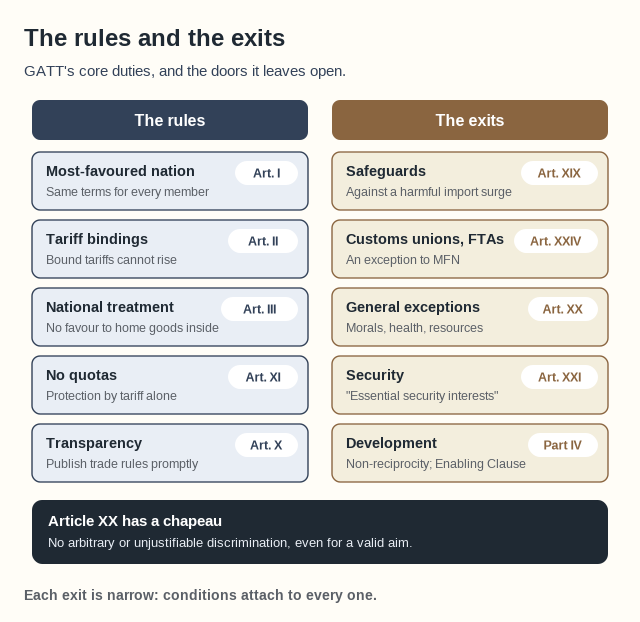
The principle of non-discrimination among trading partners is stated in Article I:1, which applies to customs duties and charges of every kind, to the method of levying them, and to all rules and formalities connected with importation and exportation. The operative language is brief.
"… any advantage, favour, privilege or immunity granted by any contracting party to any product originating in or destined for any other country shall be accorded immediately and unconditionally to the like product …"
Tariff Bindings
Article II(1)(a) requires each contracting party to accord the commerce of the other contracting parties treatment no less favourable than that provided in the appropriate Part of its annexed Schedule, so that tariffs once bound cannot be raised.
National Treatment
Once goods have entered the market, Article III prohibits discrimination in favour of domestic products. Article III(2) bars internal taxes and other internal charges on imported products, direct or indirect, in excess of those applied to like domestic products. Article III(4) extends the principle to regulation.
"The products of the territory of any contracting party imported into the territory of any other contracting party shall be accorded treatment no less favourable than that accorded to like products of national origin …"
Transparency
Article X(1) requires laws, regulations, judicial decisions and administrative rulings of general application to be published promptly, so that governments and traders can become acquainted with them.
Freedom of Transit
Article V(2) guarantees freedom of transit through the territory of each contracting party, by the routes most convenient for international transit, for traffic to or from the territory of other contracting parties.
Anti-Dumping
Article VI(1) recognises that dumping, by which the products of one country are introduced into the commerce of another at less than their normal value, is to be condemned if it causes or threatens material injury to an established industry in the territory of a contracting party, or materially retards the establishment of a domestic industry.
Quantitative Restrictions
Article XI(1) prohibits any restrictions "other than duties, taxes or other charges", whether made effective through quotas, import or export licences or other measures, on the importation of any product of another contracting party or on the exportation of any product destined for it. Protection must therefore be given by tariffs alone.
Exceptions
Safeguards
The multilateral system permits temporary protection in specified circumstances. Article XIX(1)(a) allows a safeguard against import surges: where, as a result of unforeseen developments and of obligations including tariff concessions, a product is imported in such increased quantities and under such conditions as to cause or threaten serious injury to domestic producers of like or directly competitive products, the contracting party is free to act.
It may suspend the obligation in whole or in part, or withdraw or modify the concession, to the extent and for such time as is necessary to prevent or remedy the injury.
Regional Integration
Article XXIV permits customs unions and free-trade areas as an exception to MFN, subject to conditions. Under Article XXIV(4), the contracting parties recognise the desirability of increasing freedom of trade through voluntary agreements that bring their economies into closer integration. They also recognise that the purpose of a customs union or free-trade area should be to facilitate trade between the constituent territories and not to raise barriers to the trade of other contracting parties.
Security Exception
Article XXI preserves a security exception: nothing in the Agreement requires a contracting party to furnish information the disclosure of which it considers contrary to its "essential security interests".
General Exceptions
Article XX permits measures to protect public morals, health, and the conservation of exhaustible natural resources, subject to a chapeau that prohibits arbitrary or unjustifiable discrimination. Its application is discussed in the article on dispute settlement in this series.
Development Provisions
Part IV
By the 1960s, newly independent States, including India, secured the addition of Part IV to the GATT (1965), which recognised the special needs of less-developed contracting parties. Article XXXVI(8) states the principle of non-reciprocity.
"The developed contracting parties do not expect reciprocity for commitments made by them in trade negotiations to reduce or remove tariffs and other barriers to the trade of less-developed contracting parties."
Article XVIII
Article XVIII, of special importance to India, recognised that developing economies might need protective measures to promote development. Paragraph 1 recognises that the objectives of the Agreement are facilitated by the progressive development of the economies of contracting parties with low standards of living that are in the early stages of development.
Paragraph 2 recognises further that such parties may need to take protective or other measures affecting imports in order to implement programmes of economic development designed to raise the general standard of living of their people, and that such measures are justified in so far as they facilitate the attainment of the Agreement's objectives.
Enabling Clause
The Enabling Clause of 1979 gave a permanent legal basis for the Generalized System of Preferences and for preferential arrangements among developing countries, an exception to the MFN principle.
Uruguay Round
New Mandate
The Uruguay Round, launched at Punta del Este in 1986 and concluded at Marrakesh on 15 April 1994, extended the system to services, intellectual property and agriculture, and created the WTO. It was the most extensive trade negotiation in history.
Marrakesh Preamble
The preamble to the Marrakesh Agreement restates the objectives of the system and adds sustainable development and the position of developing countries. The Members recognise that trade relations should aim at raising standards of living, ensuring full employment, a growing volume of real income and effective demand, and expanding the production of and trade in goods and services.
This is to be done while allowing for the optimal use of the world's resources in accordance with sustainable development, seeking both to protect and preserve the environment and to enhance the means for doing so, consistently with their respective needs and concerns at different levels of economic development.
The preamble also recognises the need for positive efforts to ensure that developing countries, and especially the least developed among them, secure a share in the growth of international trade commensurate with the needs of their economic development. The Members resolve to develop an integrated, more viable and durable multilateral trading system encompassing the GATT, the results of past trade liberalisation efforts, and all the results of the Uruguay Round.
Marrakesh Structure
Scope
Article II(1)–(2) of the Marrakesh Agreement makes the WTO the common institutional framework for the conduct of trade relations among its Members in matters related to the agreements and associated legal instruments in the Annexes. The agreements in Annexes 1, 2 and 3, called the Multilateral Trade Agreements, are integral parts of the Agreement and are binding on all Members.
Annexes
The Agreement has four annexes: Annex 1A (multilateral agreements on trade in goods, including GATT 1994, Agriculture, SPS, TBT, TRIMs, Anti-Dumping, Subsidies and Safeguards), Annex 1B (GATS), Annex 1C (TRIPS), Annex 2 (DSU), Annex 3 (Trade Policy Review Mechanism) and Annex 4 (plurilateral agreements).
Functions
Article III(1)–(2) sets out the functions of the WTO. It facilitates the implementation, administration and operation, and furthers the objectives, of the Agreement and the Multilateral Trade Agreements, and provides the framework for the Plurilateral Trade Agreements. It also provides the forum for negotiations among Members on matters dealt with under the Annexes, and may provide a forum for further negotiations and a framework for implementing their results, as decided by the Ministerial Conference.
General Council
Article IV(2) establishes a General Council composed of representatives of all the Members, which meets as appropriate. In the intervals between meetings of the Ministerial Conference, it conducts that body's functions, along with those assigned to it by the Agreement. It establishes its own rules of procedure and approves those of the Committees provided for in paragraph 7.
Ministerial Conference
Article IV(1) establishes a Ministerial Conference composed of representatives of all the Members, which must meet at least once every two years. It carries out the functions of the WTO and takes the actions necessary to this effect.
Legal Personality
International Organisation
The notes of De Facto IAS describe international organisations generally.
International organizations are permanent entities formed by state collaborations, governed by international law through treaties. Emerged in the late 19th century, they function as 'subjects' of international law. The rules guiding these bodies can be seen as the 'Constitutional Law' of international relations.
Their decisions are typically framed through either international treaties ratified by members or resolutions advising member-state actions.
Legal Capacity
Unlike GATT, the WTO is an international organisation with its own legal personality, as Article VIII(1)–(2) of the Marrakesh Agreement provides.
"The WTO shall have legal personality, and shall be accorded by each of its Members such legal capacity as may be necessary for the exercise of its functions."
Decision-Making
Consensus
Article IX(1) of the Marrakesh Agreement preserves the GATT practice of consensus.
"The WTO shall continue the practice of decision-making by consensus followed under GATT 1947. Except as otherwise provided, where a decision cannot be arrived at by consensus, the matter at issue shall be decided by voting."
Under Article IX(1), where the European Communities exercise their right to vote, they have a number of votes equal to the number of their member States that are Members of the WTO. Decisions of the Ministerial Conference and the General Council are taken by a majority of the votes cast, unless otherwise provided.
Voting
Where consensus is not possible, each Member has one vote, and decisions are by majority of votes cast, unless otherwise provided. Interpretations and waivers require special majorities. In practice voting has never been used, which gives every Member, large or small, a practical veto, and explains the slow pace of multilateral negotiation.
Single Undertaking
Package Approach
The Uruguay Round results were adopted as a single undertaking: a Member accepts the multilateral agreements as a whole, and cannot pick and choose among them, in contrast with the Tokyo Round codes. Article XVI(5) of the Marrakesh Agreement reinforces the point.
"No reservations may be made in respect of any provision of this Agreement."
Conformity Duty
Article XVI(4) places a direct obligation on Members to align their domestic law with the Agreement. This is of particular significance for dualist States such as India, where treaty obligations do not become domestic law automatically.
"Each Member shall ensure the conformity of its laws, regulations and administrative procedures with its obligations as provided in the annexed Agreements."
Original Members
India was an original Member of the WTO. Article XI(1) makes original Members of the contracting parties to GATT 1947 at the date of entry into force, together with the European Communities, that accept the Agreement and the Multilateral Trade Agreements and have Schedules of Concessions and Commitments annexed to GATT 1994 and Schedules of Specific Commitments annexed to GATS.
Accession
Article XII(1)–(2) allows any State or separate customs territory possessing full autonomy in the conduct of its external commercial relations to accede to the Agreement, on terms agreed between it and the WTO. Accession applies to the Agreement and the annexed Multilateral Trade Agreements. The Ministerial Conference decides on accession and approves the terms by a two-thirds majority of the Members of the WTO.
Withdrawal
Article XV(1) allows any Member to withdraw from the Agreement. The withdrawal applies to both the Agreement and the Multilateral Trade Agreements, and takes effect six months after written notice is received by the Director-General of the WTO.
Enforcement
Binding Disputes
The WTO's principal innovation was a binding system of dispute settlement under the Dispute Settlement Understanding, with panels, appellate review, and authorised retaliation. The system and the present crisis of the Appellate Body are discussed in the next article of this series.
Trade Review
The Trade Policy Review Mechanism (Annex 3) provides for periodic review of the trade policies of all Members, promoting transparency.
India and the WTO
Founding Role
India, an original GATT contracting party, became a WTO Member on 1 January 1995. It implements its obligations through the Foreign Trade (Development and Regulation) Act 1992, the Customs Tariff Act 1975 and amendments to statutes such as the Patents Act 1970.
Agricultural Stand
India has been a leading voice on agriculture. It has argued that the Agreement on Agriculture entrenches asymmetries and has sought a permanent solution on public stockholding for food security, on which an interim "peace clause" was agreed at Bali (2013).
Development Agenda
India has defended special and differential treatment as a core principle, and has opposed attempts to expand the scope of the WTO to non-trade issues. The Doha Development Agenda launched in 2001 remains unconcluded.
Current Challenges
Erosion of MFN
Regional trade agreements and unilateral tariff measures have eroded the practical significance of MFN treatment. Plurilateral initiatives on e-commerce and investment facilitation raise the question whether the single undertaking can survive.
Rule Enforcement
The suspension of Appellate Body appointments has removed the binding second tier of dispute settlement, and invocation of the security exception in Article XXI has broadened. The multilateral system now depends heavily on the goodwill of its principal members.
The Verdict
Constitution of Trade
The WTO supplies a constitutional framework for the global economy. The GATT principles of non-discrimination remain its core, while the Marrakesh Agreement added permanence, comprehensiveness and enforcement. The central question for the next decade is how far a rule-based system can accommodate unilateralism, industrial policy and development claims.
Answer Map
A well-structured answer should trace GATT 1947 and its rounds; state MFN, national treatment, bindings and the exceptions; explain the Marrakesh Agreement, single undertaking, personality and consensus; and close with India's position.
FAQs
What is the difference between GATT and the WTO?
GATT 1947 was a provisional multilateral agreement on trade in goods, administered without a formal organisation. The WTO, established by the Marrakesh Agreement of 1994, is a permanent international organisation with legal personality, covering goods, services and intellectual property, and with a binding dispute settlement system.
What are the main principles of the GATT?
The most-favoured-nation principle (Article I), tariff bindings (Article II), national treatment (Article III), the general elimination of quantitative restrictions (Article XI), and exceptions for matters such as public health, conservation and security (Articles XX and XXI).
What is the single undertaking?
The single undertaking is the rule that the results of the Uruguay Round are accepted as a package. A Member of the WTO must accept the Multilateral Trade Agreements in Annexes 1, 2 and 3 as a whole, and no reservations may be made to the Marrakesh Agreement itself.
Is the WTO decision-making based on voting or consensus?
The WTO continues the GATT practice of decision-making by consensus. The Agreement provides for voting where consensus cannot be reached, on a one-member-one-vote basis, but in practice decisions are rarely put to a vote.
What is India's relationship with the GATT and WTO?
India was an original contracting party to GATT 1947 and a founding member of the WTO from 1 January 1995. It has been a leading voice for developing countries on agricultural subsidies, public stockholding for food security and special and differential treatment.