
On this page 12 sections
The dispute settlement system of the World Trade Organization has been described as the most active and most legalised international adjudicatory system. It is distinctive in international law because its rulings are, in principle, adopted automatically and are backed by authorised retaliation. Since December 2019 the second tier of that system, the Appellate Body, has not been able to function.
This article describes the rules of the Dispute Settlement Understanding (DSU), the role of the Appellate Body, the causes and consequences of the crisis, the interim appeal arbitration arrangement, and India's position.
System Basics
Legal Basis
The DSU forms Annex 2 to the Marrakesh Agreement establishing the WTO, and is administered by the WTO through the Dispute Settlement Body (DSB), which is the General Council in another guise. Article III(3) of the Marrakesh Agreement expressly provides that the WTO administers the DSU as set out in Annex 2.
Dispute Settlement Body
Article 2(1) of the DSU establishes the Dispute Settlement Body to administer the DSU rules and, unless a covered agreement provides otherwise, the consultation and dispute settlement provisions of the covered agreements. The DSB has authority to establish panels, adopt panel and Appellate Body reports, maintain surveillance of the implementation of rulings and recommendations, and authorise the suspension of concessions and other obligations.
Security and Predictability
The purposes of the system are stated in Article 3 of the DSU. Article 3(2) calls the system a central element in providing security and predictability to the multilateral trading system, serving to preserve Members' rights and obligations and to clarify the existing provisions of the covered agreements in accordance with customary rules of interpretation of public international law. The same paragraph adds that DSB recommendations and rulings cannot add to or diminish those rights and obligations.
Article 3(3) treats the prompt settlement of situations in which a Member considers its benefits to be impaired by another Member's measures as essential to the effective functioning of the WTO and to a proper balance between the rights and obligations of Members.
Good Faith
Article 3(10) of the DSU provides that requests for conciliation and the use of dispute settlement procedures should not be intended or considered as contentious acts. If a dispute arises, all Members are to engage in these procedures in good faith in an effort to resolve it.
Solutions Preferred
Under Article 3(7), a Member must judge whether action under the procedures would be fruitful before bringing a case. The aim of the mechanism is a positive solution to the dispute, and a solution acceptable to both parties and consistent with the covered agreements is "clearly to be preferred".
GATT Heritage
The system evolved from Articles XXII and XXIII of GATT 1947, under which the losing party could block adoption of a panel report. That deficiency led the Uruguay Round negotiators to create a new system. Article 3(1) of the DSU affirms Members' adherence to the principles for the management of disputes applied under those two GATT articles, together with the rules and procedures further elaborated and modified in the DSU.
Exclusive Jurisdiction
Compulsory Forum
Unlike the ICJ, whose jurisdiction rests on consent, the WTO system is compulsory for all members in respect of the covered agreements, and Article 23 prohibits unilateral determination of violations. Article 23(1) requires Members who seek redress of a violation, or of nullification or impairment of benefits, or of an impediment to the attainment of any objective of the covered agreements, to have recourse to and abide by the rules and procedures of the DSU.
No Self-Help
Article 23(2)(a) closes the door to self-help. A Member may not determine that a violation has occurred, that benefits have been nullified or impaired, or that attainment of an objective has been impeded, except through recourse to dispute settlement under the DSU.
Contrast With ICJ
The De Facto IAS notes distinguish arbitration from judicial settlement by an established tribunal. The WTO system combines elements of both: it uses ad hoc panels, but also a permanent appellate tier.
Judicial settlement is a settlement of dispute between States by an international tribunal in accordance with the rules of International Law. The international character of the tribunal is in both its organization and its jurisdiction.
Panels and Adoption
Panel Establishment
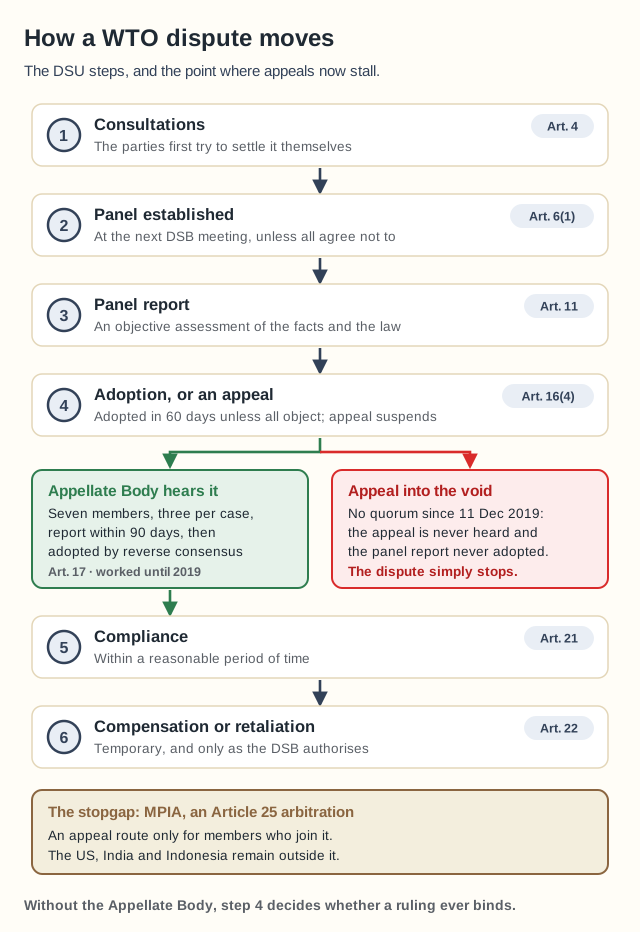
Under Article 6(1) of the DSU, a panel is established if the complaining party so requests, at the latest at the DSB meeting following the one at which the request first appears on the agenda. The only escape is a consensus decision of the DSB not to establish a panel.
Objective Assessment
Article 11 of the DSU says that the function of panels is to assist the DSB in discharging its responsibilities. A panel should make an objective assessment of the matter before it, including the facts and the applicability of and conformity with the relevant covered agreements, and make such other findings as will assist the DSB in its recommendations or rulings.
Reverse Consensus
The decisive innovation is the rule of adoption of panel reports. A report is adopted unless the DSB decides by consensus not to adopt it, so that the winning party can itself block rejection. This is known as negative or reverse consensus, and it is set out in Article 16(4) of the DSU, which gives sixty days from circulation of the report for adoption.
"… the report shall be adopted at a DSB meeting unless a party to the dispute formally notifies the DSB of its decision to appeal or the DSB decides by consensus not to adopt the report."
Appeal Trigger
Article 16(4) also contains the provision that later enabled the present crisis: a notification of appeal suspends adoption until the appeal is complete.
Appellate Body
Standing Body
Article 17 created a standing Appellate Body of seven persons, three of whom serve on any one case in rotation. It was the first permanent appellate tribunal in the history of international trade law. Article 17(1) states its basic function.
"A standing Appellate Body shall be established by the DSB. The Appellate Body shall hear appeals from panel cases."
Appointments
Under Article 17(2), the DSB appoints persons to the Appellate Body for a four-year term, and each may be reappointed once. The terms of three of the seven persons first appointed expired after two years, determined by lot, and vacancies are filled as they arise.
Working Procedures
The Appellate Body's own working procedures, including the rule on continued service of outgoing members, derive from Article 17(9). That provision requires the Appellate Body to draw up its working procedures in consultation with the Chairman of the DSB and the Director-General, and to communicate them to the Members for their information.
Parties Only
Article 17(4) allows only parties to the dispute, and not third parties, to appeal a panel report.
Anonymous Opinions
Articles 17(10) and 17(11) make Appellate Body proceedings confidential. Its reports are drafted without the parties present, in the light of the information provided and statements made, and the opinions of individual members expressed in a report are anonymous.
Qualifications
Under Article 17(3), the Appellate Body comprises persons of recognised authority with demonstrated expertise in law, international trade and the subject matter of the covered agreements generally. They must be unaffiliated with any government.
Time Limits
Article 17(5) sets, as a general rule, a limit of 60 days from the date a party notifies its decision to appeal to the date the Appellate Body circulates its report, taking into account Article 4(9) where relevant. If the Appellate Body cannot meet the 60 days, it must inform the DSB in writing of the reasons for the delay and give an estimate of when it will report, but in no case may the proceedings exceed 90 days.
Issues of Law
The scope of appeal is confined to legal questions. This limit is central to one of the United States' objections. Article 17(6) states it.
"An appeal shall be limited to issues of law covered in the panel report and legal interpretations developed by the panel."
Under Article 17(13), the Appellate Body may uphold, modify or reverse the legal findings and conclusions of the panel.
Automatic Adoption
Article 17(14) makes adoption of an Appellate Body report close to automatic. The DSB adopts it within 30 days of circulation unless it decides by consensus not to do so, and the parties must accept it.
"… unconditionally accepted by the parties to the dispute unless the DSB decides by consensus not to adopt the Appellate Body report within 30 days following its circulation to the Members."
Remedies
Prompt Compliance
Article 21(1) of the DSU states that prompt compliance with DSB recommendations or rulings is essential to ensure effective resolution of disputes to the benefit of all Members.
Compliance
Implementation of rulings is the objective of the system; compensation and retaliation are temporary measures. Article 22(1) states the point.
"Compensation and the suspension of concessions or other obligations are temporary measures available in the event that the recommendations and rulings are not implemented within a reasonable period of time."
The same paragraph adds that neither compensation nor suspension of concessions is preferred to full implementation of a recommendation to bring a measure into conformity with the covered agreements. Compensation is voluntary and, if granted, must be consistent with the covered agreements.
Retaliation
Article 22(2) deals with the case where the Member concerned fails to bring the measure into compliance, or otherwise to comply with the recommendations and rulings, within the reasonable period of time. Any party that invoked the dispute settlement procedures may then request authorisation from the DSB to suspend the application to that Member of concessions or other obligations under the covered agreements.
Authorised Retaliation
Retaliation is authorised by the DSB, not exercised unilaterally, and normally in the same sector. Article 22(3)(a) states the general principle that the complaining party should first seek to suspend concessions or other obligations in the same sector or sectors in which the panel or Appellate Body found a violation or other nullification or impairment.
Landmark Rulings
Shrimp-Turtle
In United States - Shrimp (1998), brought by India, Malaysia, Pakistan and Thailand, the Appellate Body held that a ban on shrimp harvested without turtle excluder devices fell within the environmental exception in Article XX(g) of GATT, but failed the test of the chapeau because it was applied in an arbitrarily discriminatory manner.
General Exceptions
Article XX of GATT 1947 permits measures that are not applied as a means of arbitrary or unjustifiable discrimination between countries where the same conditions prevail, or as a disguised restriction on international trade. Among the listed grounds are measures necessary to protect public morals (paragraph (a)), measures necessary to protect human, animal or plant life or health (paragraph (b)), and measures relating to the conservation of exhaustible natural resources if made effective in conjunction with restrictions on domestic production or consumption (paragraph (g)).
India Patents
In India - Patent Protection for Pharmaceutical and Agricultural Chemical Products (1997), the Appellate Body held that India's "mailbox" administrative instructions did not satisfy Article 70.8 of TRIPS. The ruling required amendments to India's Patents Act and is the origin of the interim regime for pharmaceutical patents.
The Crisis
Blocked Appointments
From 2016 the United States declined to join the consensus required to appoint or reappoint Appellate Body members, and since 2017 it has blocked every proposal, supported by well over one hundred members, to fill vacancies. By 11 December 2019 only one member remained, below the quorum of three, and on 30 November 2020 the last member's term expired.
US Objections
The United States, under successive administrations, has criticised the Appellate Body on grounds that correspond to specific DSU provisions: overrunning of the 90-day limit (Article 17.5); members serving past their terms (Article 17.2); review of facts and domestic law (Article 17.6); advisory opinions; and treatment of reports as precedent.
The Textual Basis
The last of these objections invokes the final sentence of Article 3(2), which the United States reads as a prohibition of law-making by adjudicators.
"Recommendations and rulings of the DSB cannot add to or diminish the rights and obligations provided in the covered agreements."
Defence
Defenders respond that the 90-day period was extended with the parties' consent, that reports served the security and predictability Article 3(2) requires, and that the blockage reflects wider dissatisfaction with trade rules on subsidies and non-market economies.
Effect on Appeals
With no Appellate Body, a losing party can notify an appeal under Article 16(4) and thereby prevent adoption of the panel report indefinitely. Dozens of such appeals "into the void" are now pending, including several filed by India, the European Union and others.
Interim Solutions
Article 25 Arbitration
The principal response is the Multi-Party Interim Appeal Arbitration Arrangement (MPIA), notified in April 2020 by the European Union, China, Canada, Australia, Brazil and other members, which relies on Article 25 of the DSU. Article 25(1) recognises expeditious arbitration within the WTO as an alternative means of dispute settlement for certain disputes concerning issues clearly defined by both parties, and Article 25(2) makes resort to it subject to the parties' mutual agreement, with the parties agreeing the procedures to be followed.
Binding Award
Under Article 25(3), other Members may become party to an arbitration only if the parties agree, and awards are notified to the DSB and to the relevant Council or Committee, where any Member may raise points relating to them. The binding force of the award rests on the parties' own undertaking.
"The parties to the proceeding shall agree to abide by the arbitration award."
Article 25(4) applies Articles 21 and 22 of the DSU, on surveillance of implementation and on compensation and retaliation, to arbitration awards with the necessary changes.
Limits of MPIA
The MPIA binds only its participants, and the most active litigants outside it, including the United States, India and Indonesia, remain free to appeal into the void. It is therefore a partial and voluntary solution rather than a restoration of the system.
Arbitration Nature
The De Facto IAS notes record the general features of arbitration, which explain both its attraction and its limits.
Arbitration cannot be initiated without the agreement of the parties to a dispute. An agreement of arbitration may be concluded for settling a particular dispute, or a series of disputes that have arisen between the parties.
Reform Efforts
Ministerial Mandate
At the Twelfth Ministerial Conference (June 2022), members committed to discussions aimed at a fully and well-functioning dispute settlement system accessible to all members by 2024. The informal process produced draft procedural reforms but no consensus on restoring the Appellate Body, and the 2024 deadline was not met.
Reform Options
Proposals include restoring the Appellate Body with strict limits, a single tier with senior adjudicators, and a stronger role for members in authoritative interpretation under Article IX(2) of the Marrakesh Agreement. That paragraph vests the power in the political organs of the WTO.
"The Ministerial Conference and the General Council shall have the exclusive authority to adopt interpretations of this Agreement and of the Multilateral Trade Agreements."
For an interpretation of a Multilateral Trade Agreement in Annex 1, they act on a recommendation by the Council overseeing that Agreement, and the decision to adopt an interpretation requires a three-fourths majority of the Members.
Systemic Risk
Without binding adjudication, members facing adverse rulings may disregard them and states may revert to unilateral measures, the outcome Article 23 was designed to prevent.
India's Position
India as Litigant
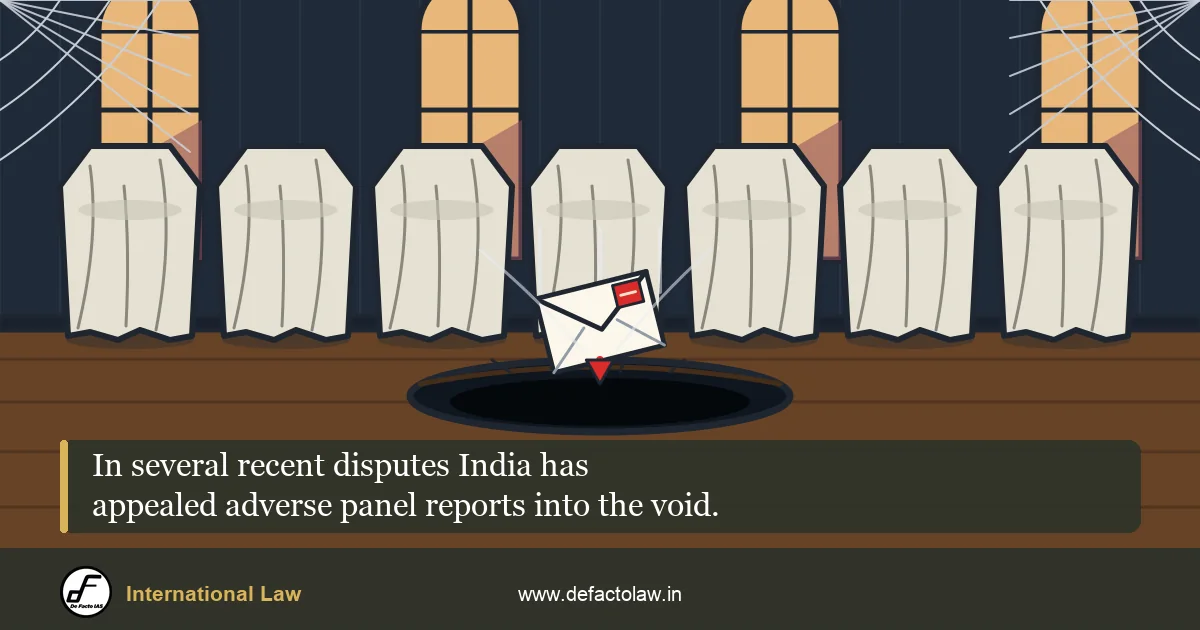
India has been a complainant in disputes such as US - Shrimp, and a respondent in disputes on patents, quantitative restrictions, solar cells, sugar subsidies, export-related measures and information and communication technology tariffs. In several recent disputes India has appealed adverse panel reports into the void.
Policy Stance
India has consistently called for the restoration of a functioning two-tier system with binding outcomes, while resisting what it perceives as judicial overreach in its policy space. It has not joined the MPIA.
Implications
For a developing economy that relies on rules rather than leverage, the weakening of binding adjudication reduces its protection against larger trading partners, and the credibility of India's own challenge to unilateral measures such as carbon border adjustments.
The Verdict
Legalisation Interrupted
The WTO dispute settlement system established, for the first time, a nearly automatic and compulsory system of trade adjudication. Its second tier is currently suspended, and its first tier is exposed to appeals into the void. The crisis is a political rather than textual breakdown: the DSU provides for the Appellate Body, but the consensus required to appoint its members is lacking.
Answer Map
A strong answer should explain the DSU stages, define reverse consensus, give the Article 17 provisions, set out the United States' objections and the defences, and describe appeal into the void, the MPIA and the reform process, with India's stance.
FAQs
What is the Appellate Body crisis?
Since December 2019 the WTO Appellate Body has lacked the minimum of three members needed to hear an appeal, because the United States has blocked the appointment of new members, and since November 2020 it has had no members at all. Appeals filed after that date cannot be heard.
What is an "appeal into the void"?
Under Article 16(4) of the DSU a panel report is adopted unless a party appeals. A losing party can therefore notify an appeal to the non-functioning Appellate Body, so that the report is never adopted and has no binding effect.
What is the MPIA?
The Multi-Party Interim Appeal Arbitration Arrangement of April 2020 is a plurilateral arrangement under Article 25 of the DSU by which participating members agree to resolve appeals through arbitration in place of the Appellate Body. India and the United States are not participants.
What does reverse consensus mean?
It means that a panel or Appellate Body report is adopted automatically unless all members of the Dispute Settlement Body, including the winning party, agree by consensus not to adopt it. It removes the power of a losing party to block a ruling.
Why does the crisis matter to India?
India has been both a complainant and a respondent in WTO disputes, and has itself appealed into the void in several of them. As a developing country relying on rules rather than power, India has a systemic interest in a binding, rule-based dispute settlement system.